Beyond the Surface: A Definitive Guide to Understanding the Revolution of Analytical Cubism
Master the complexities of Analytical Cubism with our expert guide. Explore how Picasso and Braque revolutionized art through fragmented perspectives, geometric deconstruction, and simultaneous viewpoints. A definitive resource for art students and collectors seeking deep historical insight.
The Genesis of Fragmentation: Breaking the Single Perspective For centuries, the Western tradition of painting was anchored by a singular, unwavering truth: the fixed viewpoint. From the Renaissance masters to the Impressionists, art sought to captur...
For centuries, the Western tradition of painting was anchored by a singular, unwavering truth: the fixed viewpoint. From the meticulous mastery of the Renaissance masters to the fleeting light of the Impressionists, art sought to capture a moment through a window-like perspective, where depth and distance were carefully orchestrated to mimic human vision. This established a passive relationship between the viewer and the canvas, where the eye simply observed a stable reality. However, at the dawn of the twentieth century, a seismic shift occurred that would forever shatter this illusion. This was not merely a change in aesthetic preference; it was a fundamental revolution in how we perceive reality itself.
The birth of fragmentation marked the end of the passive observer and the beginning of an active, intellectual engagement with the canvas. As the world grew increasingly dynamic and complex, the traditional single-point perspective began to feel like a relic of a simpler age. The Cubist movement sought to move beyond the superficiality of what the eye sees to capture what the mind knows. This radical departure challenged the very concept of a correct view, suggesting instead that truth is multifaceted, temporal, and inherently unstable. It was an era where the canvas ceased to be a mirror of nature and began to transform into an independent language of form and structure.
The Mechanics of Deconstruction: Geometric Abstraction and the Muted Palette
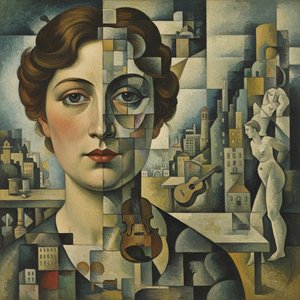
A Symphony of Fractured Planes In the pantheon of modernism, few works capture the radical spirit of transformation quite like Pablo Picasso’s “Mujer con zítara o guitarra.” This masterpiece, a profound exploration of Analytic Cubism from 1914, invit...
To truly understand Analytical Cubism, one must look past the initial confusion of broken lines and enter the disciplined realm of geometric deconstruction. The term analytical is not incidental; it describes the rigorous process by which pioneers like Pablo Picasso and Georges Braque dissected their subjects. They stripped away the distractions of vibrant color and sentiment to focus on the underlying architecture of form. By reducing complex, organic shapes into a visual vocabulary of cylinders, spheres, and cones, they created a sense of structural integrity that prioritized the essence of the object over its surface decoration.
This intellectual rigor was accompanied by a deliberate and sophisticated restraint in color. Eschewing the distracting brilliance found in later movements, Analytical Cubism utilized a muted spectrum of ochre, earthy browns, and somber grays. This monochromatic approach served a vital purpose: it directed the viewer's eye toward the interplay of light and shadow across fractured surfaces rather than allowing the eye to wander through a sea of pigment. In works such as Picasso’s Mujer con zítara o guitarra, we see this mastery in action, where the subject is meticulously dismantled and reconstructed through a rhythmic dance of geometric planes that dissolve the boundaries between the human figure and the surrounding space.
Simultaneity and Structure: Exploring Multiple Viewpoints in Picasso and Braque
Harlequinesque Personage – A Fragment of Picasso’s Analytical Cubism Pablo Picasso's “Harlequinesque Personage,” painted in 1913, stands as a captivating enigma within the artist’s oeuvre and a cornerstone of Analytical Cubism. More than just a portr...
The true genius of the Analytical phase lies in the concept of simultaneity—the representation of multiple perspectives at once. Rather than presenting a subject from one static angle, the Cubists began to explore various facets of an object simultaneously. This technique allows the artist to depict the subject in a greater context, offering a more complete, albeit fragmented, understanding of its existence in space and time. It is a profound exploration of how we experience objects in our daily lives—not as frozen snapshots, but as entities we move around, observe from above, and touch from the side.
This method creates a breathtaking complexity through the layering of translucent facets that overlap and intersect. In pieces like Harlequinesque Personage, Picasso utilizes these fractured perspectives to reflect the anxieties and dynamism of the era. The figure is rendered in a disconcerting manner, reminiscent of a theatrical archetype, where the very geometry of the composition mirrors the psychological complexities of a world on the brink of change. By presenting different views of the subject successively or at once, the artists achieved a sense of depth that was paradoxically both shallow and infinite, inviting the viewer to piece together the visual puzzle through active contemplation.
From Analysis to Synthesis: The Evolution of the Cubist Language
--- title: Analytic and Synthetic Cubism | MoMA author: Alexandra Morrison url: https://www.moma.org/collection/terms/cubism/analytic-and-synthetic-cubism hostname: moma.org description: Art critics and art history scholars have divided Cubism into t...
While the Analytical phase focused on the dissection of form, it laid the essential groundwork for what would eventually become Synthetic Cubism. If the first phase was about breaking down reality into its constituent parts, the second phase was about building a new reality through the assembly of disparate elements. This evolution saw the introduction of more vibrant colors and the invention of collage, where real-world textures—such as newspaper clippings or cloth—were integrated directly into the artwork. This transition marked a shift from the purely cerebral deconstruction of the 1908–1912 period toward a more constructive and decorative approach.
This progression demonstrates the restless, evolving mind of Picasso and his contemporaries. The movement was never static; it was a continuous dialogue between destruction and creation. Even as the artists moved toward more recognizable forms in their later works, the lessons of the Analytical period remained embedded in the DNA of modern art. The ability to manipulate space, to use texture as a narrative tool, and to challenge the viewer's perception of depth all stem from this initial, radical period of fragmentation. It was here that the seeds of much of twentieth-century abstraction were sown, influencing everything from Futurism and Constructivism to the very foundations of modern graphic design.
The Intellectual Legacy: How Analytical Cubism Redefined Modern Perception
Cubism is an early-20th-century avant-garde art movement which began in Paris. It revolutionized painting and the visual arts, and sparked artistic innovations in music, ballet, literature, and architecture. Cubist subjects are analyzed, broken up, a...
The impact of Analytical Cubism extends far beyond the boundaries of the canvas. It sparked artistic innovations that rippled through music, ballet, literature, and architecture, fundamentally altering the cultural landscape of the twentieth century. By breaking the single perspective, Cubism introduced a new way of thinking about structure and composition in all creative disciplines. It taught us that reality is not a fixed entity to be captured, but a complex web of perspectives to be navigated and interpreted.
Today, we see the echoes of this revolution in every corner of our visual culture. The movement's emphasis on fragmentation and reconstruction continues to inspire artists who seek to represent the fractured experience of modern consciousness. For the student of art history or the discerning collector, understanding Analytical Cubism is akin to understanding the moment the modern eye was truly born. It remains a testament to the power of artistic rebellion—a defiant assertion of intellectual freedom that transformed the act of seeing into an act of profound discovery.
At OriginalUniqueArt.com, we are dedicated to preserving the legacy of these transformative movements. For those moved by the structural brilliance of the Cubists, we offer museum-quality, hand-painted oil reproductions that capture the true texture and depth of the masters. Whether you seek a meticulous reconstruction of a Picasso masterpiece or wish to transform a personal photograph into a Cubist-inspired work of art through our professional digital mockup service, our artists bring the rigor of the academy to your collection. Explore our curated library of canonical masterpieces and bring the revolution of perspective into your own space.
Explore the revolutionary art of Georges Braque, a pioneer of Cubism alongside Picasso. Discover his artistic evolution, key works, and lasting impact on modern art. A guide for discerning collectors.
Explore 10 revolutionary Cubist portraits by Picasso, Braque & more! Discover the stories behind these iconic paintings and how they shaped modern art. Find museum-quality reproductions to elevate your home decor on OriginalUniqueArt.com.
Explore the revolutionary world of Cubism with OriginalUniqueArt. Discover Picasso & Braque's groundbreaking techniques, its philosophical roots, and lasting impact on modern art. Expert insights for collectors.
जॉर्ज सेउरा की 25 सर्वश्रेष्ठ कृतियों का अन्वेषण करें! बिंदुवाद, आधुनिक कला और रंग सिद्धांत के जादू को जानें। उच्च गुणवत्ता वाले कला प्रिंट और दीवार सजावट के लिए OriginalUniqueArt.com पर खोजें।
Master the complexities of Cubism with our expert guide. Explore how Picasso and Braque revolutionized modern art through fragmentation, multiple perspectives, and geometric innovation. Perfect for art students and collectors seeking deep historical insight.


 Unlocking Analytical Cubism: A Collector's Guide to the Revolution of Fragmented Perspective
 Mujer con zítara o guitarra
 Harlequinesque personage
 Cubism