The Genesis of Non-Representation: From Impressionism to Abstraction
 Wikipedia: Abstract art
Abstract art uses visual language of shape, form, color and line to create a composition which may exist with a degree of independence from visual references in the world. Abstract art, non-figurative art, non-objective art, and non-representational ...
The journey toward geometric abstraction wasn’t a sudden leap, but rather a gradual unfolding—a quiet rebellion against centuries of artistic convention. For generations, Western art had been tethered to the visible world, striving for increasingly accurate depictions of reality. The Renaissance championed perspective, meticulously recreating three-dimensional space on a two-dimensional canvas. By the 19th century, Impressionism loosened those bonds, prioritizing fleeting moments of light and color over precise form. Artists like Monet and Renoir weren’t concerned with *what* they painted so much as *how* it appeared under specific conditions. This focus on subjective perception was a crucial first step, eroding the necessity for strict representation. However, even Impressionism retained its roots in observable reality. The true rupture came with Post-Impressionists like Cézanne, who began to dissect and reconstruct forms, foreshadowing the fragmentation that would define Cubism. He sought not to merely *represent* an apple, but to convey its essential structure—its underlying geometry. This intellectual approach, coupled with a growing fascination with non-Western art – particularly African masks and tribal designs – paved the way for artists to explore entirely new visual languages, unburdened by the constraints of mimetic accuracy.
Geometric Harmony: Defining Principles of Abstract Art
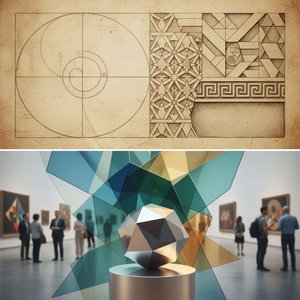
Geometric abstraction is a form of abstract art based on the use of geometric forms sometimes, though not always, placed in non-illusionistic space and combined into non-objective (non-representational) compositions. Although the genre was popularize...
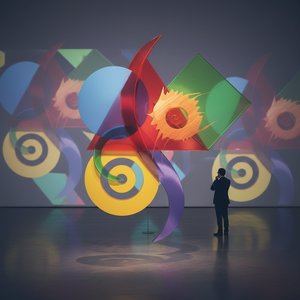
The early 20th century witnessed an explosion of abstract movements, each with its unique approach. Cubism, pioneered by Picasso and Braque, shattered objects into fragmented planes, presenting multiple perspectives simultaneously. While not entirely non-representational initially, it fundamentally challenged the notion of a single, fixed viewpoint. But true abstraction—the complete rejection of recognizable forms—required a more radical departure. Artists began to focus on the inherent qualities of visual elements: line, shape, color, and texture. This wasn’t simply about removing objects; it was about creating a new reality *through* these elements. The emphasis shifted from depicting *something* to exploring the relationships between *things*. Geometric abstraction, in particular, embraced mathematical precision and order. Squares, circles, triangles—these weren't arbitrary choices but fundamental building blocks of visual harmony. Artists believed that these forms possessed an inherent beauty and could evoke universal emotions without relying on narrative or symbolism.
De Stijl and Neoplasticism: A Pursuit of Universal Aesthetics
 Wikipedia: De Stijl
De Stijl (, Dutch: [də ˈstɛil]; 'The Style') was a Dutch art movement founded in 1917 by a group of artists and architects based in Leiden (Theo van Doesburg, J.J.P. Oud), Voorburg (Vilmos Huszár, Jan Wils) and Laren (Piet Mondrian, Bart van der Leck...
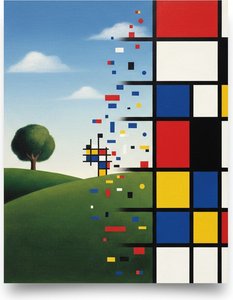
Emerging in the Netherlands during World War I, De Stijl (The Style) represented a particularly rigorous form of geometric abstraction. Founded by Piet Mondrian and Theo van Doesburg, the movement sought to create a utopian visual language based on pure abstraction. Mondrian’s Neoplasticism—his specific articulation of De Stijl principles—was characterized by its strict adherence to horizontal and vertical lines, primary colors (red, yellow, blue), and black, white, and gray. He believed that these elements represented the underlying structure of reality and could express a sense of universal harmony. The rejection of diagonals, curves, and representational imagery wasn’t merely aesthetic; it was philosophical. Mondrian sought to eliminate all subjective interpretation, creating an art that was objective, rational, and spiritually resonant. His compositions weren't intended as depictions of the world but as expressions of a deeper, underlying order—a visual manifestation of cosmic principles. The influence of Theosophy, with its emphasis on spiritual interconnectedness, is palpable in Mondrian’s work.
Suprematism and the Spiritual in Geometric Form
 suprematism fine arts museum, krasnodar
Explore Kazimir Malevich’s Suprematism Fine Arts Museum, Krasnodar – a revolutionary 1917 abstract masterpiece. Geometric forms & vibrant colors evoke spiritual depth. #Suprematism #Malevich #AbstractArt
Across Europe, in Russia, Kazimir Malevich was pursuing a similar path toward pure abstraction, but with a distinctly different philosophical underpinning. Malevich founded Suprematism, an art movement that sought to liberate art from all representational constraints and express “the supremacy of pure feeling.” His iconic 1915 painting, *Black Square*, is often considered the first purely abstract artwork—a black square on a white background. This wasn’t simply a minimalist gesture; it was a radical attempt to strip away all illusionistic depth and create an art that existed solely as form and color. Malevich believed that geometric forms possessed inherent spiritual power, capable of evoking profound emotions without relying on recognizable imagery. His compositions—floating shapes in dynamic arrangements—were intended as windows into another dimension, expressions of pure consciousness. Unlike Mondrian’s rational Neoplasticism, Suprematism embraced a more intuitive and emotional approach to abstraction.
Beyond Visuals: The Philosophical Underpinnings of Pure Abstraction
 Composition with yellow patch
Explore Piet Mondrian’s "Composition with Yellow Patch," a seminal Neoplastic masterpiece. Admire its geometric abstraction & vibrant color palette – a cornerstone of 20th-century art.
Both De Stijl and Suprematism, despite their stylistic differences, shared a common goal: to transcend the limitations of the visible world and express deeper truths. They were driven by a belief that art could be more than just decoration or representation; it could be a vehicle for spiritual enlightenment. This philosophical ambition was rooted in the broader intellectual climate of the early 20th century—a period marked by rapid scientific advancements, technological innovation, and a growing sense of disillusionment with traditional values. Artists sought to create new forms that reflected this changing world, rejecting the past and embracing the possibilities of abstraction. The exploration of geometry wasn’t merely an aesthetic choice; it was a way of understanding the underlying structure of reality—a search for universal principles that governed both the physical and spiritual realms. The emphasis on flatness in paintings like Mondrian's compositions also reflected a desire to acknowledge the inherent two-dimensionality of the canvas, rejecting the illusionistic depth that had dominated Western art for centuries.
The Enduring Legacy: How Geometric Abstraction Continues to Inspire
Geometric abstraction’s influence extends far beyond the confines of painting. It profoundly impacted architecture, design, and typography, shaping the visual landscape of the 20th and 21st centuries. The principles of simplicity, order, and clarity—so central to movements like De Stijl—continue to resonate with contemporary artists and designers. From minimalist furniture to Bauhaus buildings, the legacy of geometric abstraction is everywhere. Moreover, its philosophical underpinnings—the search for universal truths and the exploration of pure form—remain relevant today. Artists continue to be drawn to the power of geometry, using it as a means of expressing complex ideas and emotions without relying on representational imagery. At OriginalUniqueArt.com, we celebrate this enduring legacy by offering high-quality reproductions of masterpieces from Mondrian, Malevich, and other pioneers of geometric abstraction, allowing you to bring these iconic works into your own home and experience the power of pure form firsthand.