Une chronique vivante de la grandeur romaine
La Piazza di Campitelli s'érige comme un témoignage profond de l'esprit éternel de Rome, agissant comme une chronique vivante qui transcende les limites du simple espace urbain. Bien plus qu'un simple croisement de pavés antiques et de bâtiments chargés d'histoire, elle incarne la grandeur de l'ambition impériale, la ferveur de la dévotion religieuse et l'éclosion créative de la Renaissance. Située au cœur du Rione X , cette place occupe une position stratégique surplombant le Capitole et le Forum de Trajan, offrant des panoramas à couper le souffle qui captivent l'âme des artistes depuis des générations. Historiquement, le quartier est passé d'une animée place de marché à un point focal de la vie civique et du discours intellectuel. Les échos de l'histoire y sont palpables ; l'on peut presque ressentir la ferveur religieuse enflammée par les sermons de Saint Bernardino de Sienne en 1442, ou l'énergie savante apportée par la fondation du Collegio Romano par Saint Ignace de Loyola . C'est un lieu où les strates du temps ne sont pas seulement observées mais ressenties, car la place porte en elle les cicatrices et les triomphes de transformations urbaines spectaculaires.
Chefs-d'œuvre architecturaux et dialogues stylistiques
Le paysage architectural de la Piazza offre un dialogue saisissant entre des époques artistiques distinctes, présentant une collection de structures qui reflètent l'évolution des goûts des mécènes romains. L'œil est immédiatement attiré par le Palazzo Muti-Bussi , achevé vers 1585 par le maître Giacompio della Porta . Ce palais magnifique présente une structure pentagonale révolutionnaire, une rupture audacieuse avec le design conventionnel, arborant une entrée ornée d'un blason finement sculpté qui témoigne de la précision de l'ornementation classique. En contraste délicieux, le Palazzo Fani propose une esthétique maniériste > plus délicate, caractérisée par une frise gracieuse embellie de motifs floraux reflétant les idéaux humanistes de son époque. Cette tension architecturale est harmonisée par la fontaine centrale, également une création de Della Porta , qui s'impose comme un chef-d'œuvre sculptural incarnant la fascination de la Renaissance pour l'ingénierie hydraulique et la forme classique. Pour le collectionneur ou le designer, ces façades offrent une étude inégalée de précision géométrique et d'élégance ornementale.
Une vue au-delà du temps : La muse de l'artiste
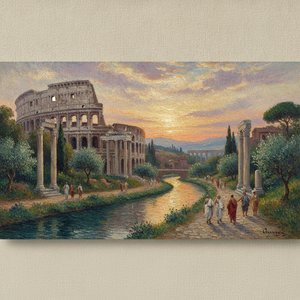
Ce qui distingue véritablement la Piazza di Campitelli, c'est sa vue panoramique sans égale, un paysage urbain spectaculaire qui sert de fenêtre sur le cœur même de la Ville Éternelle. Bien que la construction ambitieuse du monument Vittoriano et les démolitions ultérieures aient altéré l'intimité originelle de la place, elles ont paradoxalement dévoilé un panorama d'une puissance immense. Depuis ce point de vue, l'on peut contempler le majestueux Capitole , l'emblématique Colonne de Trajan et l'imposante Torre delle Milizie , le tout encadré dans une perspective unique et dramatique. Ce paysage singulier a longtemps servi d'inspiration à des peintres tels que Frederick Childe Hassam et Aleksandr Deineka , qui ont cherché à capturer l'esprit de Rome à travers leurs toiles. Visiter la Piazza, c'est être témoin d'un chef-d'œuvre de composition urbaine, où l'antique et le moderne fusionnent en un panorama intemporel qui continue d'inspirer l'émerveillement de chaque voyageur et amoureux de l'art.