Menu
CONSEIL EN ART GRATUIT

Baptistère Saint-Jean

Informations clés

  • Works on APS: 7
  • Location: Pise, Italie
  • Alternate names:
    • Baptistérie de Saint Jean
    • Baptistérie
    • Baptistérie de Pise Saint Jean
    • Baptistérie de Pise
    • Baptistery
  • Featured artists: Nicola Pisano

Quiz d'art

Chaque question ne comporte qu'une seule réponse correcte.

Question 1:
Quel style architectural domine principalement le baptistère de Pise ?
Question 2:
La forme octogonale du baptistère symbolise:
Question 3:
Qui est réputé pour avoir créé des sculptures en marbre complexes ornées du baptistère intérieur ?
Question 4:
Quel élément central de l'intérieur du baptistère est utilisé historiquement pour les baptêmes chrétiens ?
Question 5:
Qu'est-ce qui fait du baptistère de Pise un bâtiment unique parmi les autres structures religieuses ?

Baptistery: A Testament to Medieval Artistic Genius

The Baptistery of San Giovanni in Pisa stands as an unparalleled achievement of Romanesque and Gothic architecture, a beacon of artistic innovation that continues to inspire awe centuries after its construction. Located prominently within Piazza dei Miracoli – alongside the Duomo and Camposanto Monumentale – this cathedral’s baptistery is more than just a religious building; it's a sculptural masterpiece embodying the spiritual fervor and intellectual curiosity of twelfth-century Italy. Its enduring beauty resides not only in its impressive scale but also in the meticulous craftsmanship and profound symbolism woven into every stone.

Architectural Excellence: The Heartbeat of Eternity

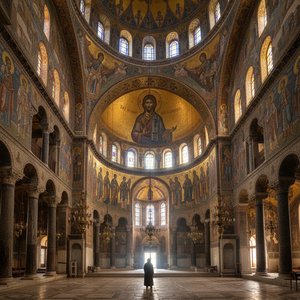
The Baptistery’s octagonal plan is deliberately designed to represent eternity, mirroring the Christian concept of heaven—a harmonious blend of Romanesque solidity and Gothic soaring height achieved through masterful marble carving and precise mathematical proportions. Constructed in 1153 by Diotisalvi, whose signature graces two pillars within its walls, it immediately established itself as a pioneering example of architectural style. The dome, constructed without scaffolding – an astonishing feat of engineering ingenuity for its time – ascends to a height of 54.86 meters, symbolizing divine aspiration and demonstrating the mastery of medieval builders. Its exterior cladding in alabaster marble—a luminous stone chosen for its purity—creates a breathtaking visual spectacle that captivates visitors from afar. The harmonious interplay between Romanesque arches and Gothic vaults exemplifies the transformative influence of Gothic ideals on Italian art.

Sculptural Treasures: Echoes of Biblical Narratives

The Baptistery’s interior is dominated by monumental sculptures created by Diotisalvi and Nicola Pisano—artists who redefined the art of carving marble. These figures depict biblical scenes, primarily focusing on Saint John the Baptist, conveying narratives of salvation and divine grace. The sculptures embody Romanesque style with their robust forms and expressive faces, while Pisano’s pulpit heralds the Gothic era’s emphasis on naturalism and grandeur. Nicola Pisano's pulpit, featuring a depiction of Christ Pantocrator—the Almighty King—represents a pivotal moment in artistic history, establishing a new standard for sculptural representation. The Baptistery’s sculptures are not merely decorative embellishments; they serve as didactic symbols—visual interpretations of sacred scripture intended to educate and inspire contemplation.

Acoustic Wonder: Amplifying Faith

Remarkably, the Baptistery possesses exceptional acoustic properties. Visitors recount experiencing a palpable resonance as voices ascend within its walls, creating an immersive auditory experience that underscores its significance as a sacred space for liturgical music and contemplation. The dome’s ingenious construction—a double shell utilizing innovative techniques—contributes to this remarkable effect, ensuring that every utterance is heard with clarity and solemnity. This acoustic dimension elevates the Baptistery beyond mere architectural grandeur, transforming it into an instrument of divine communion.

Historical Significance: Witness to Centuries of Faith

Commissioned by Bishop Guido da Montefiore in 1153, the Baptistery represents Pisa’s unwavering devotion to Christianity and its role as a leading center for artistic patronage. Throughout its history, it has served as a focal point for civic life, witnessing coronations, processions, and countless baptisms—each event reinforcing its status as a symbol of Pisa’s cultural heritage. Its enduring presence testifies to the resilience of faith and artistry across generations. The Baptistery's walls bear witness to centuries of history—from papal ceremonies to artistic commissions—solidifying its place in the annals of Italian art and spirituality.

What Makes It Unique: A Synthesis of Style and Innovation

What distinguishes the Baptistery from other ecclesiastical structures is its unparalleled artistic achievement combined with groundbreaking architectural innovation. It stands as an indelible reminder of Pisa’s golden age—a testament to human creativity and spiritual aspiration that continues to resonate powerfully today. The harmonious blend of Romanesque solidity and Gothic soaring height, coupled with the masterful execution of marble sculpture and the extraordinary acoustics—makes it a singular masterpiece—a beacon of artistic excellence that captivates visitors from across the globe. Its legacy persists as an inspiration for architects and sculptors alike—a symbol of Pisa’s enduring contribution to the history of European art.

Collection d'œuvres d'art

Aucune œuvre d'art trouvée.