Winfred Nana Amoah : Transformer les déchets en vision
Le voyage artistique de Winfred Nana Amoah a débuté à Hohoe, au Ghana, une région imprégnée de traditions et de plus en plus façonnée par les complexités de la vie moderne. Né en 199 et il possède une compréhension innée du patrimoine comme des préoccupations contemporaines — une dualité qui informe profondément son approche distinctive de la création. Plutôt que de s'appuyer sur des médiums conventionnels tels que les pinceaux et les toiles, Amoah prône une réinvention radicale de l'expression artistique à travers des matériaux revalorisés. Il rassemble méticuleusement des plastiques jetés, des restes de textiles, de vieilles cartes de crédit, des articles de recherche et des journaux — des objets souvent négligés comme étant des rebuts — pour les transformer en formes sculpturales qui résonnent de significations multiples.
Influences précoces : Les années de formation d'Amoah ont été marquées par une exposition au paysage culturel vibrant du Ghana, favorisant une profonde appréciation pour la narration et la représentation visuelle au sein des traditions indigènes.
Exploration des matériaux : Sa fascination pour les matériaux recyclés provient d'un désir de confronter les enjeux de durabilité et de consommation des ressources, tout en honorant simultanément la beauté inhérente aux objets abandonnés. Il perçoit un potentiel là où d'autres ne voient que des déchets.
Technique et processus : La technique d'Amoah se caractérise par un assemblage et une manipulation minutieux, combinant la sculpture avec le tissage textile et les méthodes de collage. Ce processus délibéré souligne son engagement à transformer des articles ordinaires en œuvres d'art extraordinaires.
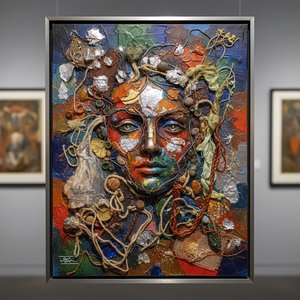
Sa production artistique s'articule autour de l'exploration des thèmes de l'identité et de l'appartenance, particulièrement dans le contexte du Ghana contemporain. Des pièces telles que « Emo Eve (Two faces) » et « D'umevi (A native of the town) » illustrent cette préoccupation, présentant des figures fragmentées construites à partir de morceaux de plastique et de textile qui expriment simultanément vulnérabilité et résilience. Ces œuvres ne sont pas simplement décoratives ; elles constituent des déclarations sur le patrimoine culturel et l'expérience personnelle, entrelacées dans une critique plus large des récits sociétaux. Le travail d'Amoah évoque les défis auxquels sont confrontés les individus naviguant dans des paysages sociaux en mutation tout en conservant un lien avec leurs racines.
Réalisations notables et reconnaissance
Bien qu'il soit relativement jeune, les efforts artistiques d'Amoah ont attiré une attention considérable au sein de la scène artistique florissante du Ghana. Les expositions présentant ses sculptures et ses installations textiles ont été saluées pour leur profondeur conceptuelle et leur exécution magistrale. De plus, ses collaborations avec des organisations locales promouvant la sensibilisation environnementale démontrent l'engagement d'Amoah à utiliser son art comme un vecteur de commentaire social.
Symbolisme et profondeur conceptuelle
La vision artistique d'Amoah transcende le simple attrait esthétique ; elle opère sur plusieurs niveaux de signification symbolique. La sélection de matériaux recyclés n'est pas arbitraire mais délibérée — un acte conscient de réappropriation d'objets mis au rebut et de leur réutilisation pour communiquer des idées puissantes sur la consommation, la mémoire et la transformation. Chaque pièce incarne un récit qui invite à la contemplation de notre relation avec l'environnement et des histoires ancrées dans la vie quotidienne.
Importance historique et perspectives d'avenir
La contribution de Winfred Nana Amoah à l'art ghanéen est significative par son refus des conventions établies et son adoption d'approches innovantes ancrées dans une conscience écologique. Il représente une nouvelle génération d'artistes s'engageant activement sur les questions sociales pressantes tout en honorant les traditions artistiques. Alors qu'il continue de développer sa pratique, Amoah promet d'enrichir davantage le dialogue autour de l'identité, de la durabilité et de la narration visuelle — consolidant ainsi sa place en tant que voix captivante au sein du paysage évolutif de l'art africain contemporain.
Par la rédaction de OriginalUniqueArt.com
Quiz d'art
Chaque question ne comporte qu'une seule bonne réponse.
Question 1:
Quel matériau Winfred Nana Amoah utilise principalement dans ses œuvres ?
Question 2:
Où Winfred Nana Amoah est-il né ?
Question 3:
Quels sont les thèmes principaux explorés dans l’œuvre de Winfred Nana Amoah ?
Elevate hospitality interiors with professional mixed media art. Our guide explores texture, layering, and durability for hotel designers and procurement managers seeking high-impact, custom-commissioned artworks that define luxury guest experiences.
Master the art of high-impact decor with our trend forecast on mixed media. Discover how to layer street style textures and dimensional elements to create a bold, urban aesthetic for your modern space. Elevate your collection with professional insights into contemporary art trends.
Elevate your artistic practice with our expert guide to mastering mixed media art. Discover professional techniques for layering, material integration, and creating structural depth to transform your creative vision into sophisticated, multi-dimensional masterpieces.
OAssistant du studioEn ligne · répond en une minute
Bonjour ! Je peux vous aider à choisir une œuvre d'art, à suivre une commande ou à répondre à vos questions sur la garantie. Comment puis-je vous aider ?