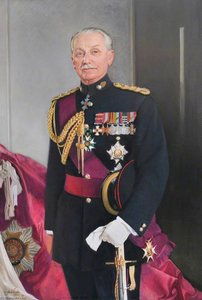
The Visionary of the Scottish Landscape: The Life of William Oliphant Hutchison
In the annals of early 20th-century British art, few names evoke the serene majesty and rugged charm of the Scottish countryside as poignantly as William Oliphant Hutchison. Born in Kirkcaldy in 1889, Hutchison was a man whose life and brushwork were inextricably linked to the textures of his homeland. His journey from a scholar at Kirkcaldy High School to a distinguished President of the Royal Scottish Academy is a testament to a profound dedication to the craft of painting. While his early years were shaped by the disciplined atmosphere of Rugby School and the rigorous training at the Edinburgh College of Art, it was his innate ability to observe the subtle shifts in light and shadow that truly defined his artistic soul. His work does not merely depict scenery; it breathes with the quiet dignity of a bygone era, capturing the very essence of rural life through a lens of masterful realism.
Hutchison’s artistic development was marked by a sophisticated blend of traditional mastery and an adventurous spirit. After honing his skills under influential mentors like John Duncan Robertson, he sought inspiration beyond the borders of Scotland, spending formative time in Paris. This period of international exposure allowed him to refine his portraiture, infusing his subjects with a psychological depth that would later characterize his most celebrated works. Upon returning to Britain, his career took on a more structured yet equally impactful trajectory. He became a central figure in the Edinburgh Group, exhibiting alongside notable contemporaries such as Eric Robertson and Dorothy Johnstone, thereby helping to foster a vibrant community of artists dedicated to the evolution of Scottish painting. His service during the First World War, though marked by the hardships of being stationed in Malta and later wounded in France, did not dampen his creative resolve; instead, it seemed to deepen the emotional resonance found within his landscapes.
Technique, Light, and the Soul of the Canvas
To stand before a Hutchison landscape is to enter a world of atmospheric tranquility. He was a practitioner of plein air painting, a method that required him to confront the elements directly to capture the fleeting nuances of nature. This intimate connection with his subject matter resulted in a technique where brushstrokes were deliberate and meticulously blended, creating a tactile quality that mirrors the undulating hills and verdant woodlands of Scotland. His palette was often characterized by a sophisticated use of muted tones—deep greens, earthy browns, and soft blues—which anchored his compositions in a sense of grounded reality. Yet, within this restrained spectrum, Hutchison possessed a remarkable ability to introduce sudden, vibrant accents. A burst of wildflower color or the golden glow of a setting sun could transform a quiet meadow into a dramatic stage of light and shadow.
Beyond the sweeping vistas, Hutchison’s mastery extended into the intimate realm of portraiture, where he displayed an uncanny ability to capture character and status. His portraits range from the regal and historical—such as his depiction of HRH Queen Elizabeth II in the robes of the Order of the Thistle—to the deeply personal and domestic, exemplified by the quiet, dignified study of The Artist’s Mother. In these works, his use of light serves not just to illuminate form, but to reveal the inner life of the sitter. Whether painting a distinguished academic like Francis Hugh Adam Marshall or the simple, peaceful movement of a dog near a river in Letheringham Mill, Hutchison maintained a consistent commitment to truth and texture, ensuring that every subject, no matter how grand or humble, was treated with profound respect.
Legacy and Institutional Leadership
The historical significance of William Oliphant Hutchison extends far beyond the borders of his canvases. As the Director of the Glasgow School of Art from 1933 to 1943, he played a pivotal role in navigating the institution through one of the most turbulent periods in modern history. Though often regarded as a traditionalist, Hutchison possessed a progressive wisdom; he encouraged the avant-garde movements of his time while ensuring that the foundational principles of classical training remained intact. His leadership was characterized by a deep care for his students and staff, particularly during the hardships of World War II, cementing his reputation as a pillar of the Scottish art community.
His accolades were numerous and reflected his high standing in the international art world:
- President of the Royal Scottish Academy
- Honorary Member of the Royal Academy
- Member of the Royal Society of Arts
- Recipient of the LLD (Doctor of Laws) degree
Today, Hutchison’s legacy lives on through the permanent collections of galleries across the United Kingdom, where his works continue to serve as windows into the heart of Scotland. He remains a vital figure for students of art history, representing a bridge between the rigorous realism of the 19th century and the evolving complexities of 20th-century modernism. His ability to find the extraordinary within the ordinary ensures that his vision remains as luminous and enduring as the landscapes he so lovingly painted.
Questions et réponses
Existe-t-il une visite virtuelle en 3D des œuvres de William Oliphant Hutchison ?
La Musée 3D de William Oliphant Hutchison est une page qui présente les œuvres de l'artiste dans une galerie virtuelle en trois dimensions.
Puis-je parcourir les œuvres de William Oliphant Hutchison par ambiance ?
La page L'ambiance par émotion de l'artiste présente les œuvres de William Oliphant Hutchison classées par atmosphère.
Puis-je explorer les œuvres de William Oliphant Hutchison par spectre de couleurs ?
Les œuvres de William Oliphant Hutchison peuvent être explorées par couleur sur la page Index spectral de l'artiste.