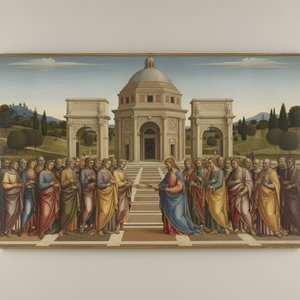
Un visionnaire de l'âme gothique de Sienne
Sano di Pietro, né vers 1405/06, demeure un nom qui résonne avec la grandeur et la beauté éthérée caractéristiques de la peinture siennoise durant le Quattrocento. Alors qu'une grande partie du monde de l'art italien commençait à pivoter vers l'essor de la Renaissance florentine — un mouvement défini par un réalisme rigoureux et des idéaux humanistes — la vision artistique de Sano s'est attachée avec constance aux traditions de l'héritage gothique de Sienne. Cet engagement lui a permis d'imprégner ses toiles d'une profondeur spirituelle et d'une qualité lumineuse qui le distinguent comme l'une des voix les plus originales et les plus durables de son époque. Sa vie était profondément tissée dans la trame civique et spirituelle de Sienne ; au-delà de l'atelier, il servit en tant que chef du quartier de San Donato et agit même comme arbitre lors de litiges entre maîtres contemporains, prouvant ainsi qu'il était un homme d'une intégrité et d'un rang social considérables.
L'atelier établi par Sano fut un moteur de créativité prolifique, produisant une gamme étonnante d'œuvres touchant à divers supports. Il n'était pas seulement un peintre de retables ; sa maîtrise s'étendait à l'art délicat des miniatures, à l'échelle monumentale des fresques et même à l'art complexe de la reliure de livres. Son style distinctif est immédiatement reconnaissable pour tout admirateur de l'école siennoise, caractérisé par des couleurs vibrantes et somptueuses juxtaposées à des draperies élégantes et fluides. Ces éléments travaillent en harmonie pour créer des compositions qui semblent scintiller d'une lumière intérieure. Une grande partie de cette sensibilité esthétique peut être retracée jusqu'à l'influence de Sassetta, dont l'utilisation innovante de la couleur et de la perspective a fourni le fondement sur lequel Sano a bâti son propre langage dévotionnel unique.
Chefs-d'œuvre de dévotion et de narration
L'étendue de l'œuvre de Sano offre une fenêtre sur les profonds récits religieux qui ont défini le XVe siècle. Sa capacité à traduire des histoires bibliques complexes en une imagerie accessible et émouvante s'exprime peut-être le mieux dans ses diverses représentations de figures sacrées. Parmi ses accomplissements les plus notables, on peut citer :
- Saint Jérôme : Un portrait saisissant de la figure biblique dans son étude, où Sano utilise des couleurs riches et des détails complexes pour créer un chef-d'œuvre d'art dévotionnel qui invite à la contemplation silencieuse.
- L'Assomption de la Vierge : Une vision céleste datant de 1448, cette œuvre capture la Vierge Marie s'élevant au milieu d'une multitude d'anges, incarnant parfaitement la beauté éthérée et la grâce divine de l'ère gothique.
- Scènes de la vie de Saint Jérôme : Ces panneaux à la détrempe démontrent sa capacité à tisser des récits religieux complexes à travers des figures vibrantes et une maîtrise de la tradition siennoise.
- Martyre de Sainte Agathe : Une représentation poignante et lumineuse au sein d'une lettrine, témoignant de son talent dans le domaine délicat de l'enluminure de manuscrits.
À travers ces œuvres, Sano di Pietro a atteint un équilibre rare entre la beauté ornementale du style gothique et une profonde résonance émotionnelle. Sa mort en 1481 fut marquée par un hommage émouvant, le décrivant comme "un peintre célèbre et un homme entièrement dédié à Dieu." Cet épitaphe constitue un résumé fidèle de son héritage — un artiste dont la vie et l'œuvre étaient indissociables de la dévotion spirituelle de Sienne, laissant derrière lui une trace lumineuse d'art qui continue d'enchanter le regard moderne.
Questions et réponses
Puis-je explorer les œuvres de Sano Di Pietro par sujet ?
Retrouvez les œuvres de Sano Di Pietro classées par sujet sur la page Index thématique de l'artiste.
Où puis-je consulter l'ensemble des œuvres de Sano Di Pietro ?
Retrouvez toutes les œuvres de Sano Di Pietro sur ce site en consultant sa page Toutes les œuvres d'art.
À quelle époque historique Sano Di Pietro a-t-il vécu ?
Sano Di Pietro a œuvré durant la période Renaissance. Cette époque permet de situer l'activité de l'artiste dans l'histoire.