Un héritage d'élégance : La vie et l'art de Raimundo de Madrazo
Raimundo de Madrazo y Garreta, né à Rome en 1841, est entré dans un monde déjà imprégné de traditions artistiques. Sa lignée était d'un prestige considérable ; son grand-père, José de Madrazo, occupait la fonction estimée de directeur du Museo del Prado, tandis que son père, Federico de Madrazo, était lui-même un portraitiste célèbre. Ce fondement familial ne relevait pas seulement de l'héritage — il a instillé chez le jeune Raimundo non seulement une maîtrise technique, mais aussi une compréhension du pouvoir et du statut social associés à la création artistique. Ses premiers apprentissages se sont déroulés dans l'intimité des ateliers familiaux, où il a absorbé les principes de la technique classique auprès de son père et de son grand-père. Ses études formelles à la Real Academia de Bellas Artes de San Fernando à Madrid, sous la direction de Carlos Luis de Ribera et Carlos de Haes, ont affiné ses compétences en l'exposant aux courants artistiques contemporains. Cependant, c'est un séjour charnière à Paris en 1860 qui a véritablement transformé sa trajectoire. Étudier auprès de Léon Cogniet et tisser des liens au sein du monde de l'art parisien allait définir sa sensibilité esthétique pour les décennies à venir. L'influence d'Alfred Stevens durant cette période s'est révélée particulièrement significative, faisant évoluer subtilement son approche vers une sensibilité plus raffinée et décorative — un mouvement s'éloignant de l'académancement strict vers un style imprégné de grâce et d'allure.Le Réalisme infusé de raffinement : Style artistique et influences
Le style artistique de Madrazo est fondamentalement ancré dans le réalisme, pourtant il transcende la simple imitation par une infusion d'élégance et de sophistication. Bien qu'attaché à une représentation fidèle, ses peintures possèdent une grâce délicate qui les distingue des courants plus austères du mouvement. Ce raffinement a évolué au fil du temps, incorporant subtilement des éléments rappelant le Rococo — un penchant pour le détail orné et la composition ludique — ainsi que le Japonisme, cette fascination croissante de l'Occident pour l'art japonais, notamment dans son accent sur la perspective aplatie et les motifs décoratifs. Il est devenu célèbre pour ses portraits, capturant non seulement la ressemblance physique mais aussi l'essence intérieure de ses sujets avec une compétence remarquable. L'influence de Mariano Fortuny est palpable dans les scènes de tableautin à plus petite échelle de Madrazo — aperçus intimes de la vie bourgeoise — et dans sa capacité à dépeindre un monde de textures luxueuses et d'émotions subtiles. La rigueur académique de Cogniet, combinée au flair décoratif de Stevens, a créé le fondement de la voix artistique unique de Madrazo. Il ne se contentait pas d'enregistrer la réalité ; il en façonnait une vision idéalisée, qui répondait aux goûts d'une clientèle exigeante en quête de beauté et de raffinement dans l'art. Cette capacité à mêler le réalisme à une touche de fantaisie lui a permis de créer des œuvres à la fois captivantes et aspirationnelles.Portraits d'une époque : Œuvres majeures et thèmes
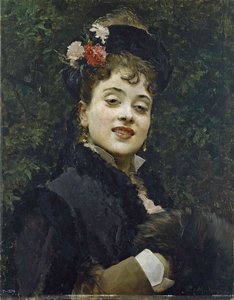
L'œuvre de Madrazo est peuplée de portraits captivants et de scènes de genre qui offrent une fenêtre sur le monde social de la fin du XIXe siècle. Son Portrait de son père peignant témoigne à la fois de l'affection filiale et du talent artistique, présentant non seulement une ressemblance mais aussi l'acte même de la création — un peintre portraitant un peintre, un méta-commentaire sur le processus artistique. Des œuvres comme Souvenirs tendres démontrent son talent pour évoquer la nostalgie et capturer des moments intimes avec une sensibilité poignante. Cependant, ce sont ses peintures de genre, mettant souvent en scène Aline Masson comme modèle, qui lui ont valu une reconnaissance mondiale. La maîtresse réticente, Après le bain et le Portrait d'Aline Masson en mantille en sont des exemples parfaits — des scènes sensuelles, méticuleusement rendues, qui célèbrent la beauté et la grâce féminines. La présence d'Aline Masson est centrale pour comprendre la production artistique de Madrazo ; elle fut sa muse pendant de nombreuses années, incarnant l'idéal d'élégance raffinée qui imprégnait ses tableaux. Ces œuvres n'étaient pas de simples représentations de la société mondaine ; elles étaient des fantasmes soigneusement construits, conçus pour séduire une clientèle désire et posséder des images de beauté et de luxe. Le motif récurrent de l'attrait féminin, souvent voilé par une atmosphère de doux mystère, est devenu la marque de fabrique de son style.Reconnaissance internationale et impact durable
La carrière de Raimundo de Madrazo s'est déployée sur la scène internationale. Son exposition de début à Paris en 1860 a marqué le commencement de son parcours professionnel, rapidement suivie de voyages fréquents à New York où il a cultivé une clientèle fidèle parmi des familles éminentes telles que les Vanderbilt et Alexander Turney Stewart. Malgré ce succès à l'étranger, il est resté relativement réservé quant à ses expositions en Espagne. Témoignant de son engagement à favoriser les échanges artistiques, il a cofondé une « Exposition internationale de peinture » à Paris en 1882, aux côtés d'Alfred Stevens, de Nittis et de Petit — une initiative destinée à promouvoir le travail des artistes étrangers. Il exposait régulièrement au prestigieux Salon de Paris, recevant une médaille majeure à l'Exposition Universelle de 1889, consolidant ainsi sa réputation d'artiste de premier plan de son temps. Au-delà de ses accomplissements artistiques, Madrazo a fait preuve d'un engagement envers la préservation culturelle par son don généreux des œuvres de Francisco de Goya au Museo del Prado en 1894 et par son appartenance à la Royal Academy de Londres. Raimundo de Madrazo s'est éteint en 1920, laissant derrière lui l'héritage de l'un des plus grands peintres réalistes d'Espagne — un maître portraitiste qui a capturé l'esprit d'une époque avec élégance, savoir-faire et un attrait durable. Son œuvre continue de résonner aujourd'hui, offrant un aperçu du monde opulent de la Gilded Age et des sensibilités artistiques qui l'ont définie. Son fils, Federico de Madrazo y Ochoa (« Coco »), a poursuivi la tradition familiale, garantissant que le nom de Madrazo reste synonyme d'excellence artistique pour les générations à venir. Les peintures de Madrazo demeurent un témoignage de sa capacité à jeter un pont entre les traditions académiques et les styles modernes émergents, laissant une marque indélébile sur l'art espagnol du XIXe siècle.Questions et réponses
Quelles émotions les œuvres de Raimundo de Madrazo y Garreta expriment-elles ?
Les œuvres de Raimundo de Madrazo y Garreta peuvent être explorées par émotion sur la page L'espace des émotions de l'artiste, qui organise les créations selon l'ambiance qu'elles dégagent.
Comment l'art de Raimundo de Madrazo y Garreta a-t-il évolué au fil du temps ?
La Parcours de carrière de Raimundo de Madrazo y Garreta est une frise chronologique interactive qui se parcourt au défilement, présentant les œuvres de l'artiste par ordre chronologique et regroupées par périodes de sa carrière.
Puis-je explorer les œuvres de Raimundo de Madrazo y Garreta par spectre de couleurs ?
La page Par couleur organise les œuvres de Raimundo de Madrazo y Garreta par couleur.