Le Pont entre deux Époques : La Vie et l'Héritage de Pierre Narcisse Guérin
Dans la grande tapisserie de l'histoire de l'art français, peu de figures incarnent la transition délicate entre la rigueur disciplinée du Néoclassicisme et la passion turbulente du Romantisme avec autant de grâce que Pierre Narcisse Guérin. Né à Paris en 1774, Guérin a émergé durant une période de profonde transformation sociétale, où les échos de la Révolution française résonnaient encore dans les couloirs de l'Académie. Élève du très estimé Jean-Baptiste Regnault, le début de la carrière de Guérin fut marqué par une distinction immédiate ; en 1796, il remporta l'un des prestigieux grands prix, une victoire qui annonçait son arrivée en tant que talent formidable, capable de raviver l'esprit de compétition du monde de l'art français après des années d'interruption révolutionnaire.
L'ascension de Guérin vers la célébrité ne fut pas seulement une question de maîtrise technique, mais de résonance émotionnelle. Lorsqu'il dévoila Le Retour de Marcus Sextus au Salon de 1799, l'impact fut tout simplement électrique. Le tableau, qui dépeignait un vétéran romain revenant dans un foyer dévasté par la mort et les bouleversements politiques, servit d'allégorie poignante à l'expérience française de l'époque. À travers cette œuvre, Guérin démontra une capacité singulière à tisser le récit historique avec le chagrin brut et personnel de ses sujets, utilisant efficacement le passé classique pour refléter le chaos du présent. Cette maîtrise du drame deviendrait sa marque de fabrique, lui valant les éloges du public et menant à de nouvelles études à Rome sous la direction de Joseph-Benoît Suvée.
Un Voyage à travers la Lumière et le Mythe
La trajectoire de la vie de Guérin fut façonnée à la fois par l'ambition artistique et la fragilité physique. Son séjour à Rome, bien qu'intellectuellement enrichissant, fut écourté par une santé déclinante, l'obligeant à se réinstaller à Naples. C'est là que sa palette commença à s'élargir, embrassant la grandeur atmosphérique des paysages, comme on peut le voir dans son œuvre commémorative pour le tombeau d'Amyntas. Cette période d'errance lui permit d'insuffler à ses fondements néoclassiques un nouveau sens de la lumière et de l'ombre, précurseur des styles plus expressifs qui allaient bientôt dominer l'Europe.
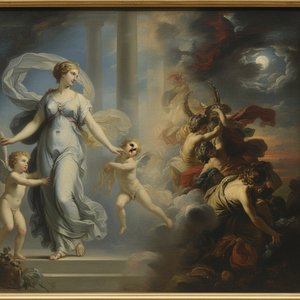
À son retour à Paris, le répertoire de Guérin s'enrichit pour inclure certaines des scènes mythologiques et historiques les plus captivantes du début du XIXe siècle. Ses œuvres présentaient souvent un clair-obscur lumineux qui insufflait la vie à des figures divines, à l'instar de l'éthéré Morphée et Iris. Qu'il s'agisse de dépeindre le destin tragique de Didon et Énée ou l'énergie héroïque et intense d'<Andromaque et Pyrrhus, Guérin possédait un don unique pour imprégner les sujets mythologiques d'une vulnérabilité humaine. Sa capacité à équilibrer la beauté idéalisée de la tradition classique avec une profondeur psychologique émergente en fit le favori de la cour impériale durant l'ère napoléonienne.
L'Influence du Maître et la Signification Artistique
Au-delà de ses toiles individuelles, l'importance historique de Guérin réside dans son rôle de mentor pivot et de pont stylistique. Il se tenait au carrefour des générations, fournissant le socle sur lequel les géants du Romantisme allaient bâtissant leur œuvre. Son influence peut être tracée à travers les travaux de peintres légendaires tels que :
- Eugène Delacroix, qui s'est appuyé sur les compositions dramatiques et l'intensité émotionnelle de Guérin pour être le pionnier du mouvement romantique.
- Théodore Géricault, dont les puissantes représentations de la lutte humaine faisaient écho au poids narratif présent dans les peintures d'histoire de Guérin.
- Henry Scheffer, un élève talentueux qui a perpétué l'élégance néoclassique raffinée enseignée par son maître.
En fin de compte, Pierre Narcisse Guérin était bien plus qu'un simple peintre de scènes magnifiques ; il était un artiste qui comprenait le pouls de son époque. À travers ses portraits, ses allégories mythologiques et ses épopées historiques, il a capturé la tension entre l'ordre et le chaos, la stabilité et le changement. Son héritage reste gravé dans les salles d'institutions telles que le Louvre et l'Ermitage, témoignant d'un homme capable de commander la discipline du vieux monde tout en murmurant les secrets du nouveau.
Questions et réponses
Comment puis-je voir toutes les œuvres créées par Pierre Narcisse Guérin ?
Chaque œuvre de Pierre Narcisse Guérin sur ce site web peut être consultée depuis la page Toutes les œuvres de l'artiste.
Comment puis-je trouver toutes les œuvres de Pierre Narcisse Guérin dans une technique donnée ?
Pour trouver toutes les œuvres de Pierre Narcisse Guérin dans une technique donnée, consultez la page Tous les médiums de l'artiste.
Existe-t-il un récit chronologique de la carrière de Pierre Narcisse Guérin ?
Un récit chronologique de l'œuvre de Pierre Narcisse Guérin est disponible sur la page Chronologie de l'artiste, où les œuvres défilent par ordre de création, chapitre par chapitre.