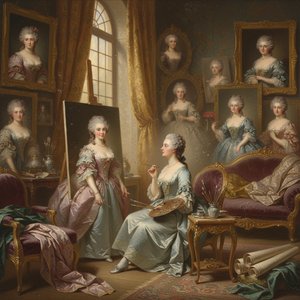
Pierre II Le Pautre (1659-1744) : Le Sculpteur de l'Élégance Rococo
Pierre II Le Pautre, né à Paris vers 1659, s'est imposé comme une figure incontournable du paysage artistique de la France de la fin du Baroque et du début du Rococo. Sa carrière prolifique, qui s'est étendue sur près de quatre décennies, a laissé une empreinte indélébile sur la sculpture, la gravure et le design architectural, particulièrement au sein des cours opulentes de Louis XIV et de François Boucher. Contrairement à de nombreux artistes de son époque qui se concentraient uniquement sur les grandes commandes royales, Le Pautre a cultivé un style distinctif, caractérisé par une ornementation raffinée et un souci méticuleux du détail, s'établissant ainsi comme l'un des sculpteurs les plus éminents de son ère.- Jeunesse et formation : On sait peu de choses sur les années formatrices de Le Pautre, si ce n'est qu'il était le fils de Jean Lepautre, lui-même célèbre sculpteur et graveur. Ce lien familial a sans aucun doute insufflé à Pierre une passion pour l'artisanat d'art et lui a offert une formation inestimable sous la tutelle de son père.
- Le Prix de Rome et influences artistiques : L'ascension de Le Pautre vers la renommée débuta par sa victoire triomphale au Prix de Rome en 1684, un concours prestigieux qui propulsa les jeunes sculpteurs dans l'orbite du mécénat papal et les exposa aux courants artistiques circulant à Rome. Cette expérience façonna profondément ses sensibilités esthétiques, l'initiant aux idéaux classiques et nourrissant une admiration pour le dynamisme expressif du Maniérisme.
- Réalisations sculpturales : La production sculpturale de Le Pautre était remarquablement diverse, englobant des œuvres monumentales destinées aux églises et aux institutions civiles, ainsi que des pièces décoratives de plus petite échelle. Ses commandes les plus célèbres incluent le magnifique Autel de Saint Ignace de Loyola dans la basilique du Gesù à Rome — un chef-d'œuvre de grandeur baroque — et les douze statues des Apôtres ornant la nef de la basilique Saint-Pierre. Ces projets témoignèrent de sa maîtrise de la taille du marbre et de sa capacité à transmettre une émotion spirituelle profonde à travers la forme sculpturale.
- Contributions architecturales : Au-delà de la sculpture, Le Pautre joua un rôle crucial dans le façonnement du panorama architectural de Versailles sous Louis XIV. Collaborant étroitement avec Jules Hardouin Mansart et Robert de Cotte, il contribua de manière significative à la conception des fontaines, des jardins et des espaces intérieurs, créant un environnement qui incarnait la splendeut et la sophistication de la monarchie française.
- Héritage et reconnaissance : L'influence de Le Pautre s'étendit bien au-delà de ses contemporains immédiats. Son attention méticuleuse aux détails et son utilisation innovante de l'ornementation ont profondément marqué le développement du style Rococo, faisant de lui une pierre angulaire de ce mouvement décoratif. Aujourd'hui, ses sculptures continuent d'inspirer l'admiration par leur élégance et leur puissance expressive, consolidant sa place parmi les artistes les plus influents de France.
Œuvres Notables : Une Symphonie de Forme et d'Ornementation
La vision artistique de Le Pautre s'est manifestée dans plusieurs pièces emblématiques qui illustrent les caractéristiques stylistiques de son temps. Parmi celles-ci, on retient notamment :- Énée portant Anchise de Troie : Réalisée en 1716, cette sculpture monumentale dépeint le récit héroïque de Virgile avec un réalisme et une profondeur émotionnelle saisissants. La composition capture le moment poignant où Énée assiste son père, Anchise, alors qu'ils fuient Troie — une scène imprégnée d'un symbolisme représentant la résilience, le souvenir et la transmission du patrimoine culturel.
- L'Autel de Saint Ignace de Loyola : Cet autel monumental est un témoignage de la prouesse sculpturale de Le Pautre et de sa capacité à transmettre une grandeur spirituelle. Ses sculptures complexes dépeignent des scènes bibliques avec une précision méticuleuse, reflétant l'accent mis par la tradition baroque sur le récit dramatique et l'impact émotionnel.
Influence et Style Artistique
Le style artistique de Le Pautre peut être caractérisé comme un mélange harmonieux entre le dynamisme maniériste et la retenue classique. Il a habilement employé des techniques sculpturales pour atteindre une richesse texturale et une complexité visuelle remarquables, puisant son inspiration tant dans la sculpture de la Renaissance italienne que dans les innovations expressives du Maniérisme. Cependant, contrairement à ses prédécesseurs, Le Pautre a tempéré l'exubérance maniériste par un engagement indéfectible envers la proportion et la clarté, aboutissant à des sculptures dotées d'une élégance raffinée et d'une beauté sobre. Son attention méticuleuse aux détails — particulièrement dans les plis des draperies et les expressions faciales — est devenue une marque de fabrique de l'art Rococo, influençant des générations de sculpteurs qui lui succédèrent.Questions et réponses
Dans quelle ville et quel pays Pierre Ii Le Pautre est-il/elle né(e) ?
Pierre Ii Le Pautre est né à Paris, en France.
Combien d'œuvres de Pierre Ii Le Pautre sont disponibles à la consultation ?
Vous pouvez parcourir 1 œuvre(s) œuvres de Pierre Ii Le Pautre sur la page Toutes les œuvres d'art.
Où et en quelle année Pierre Ii Le Pautre est-il né ?
Pierre Ii Le Pautre est né à Paris en 1659.