Portrait de Nicolas Tarkhoff

Peintures de Nicolas Tarkhoff : les 42 plus célèbres, selon le regard d'une galerie

Mis à jour en novembre 2026 · classé selon notre score de popularité (recherches, visites et commandes pour chaque œuvre) · 42 œuvres de Nicolas Tarkhoff dans notre catalogue

En bref

Aux yeux de la galerie, la peinture la plus célèbre de Nicolas Tarkhoff est Madame Tarkhoff avec ses deux enfants Jean et Boris (1907). Madame Tarkhoff et son enfant (1906) et La Place du Maine, Paris complètent ce trio que tout le monde reconnaît. Parmi les 42 œuvres de Nicolas Tarkhoff présentes dans notre catalogue, la galerie présente ci-dessous les 42 plus célèbres, chacune étant une œuvre originale avec son année, son musée et ce qui la rend unique.

1871 – 1930 Post-impressionism

Les 10 meilleures peintures de Nicolas Tarkhoff de la galerie

1
Madame Tarkhoff avec ses deux enfants Jean et Boris (1907) de Nicolas Tarkhoff

Madame Tarkhoff avec ses deux enfants Jean et Boris

1907 · Peinture à l'huile

La composition s'articule autour d'une femme allongée dans l'intimité d'un lit. Positionnée vers la gauche du cadre, son corps s'incline avec tendresse pour accueillir deux enfants. L'un d'eux, situé plus centralement, semble éveillé, tandis que le second repose paisiblement sur le côté droit du lit. Dans la partie inférieure de la scène, la main de la femme est visible, cherchant le contact avec son enfant. Le lit lui-même occupe une…

2
Madame Tarkhoff et son enfant (1906) de Nicolas Tarkhoff

Madame Tarkhoff et son enfant

1906 · Peinture à l'huile

Une atmosphère d'un calme profond et pesant enveloppe la pièce alors qu'une femme est allongée sur un lit, sa silhouette drapée dans une robe bleue intense. Elle berce son nourrisson contre son cœur, partageant avec lui un espace intime et feutré au milieu des plis de la literie. La lumière du soleil, ou peut-être la lueur d'une lampe douce, filtre à travers la pièce, venant accrocher la texture du tissu…

3
La Place du Maine, Paris de Nicolas Tarkhoff

La Place du Maine, Paris

Peinture à l'huile

Cette toile dépeint une scène de rue au cœur de la Place du Maine, à Paris. Une calèche à chevaux occupe le côté droit de la composition, s'avançant le long d'une route pavée. Deux chevaux se détachent vers la gauche, l'un précédant l'autre dans une formation décalée, tandis que plusieurs silhouettes parsèment cet environnement urbain. Certains individus se tiennent près de la calèche, alors que d'autres marchent ou restent immobiles…

4
Merry Go Round in Montmarnasse (1901) de Nicolas Tarkhoff

Merry Go Round in Montmarnasse

1901 · Oil On Canvas

The scene unfolds in the bustling heart of Paris through the work titled Merry Go Round in Montmarnasse. Painted by Nicolas Tarkhoff in 1901, this piece captures a fleeting snapshot of Parisian daily life. The energy of the city pulses through the composition, freezing a moment of public spectacle amidst the urban rush. It is a glimpse into a bygone era, where the excitement of modern life gathers around the…

5
Goats in the Sunshine (1904) de Nicolas Tarkhoff

Goats in the Sunshine

1904 · Oil On Canvas

The canvas presents a group of white goats gathered closely around a basket. This basket contains hay or grain, positioned at the center of the animals' activity. The goats are densely packed, their forms overlapping to create a sense of immediate movement within the frame. Sunlight hits the white coats of the animals, creating bright highlights that contrast against the darker shadows cast by their bodies. The background consists of…

6
Motherhood (1906) de Nicolas Tarkhoff

Motherhood

1906 · Oil On Canvas

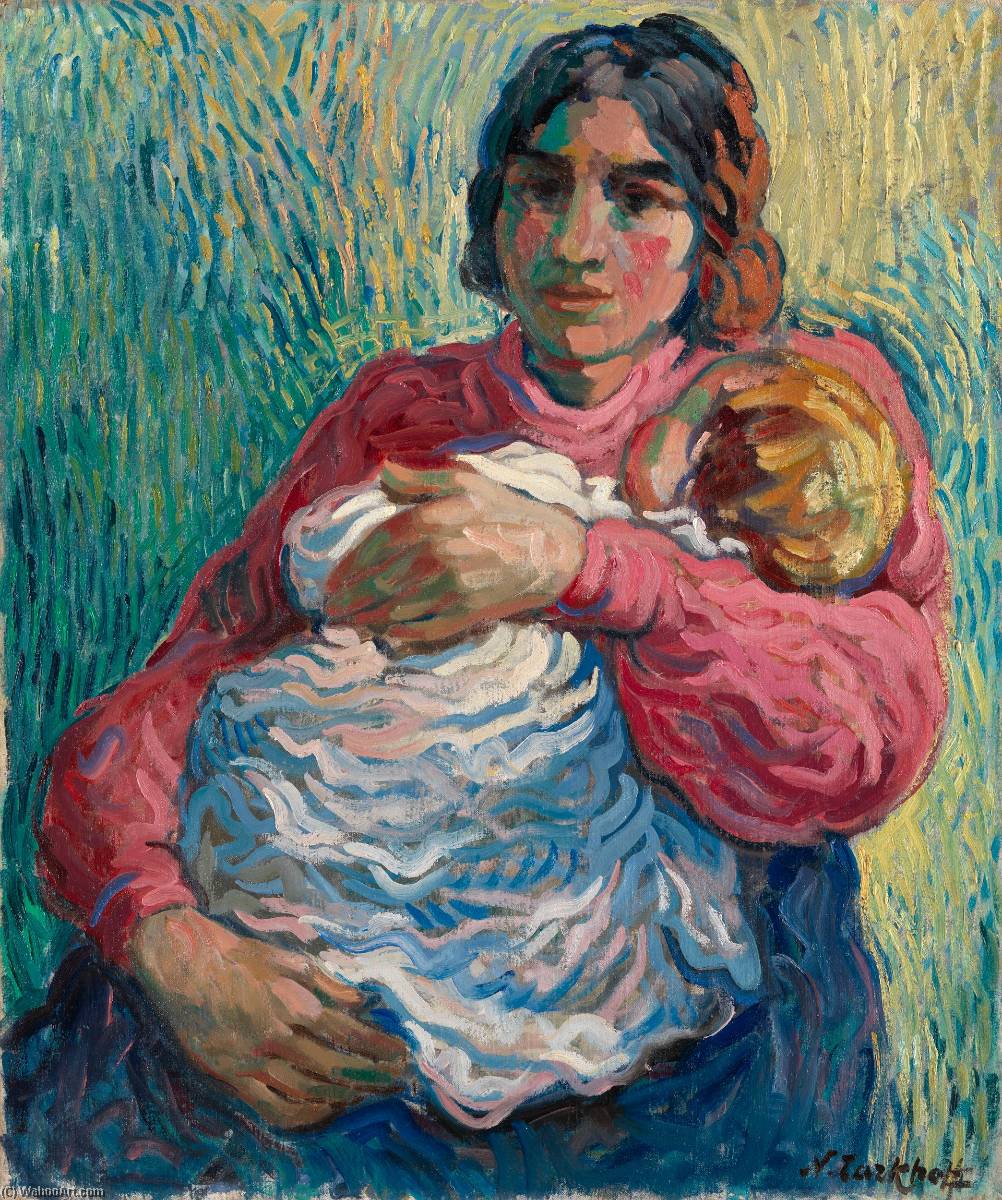
A woman holds her infant child in this 1906 oil painting, creating an intimate connection through a centered, shallow composition. The figures emerge from a textured, vertical green field that provides a stark contrast to the organic forms of the subjects. Thick, visible brushstrokes define the contours of the mother and child, emphasizing movement and energy over precise realism. The impasto technique creates a tactile surface, where layers of paint…

7
The Kiss de Nicolas Tarkhoff

The Kiss

Oil

The painting moves beyond mere depiction to capture a specific atmosphere. Through the use of bold color and varied brushwork, the artist imbues the scene with a sense of warmth and stillness. The interplay between the light hitting the mother and the shadows within the room creates a sense of movement within a frozen moment. It is a work that prioritizes the feeling of the encounter—the weight of the child,…

Peintures de Nicolas Tarkhoff, classées de 11 à 42

Les sujets qui ont captivé Nicolas Tarkhoff

Les quatre thèmes qui reviennent le plus souvent dans ces œuvres originales, chacun illustré par son plus bel exemple.

Nicolas Tarkhoff, une œuvre emblématique par décennie

Œuvres par décennie

Choisissez une décennie pour découvrir l'œuvre originale qui la définit.

Les peintures de Nicolas Tarkhoff : la galerie répond

Quelle est la peinture la plus célèbre de Nicolas Tarkhoff ?Révéler la réponse

Madame Tarkhoff avec ses deux enfants Jean et Boris (1907). Madame Tarkhoff et son enfant (1906) et La Place du Maine, Paris suivent.

Quel âge avait Nicolas Tarkhoff lors de la création de Madame Tarkhoff avec ses deux enfants Jean et Boris ?Révéler la réponse

36 ans : Madame Tarkhoff avec ses deux enfants Jean et Boris date de 1907, et Nicolas Tarkhoff est né(e) en 1871.

Quelles sont les 10 plus grands tableaux de Nicolas Tarkhoff ?Révéler la réponse

Madame Tarkhoff avec ses deux enfants Jean et Boris, Madame Tarkhoff et son enfant, La Place du Maine, Paris, Merry Go Round in Montmarnasse, Goats in the Sunshine, Motherhood, The Kiss, Street Carnival, Paris, Faubourg Saint Antoine et Fair. Le classement ci-dessus indique l'année et le musée de chacun.

Combien d'œuvres Nicolas Tarkhoff a-t-il créées ?Révéler la réponse

Notre catalogue comprend 42 œuvres de Nicolas Tarkhoff, datées de 1899 à 1912.

Quand Nicolas Tarkhoff a-t-il créé ses peintures les plus célèbres ?Révéler la réponse

En 1900s : 21 des 42 œuvres de cette page ont été créées à cette époque, dont Madame Tarkhoff avec ses deux enfants Jean et Boris.

Quelles sont les premières et les dernières œuvres célèbres de Nicolas Tarkhoff ?Révéler la réponse

Sur cette page, la plus ancienne date de Landscape with Houses (1899) et la plus récente de Landscape with Trees, Flowers and Peasant with Plough (1912).

Quels sont les sujets que Nicolas Tarkhoff a le plus explorés ?Révéler la réponse

Femme (2), Enfant (2) et Lit (2), à travers les 42 œuvres de cette page.

Avec quel médium Nicolas Tarkhoff a-t-il le plus travaillé ?Révéler la réponse

Peinture à l'huile, pour 3 des 42 œuvres de cette page.

À quel mouvement Nicolas Tarkhoff est-il associé ?Révéler la réponse

Post-impressionism, à en juger par les originaux de cette page.

Nicolas Tarkhoff : l'artiste

Early Life and Artistic Awakening

Nicolas Alexandrovich Tarkhoff, born in Moscow on January 20, 1871, emerged from a family of prosperous merchants—a background that initially seemed destined for commerce rather than canvas. However, the young Tarkhoff possessed an innate artistic inclination, described as a “fervent desire to be a painter.” Tragedy marked his childhood; he lost his mother at age three and his father eight years later, experiences that perhaps fostered a sensitivity reflected in his later work. Despite this early loss, his passion for art persisted, though it faced initial resistance from his family who favored more conventional paths. He briefly fulfilled military obligations before finding employment with the Brest-Litovsk Railways—a period of deferment before fully embracing his artistic calling. In 1894, he bravely attempted entry into the School of Painting, Sculpture and Architecture in Moscow, but was rejected due to what was perceived as a “revolutionary temperament.” This rejection didn’t deter him; instead, it propelled him towards Konstantin Korovin's studio in 1897, where he found mentorship within Moscow’s vibrant artistic circles.

Parisian Influences and the Embrace of Post-Impressionism

The late 1890s witnessed a pivotal shift as Tarkhoff journeyed to Paris, a city already pulsating with avant-garde energy. He initially settled in Munich before permanently relocating to the French capital in November 1898. Paris offered not just a change of scenery but an immersion into a world brimming with artistic innovation. Though he enrolled at the Académie Julian under Jean-Paul Laurens, his independent spirit soon led him away from strict academic constraints. He also studied with Luc-Olivier Merson, yet it was the works of Van Gogh, Gauguin, and Cézanne that truly ignited his artistic evolution. These masters revealed “hidden talents” and charted a new course for Tarkhoff’s style—one characterized by expressive brushstrokes, bold color palettes, and an exploration of subjective experience. He quickly absorbed the lessons of Impressionism but moved beyond its purely optical concerns, embracing a more emotionally charged approach that would define his Post-Impressionist identity.

Themes and Techniques: Capturing Light and Emotion

Tarkhoff’s oeuvre is remarkably diverse, encompassing landscapes, genre scenes, still lifes, and portraits. However, certain themes consistently emerge—the bustling life of Paris, the tranquility of rural settings, and intimate moments of family connection. His Parisian paintings capture the energy of boulevards, carnivals, and racing cabs, while his later works reflect a settled life in Orsay, where he resided with his family from 1911. He masterfully employed oil paint to convey not just visual reality but also atmosphere and feeling. Textured brushwork became a hallmark of his style, creating surfaces that shimmered with light and movement. He wasn’t merely depicting scenes; he was translating emotions onto canvas. His use of color was equally significant—vibrant hues were often juxtaposed to create dynamic contrasts and evoke specific moods. Works like “Goats in the Sunshine” exemplify this approach, showcasing a rural idyll bathed in warm light and imbued with a sense of peacefulness. “My Family,” painted during his Russian Post-Impressionist period, reveals a heartwarming tenderness through its expressive style and careful attention to detail.

Recognition and Legacy

Nicolas Tarkhoff achieved considerable recognition during his lifetime, participating in numerous exhibitions across Europe. His work resonated with audiences who appreciated his unique blend of Impressionistic techniques and Post-Impressionist sensibilities. He exhibited at La Libre Esthétique in Paris, showcasing pieces like “Un Jour de neige” and “Notre-Dame,” alongside other prominent artists. Although not as widely celebrated as some of his contemporaries, Tarkhoff’s paintings continue to captivate viewers with their evocative power and emotional depth. His work is represented in various collections, including the Musée du Petit Palais, ensuring that his artistic vision endures for future generations. He stands as a testament to the enduring appeal of Post-Impressionism—a style that prioritized subjective experience and paved the way for modern art movements. His ability to capture serene moments and natural beauty through a unique artistic lens solidifies his place within the rich tapestry of early 20th-century Expressionism, offering a compelling glimpse into the heart and soul of an artist deeply connected to both the world around him and the emotions within.