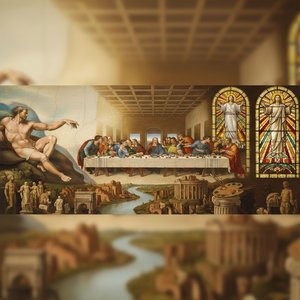
A Serene Vision of Faith: The Enigma of the Master of the Aix Annunciation
The identity of the Master of the Aix Annunciation remains one of the most captivating mysteries in the annals of Early Netherlandish painting. While his true name is shrouded in the mists of the mid-15th century, his brushwork speaks with a clarity and profound stillness that resonates across the centuries. Scholars often whisper the name Barthélemy d'Eyck in connection to this elusive figure, suggesting a lineage tied to the prestigious workshops of the Low Countries. Likely emerging from the artistic crucible of Leuven around 1430, the Master was shaped by an environment of intense devotion and technical innovation, where the mastery of oil paint allowed for a new, luminous language of spiritual expression.
To encounter the work of this artist is to step into a realm where the divine and the earthly intersect through meticulous detail. His oeuvre is characterized by a breathtaking realism that does not merely replicate the physical world but elevates it, imbuing every fold of fabric and every architectural shadow with theological significance. This period of art, marked by fervent piety and the early stirrings of humanist thought, found in the Master a perfect vessel for expressing the complex nuances of Christian iconography. His ability to capture profound emotional depth—ranging from the quiet grace of a celestial visitation to the heavy sorrow of a lamentation—marks him as a pivotal figure in the transition toward a more humanized religious art.
Mastery of Light and Symbolism
The technical prowess of the Master is most evident in his command of the relatively new medium of oil paint. Through a sophisticated process of meticulous layering, he achieved unprecedented tonal gradations and a palpable sense of textural richness. This technique allowed for a unique luminosity, where light seems to emanate from within the subjects themselves, mirroring the spiritual aspiration inherent in his sacred themes. His compositions are often balanced and architectural, utilizing elaborate settings to frame holy figures, much like the celebrated Aix Annunciation itself. In this masterpiece, the interplay of light and shadow creates a sensory experience that guides the viewer toward contemplation.
Beyond mere technical skill, the artist utilized a secret language of symbols to communicate complex truths to his audience. Every element within his panels—be it a specific botanical detail or a particular arrangement of liturgical objects—serves as a bridge between the mundane and the miraculous. This symbolic depth is particularly evident in works such as Prophet Jeremiah and Christ, where the weight of prophecy meets the promise of redemption through intricate, carefully rendered imagery. His work demonstrates an awareness of broader European trends, absorbing the structural influences of Italian masters like Giotto while remaining firmly rooted in the rich, descriptive traditions of the Flemish school.
Legacy and Historical Significance
The historical significance of the Master of the Aix Annunciation lies in his ability to capture the very essence of a transformative era. He stood at the crossroads of the late Middle Ages and the burgeoning Renaissance, crafting an aesthetic that honored tradition while embracing the technical possibilities of a new age. Although much of his biographical history remains lost to time, his artistic legacy is preserved in the silent, powerful presence of his surviving panels, which continue to inspire awe in museums from Aix-en-Provence to Brussels.
His contributions can be summarized through several enduring artistic hallmarks:
- Technical Innovation: The pioneering use of oil glazes to create depth, light, and a lifelike texture.
- Iconographic Depth: A sophisticated integration of Christian symbolism within realistic landscapes and interiors.
- Emotional Resonance: The ability to portray profound spiritual states, from serene peace to deep mourning, with subtle nuance.
- Cultural Bridge: A style that synthesized the meticulous detail of Northern Europe with an emerging awareness of broader European compositional trends.
Questions et réponses
Comment puis-je voir toutes les œuvres créées par Master Of The Aix Annunciation ?
Chaque œuvre de Master Of The Aix Annunciation sur ce site web peut être consultée depuis la page Toutes les œuvres de l'artiste.
Existe-t-il une chronologie des œuvres de Master Of The Aix Annunciation ?
La page Chronologie des œuvres de l'artiste présente les œuvres de Master Of The Aix Annunciation classées par date, année par année.
Combien d'œuvres de Master Of The Aix Annunciation sont disponibles à la consultation ?
Vous pouvez parcourir 7 œuvres d'art œuvres de Master Of The Aix Annunciation sur la page Toutes les œuvres.
Existe-t-il un récit chronologique de la carrière de Master Of The Aix Annunciation ?
La carrière de Master Of The Aix Annunciation se dévoile période par période sur la page Chronologie de l'artiste : une frise chronologique horizontale des œuvres, regroupées en chapitres correspondant aux différentes étapes de sa carrière.
Existe-t-il une visite virtuelle en 3D des œuvres de Master Of The Aix Annunciation ?
Les œuvres de Master Of The Aix Annunciation sont visibles dans une galerie 3D sur la page Musée 3D de l'artiste.
Où les œuvres de Master Of The Aix Annunciation sont-elles regroupées par mots-clés ?
Les œuvres de Master Of The Aix Annunciation peuvent être explorées par mot-clé sur la page Par mots-clés de l'artiste. Chaque mot-clé regroupe les œuvres associées.
Puis-je trier les œuvres de Master Of The Aix Annunciation par couleur ?
L'Index spectral de Master Of The Aix Annunciation est une page qui organise les œuvres de l'artiste par couleur.