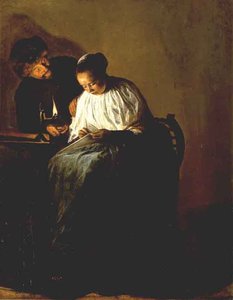
Judith Jans Leyster (1609-1660) was born in Haarlem, Netherlands, the eighth child of Jan Willemsz Leyster, a cloth maker who later transitioned into brewing. Details about her formative years remain scarce, yet scholarly consensus suggests she honed her artistic skills under the tutelage of Frans Pietersz de Grebber, a respected Haarlem artist known for his workshop and influential teaching methods. This mentorship undoubtedly shaped her stylistic sensibilities and established a foundation for her subsequent accomplishments.
Artistic Career
Leyster’s professional trajectory commenced around 1629 when she secured membership in the Haarlem Guild of St Luke—a landmark achievement, marking her as one of the first female artists to gain admittance into this prestigious institution. This decision symbolized not only her ambition but also a courageous challenge to societal norms regarding women's roles in artistic pursuits. Her early works, notably “Serenade” and “Merry Company,” exemplify the vibrant genre scenes characteristic of the Dutch Golden Age—capturing everyday life with remarkable realism and psychological insight. By 1633, she established a collaborative partnership with Jan Miense Molenaer, creating a dynamic studio environment where their artistic visions intertwined.
Notable Works and Collaborations
Leyster’s oeuvre boasts several masterpieces that continue to fascinate art historians. “Young Flute Player,” currently housed in the National Gallery of Art, Washington D.C., stands as a testament to her mastery of chiaroscuro—the dramatic interplay of light and shadow—a technique perfected by Frans Hals himself. Furthermore, her illustrations for Hugo Amman’s book on tulips from 1643 showcased her versatility and demonstrated an acute understanding of visual storytelling. Among her most celebrated paintings are “Self-Portrait” (c. 1633), a poignant depiction of female identity during the Renaissance, and two stunning still lifes discovered in a private collection in the 21st century—works that underscore Leyster’s unwavering dedication to capturing the beauty of natural forms with meticulous detail. Her collaboration with Molenaer resulted in numerous paintings reflecting their shared artistic sensibilities.
Rediscovery and Legacy
Despite her considerable talent and recognition during her lifetime, Judith Leyster’s work largely faded from view after her death in 1660—a tragic consequence of the prevailing biases against women artists within the art world. However, a pivotal moment arrived in 1893 when scholars painstakingly reconstructed her artistic heritage, correcting misattributions and elevating her status as a significant figure of the Dutch Golden Age. Today, Leyster’s paintings are celebrated for their innovative approach to genre painting—particularly portraits—and for challenging conventional narratives about female artists during the Baroque period. Her enduring influence can be observed in subsequent generations of painters who embraced her pioneering spirit and pursued artistic excellence with unwavering determination.
OAssistant du studioEn ligne · répond en une minute
Bonjour ! Je peux vous aider à choisir une œuvre d'art, à suivre une commande ou à répondre à vos questions sur la garantie. Que puis-je faire pour vous ?