Introduction
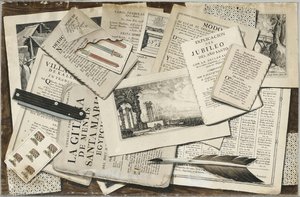
José Pérez Ruano (1750 – 1810) stands as a singular figure in Spanish art history, primarily recognized for his pioneering application of *trompe l’œil*, or engañifa—a technique that deliberately deceives the eye into perceiving illusions. Born in Córdoba, Spain, Ruano's artistic journey unfolded during the Enlightenment era, shaping him into an innovator who captivated audiences with meticulously crafted representations designed to trick the senses. His legacy resides principally within his mastery of *mesas de papeles revueltos*, tables adorned with seemingly disordered papers and objects—a genre where he achieved considerable acclaim and cemented his reputation as a virtuoso of visual illusion. Four of his works in this distinctive style were subsequently acquired by the Junta de Andalucía for the Museo Nacional de Bellas Artes de Córdoba, ensuring their preservation and accessibility to scholars and enthusiasts alike.
Artistic Style and Contributions
Ruano’s artistic approach was fundamentally rooted in *trompe l’œil*, a technique that transcends mere representation; it aims to create an immersive experience for the viewer by manipulating perception. Unlike traditional painting which strives for accurate depiction, engañifa deliberately exploits optical illusions—depth, perspective, texture—to generate a convincing illusion of reality. This stylistic choice distinguishes Ruano from his contemporaries and establishes him as a forerunner of Surrealist explorations into the subconscious mind. His *mesas de papeles revueltos* exemplify this commitment to deception, presenting tables populated with meticulously arranged papers, pencils, inkwells, and other items that appear to exist in three dimensions—a feat achieved through masterful shading, layering, and subtle visual cues.
Notable Works and Exhibitions
Ruano’s artistic output focused primarily on *mesas de papeles revueltos*, a genre he perfected with remarkable precision. These canvases became instantly recognizable for their audacious illusionistic qualities, prompting considerable admiration from critics and fellow artists alike. One particularly noteworthy piece garnered recognition at the Barcelona Exhibition of 1803, securing him a prestigious prize awarded by the Royal Academy of Arts—a testament to his technical prowess and artistic vision. Furthermore, Ruano’s works have graced several exhibitions throughout Spain, showcasing his talent and furthering the dissemination of engañifa art within the broader cultural landscape. The Museo Nacional de Bellas Artes de Córdoba houses four of his masterpieces, guaranteeing their enduring presence as symbols of Spanish artistic innovation.
Influences and Historical Context
Ruano’s artistic sensibilities were undoubtedly shaped by the prevailing intellectual currents of his time—the Enlightenment—which championed reason, observation, and experimentation. While direct biographical information remains scarce, scholars believe he drew inspiration from Baroque artists like Francisco Goya, whose dramatic use of chiaroscuro and expressive brushstrokes served as a model for Ruano’s own stylistic choices. The artistic environment of Córdoba during Ruano's formative years fostered a spirit of creativity and innovation, encouraging him to push the boundaries of conventional painting techniques. His engagement with engañifa reflects a broader fascination with visual illusion—a preoccupation that resonated throughout European art circles during the late 18th century.
Legacy and Impact
José Pérez Ruano’s contribution to Spanish art is undeniable; he stands as one of the foremost practitioners of *trompe l’œil* in his era, establishing himself as a pivotal figure in the development of engañifa art. His innovative technique continues to inspire artists today, demonstrating the enduring relevance of his stylistic vision. Beyond his technical achievements, Ruano's work embodies the spirit of intellectual curiosity and artistic daring characteristic of the Enlightenment—a legacy that secures his place among Spain’s most celebrated painters.