The lines of a life in motion
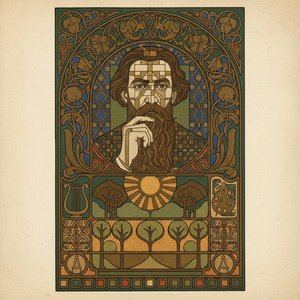
Jan Thorn Prikker began his time in the world in The Hague, born to a father who worked as a house painter and amateur artist. His early years were spent within the walls of the Royal Academy of Art, where he studied from 1881 to 1887. He did not finish those studies, yet the foundations of his craft remained. In the late 1880s and early 1890s, his work took on a different shape through connections with figures like Jan Toorop. This period saw him moving toward Symbolism, creating works that favored elegant, linear stylization. His painting Madonna in Tulips from 1892 shows this preference for smooth lines and floral ornaments.
The movement of his life eventually led him away from the Netherlands. In 1904, he moved to Germany, a transition that changed the scale of what he produced. He settled in places like Krefeld, Hagen, Munich, Düsseldorf, and finally Cologne. His hands worked through many materials: glass, ceramics, stone, and fabric. He did not limit himself to a single medium but instead applied his vision to furniture, tapestries, book covers, and mosaics.
A focus on the permanent and the public
As time passed, his interest shifted from the canvas toward more durable forms of expression. Around 1902, he began to move away from painting to dedicate himself to applied arts and religious themes. He sought to create art that could exist in public spaces for many years. This led him to become a significant figure in modern religious art, particularly through his use of stained glass. His windows in the Church of St. Georg in Cologne, completed around 1930, helped shape the direction of post-war glasswork in Germany.
His work with mosaic was equally deliberate. He used stone and glass to create pieces that felt part of the architecture itself. In Düsseldorf, his mosaics The Day and The Night from 1925 remain at the entrances of the Ehrenhof pavilions. These works were not mere decorations but were intended to be integrated into the very structure of the buildings. He also left his mark in Essen with the Apsis mosaic for the Old Catholic Church of Peace between 1914 and 1916.
Teaching and the legacy of craft
Thorn Prikker spent much of his later life sharing what he knew through teaching. He held positions at several institutions, including the Kunstgewerbeschule in Krefeld, the Folkwang Art School in Hagen, and the Cologne Art and Craft Schools. Through these roles, he passed on techniques for stained glass and mosaic to a new generation of artists. One of his students, Josef Albers, learned these glass-making methods from him during the years 1917 and 1918.
His artistic output remained varied until his death in Cologne in 1932. His career spanned several styles, including:
- Symbolism
- Impressionism
- Art Nouveau (Jugendstil)
- Post-Impressionism
- Expressionism
Even when his works were labeled as degenerate during the Nazi era and hidden away in wooden crates, they survived. Today, his mosaics and windows continue to exist in the public squares and churches of Germany, holding their place in the stone and glass he shaped so carefully.