
1

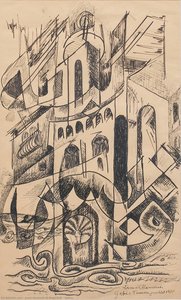
Mis à jour en novembre 2026 · classé selon notre score de popularité (recherches, visites et commandes pour chaque œuvre) · 2 œuvres de Jamil Hamoudي dans notre catalogue
En bref
Aux yeux de la galerie, le tableau le plus célèbre de Jamil Hamoudي est Qabes (1987), dont l'original est exposé au La Collection Ibrahimi, à Amman. Parmi les 2 œuvres de Jamil Hamoudي présentes dans notre catalogue, la galerie présente ci-dessous les 2 plus célèbres, chacune étant une œuvre originale avec son année, son musée et ce qui la rend unique.
Le musée qui détient le plus grand nombre de peintures figurant sur cette page.
| Musées | Ville | Œuvres de Jamil Hamoudي | Peintures de cette liste |
|---|---|---|---|
 La Collection Ibrahimi |
Amman | 2 | Qabes, Peasant Woman |
Chaque œuvre originale datée de Jamil Hamoudي sur cette page a été réalisée en 1987 : les voici, en commençant par les plus célèbres.
Choisissez une année pour voir les œuvres originales.
Qabes (1987)
63 ans : Qabes date de 1987, et Jamil Hamoudي est né(e) en 1924.
Notre catalogue comprend 2 œuvres de Jamil Hamoudي.
Principalement dans La Collection Ibrahimi (Amman). Le tableau des musées ci-dessus les répertorie tous.
Qabes et Peasant Woman : le La Collection Ibrahimi, Amman détient 2 des œuvres de cette page.
In the vibrant tapestry of twentieth-century Middle Eastern art, few threads shine as brightly or as intricately as those woven by Jamil Hamoudi Al-Baghdadi. Born in Baghdad in 1924, a period marked by the profound shifts of Iraq's burgeoning independence, Hamoudi’s life and work became an inseparable reflection of his nation's search for identity. His journey was one of constant synthesis, a delicate dance between the ancient echoes of Arabic calligraphy and the bold, experimental frontiers of European modernism. To look upon his work is to witness a dialogue between eras, where the rhythmic grace of tradition meets the structural rigor of the avant-garde.
Hamoudi’s artistic evolution was shaped by an extraordinary educational odyssey. While his roots remained firmly planted in the soil of Baghdad, his vision was expanded through rigorous training at the Baghdad College of Fine Arts and later within the prestigious halls of Paris, including the École Nationale Supérieure des Beaux-Arts, Académie Julian, and the École du Louvre. This dual immersion allowed him to master the technical precision of Western classical training while remaining deeply attuned to the spiritual and aesthetic nuances of his Mesopotamian heritage. He did not merely adopt foreign styles; he interrogated them, using the tools of European abstraction to re-examine the profound beauty of Islamic geometric patterns and the lyrical flow of the Arabic alphabet.
The most enduring chapter of Hamoudi’s career lies in his leadership within the Hurufiyya movement. Alongside visionaries such as Ahmed Sabahi and Omar Alkhalidi, Hamoudi sought to forge a new visual language that rejected the hollow mimicry of Western abstract formalism. Instead, he turned toward the huruf—the letters of the Arabic script—as a primary medium for expression. This was far more than a stylistic preference; it was a revolutionary act of cultural reclamation. By elevating calligraphy from a decorative craft to a central element of modern abstraction, Hamoudi and his contemporaries created an art form that resonated with the heartbeat of Iraqi identity.
In these works, the letter becomes a vessel for meaning, transcending its linguistic function to become pure form, rhythm, and emotion. The movement’s brilliance lay in its ability to utilize Islamic geometric motifs to convey narratives of resilience and national pride. Through his mastery, the script was liberated from the page, allowed to dance across canvases with a sense of weightlessness and structural complexity that mirrored the shifting socio-political landscape of a nation finding its voice on the global stage.
While much of his fame rests upon his painterly explorations of script, Hamoudi was equally a formidable sculptor. His ability to translate the fluid energy of calligraphy into three-dimensional form demonstrated a profound understanding of mass, space, and texture. One of his most poignant achievements is the sculpture ‘Peasant Woman,’ a work that captures the raw, dignified reality of Iraqi life during the independence era. Through deliberate simplicity and powerful anatomical presence, this piece serves as a testament to his ability to ground high art in the lived experiences of the people, reflecting the socio-political struggles and the enduring strength of the Iraqi spirit.
Beyond the studio, Hamoudi’s influence was institutional and transformative. Serving as the Director of the Ministry of Culture’s Fine Arts Department, he acted as a vital architect of Iraq's cultural policy. In this capacity, he was not just an artist but a champion for the entire creative community, fostering environments where artistic dialogue could flourish and ensuring that the burgeoning modern Iraqi art scene received the recognition it deserved. His legacy remains a cornerstone of Middle Eastern art history, reminding us that true innovation occurs when we honor our past while fearlessly embracing the future.
