A Life Painted in Light: The World of J.M.W. Turner
Joseph Mallord William Turner, known to the world as J.M.W. Turner, was more than just a painter; he was a visionary who redefined landscape art and paved the way for modern abstraction. Born in Maiden Lane, Covent Garden, London, in 1775, his beginnings were humble – the son of a barber and wig maker. Yet, even as a child, a remarkable talent blossomed within him. By age fourteen, he was enrolled at the Royal Academy, exhibiting his first work just a year later. This early promise wasn’t merely technical skill; it hinted at an innate understanding of light, color, and atmosphere that would become the hallmarks of his extraordinary career. He supplemented his artistic education with practical experience as an architectural draftsman, honing his perspective and compositional abilities – skills that would prove invaluable in rendering both detailed topographical views and vast, emotive landscapes. Turner’s early life was marked by a dedication to his craft, fueled by a natural aptitude and a relentless pursuit of artistic excellence.The Romantic Tempest: Style and Influences
Turner emerged during the height of the Romantic era, but he wasn’t simply a follower of its conventions. He absorbed influences from various sources – the Dutch masters like Claude Lorrain and Aelbert Cuyp for their luminous landscapes, and artists such as Richard Wilson for his poetic approach to nature. However, Turner didn’t merely imitate; he synthesized these influences into something entirely new. His work is characterized by an expressive use of color, often employing bold contrasts and vibrant hues to convey emotion and atmosphere. He was fascinated by the power and drama of nature – turbulent seascapes, fiery sunsets, and swirling storms became recurring motifs in his paintings. He wasn’t interested in simply depicting what he saw; he sought to capture the *feeling* of a place, the sublime awe inspired by the natural world. This pursuit led him to experiment with increasingly loose brushwork, dissolving forms into washes of color and light – techniques that would anticipate the Impressionist movement decades later. From 1840, his work gained significant recognition thanks to the championing of John Ruskin, who elevated landscape painting to a new level of critical acclaim.A Prolific Legacy: The Scope of Turner’s Output
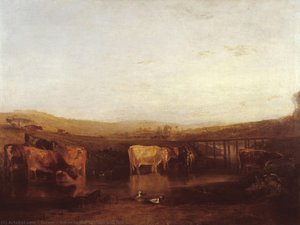
The sheer volume of Turner’s artistic output is astonishing. He created over 550 oil paintings, nearly 2,000 watercolors, and an astounding 30,000 works on paper. This prolificacy wasn’t simply a matter of quantity; it reflected his tireless exploration of different subjects, techniques, and styles. His paintings range from detailed topographical views of British landscapes to dramatic historical scenes and evocative maritime paintings. He was equally adept at capturing the tranquility of a pastoral scene and the terrifying power of a raging storm. Works like “Fort Vimieux” exemplify his mastery of depicting atmospheric effects – the swirling clouds, the crashing waves, and the intense light all contribute to a sense of drama and sublime beauty. Similarly, "Scene in the Campagna" showcases his ability to capture the warmth and serenity of the Italian countryside with delicate brushwork and luminous colors. Beyond painting, Turner was also a skilled printmaker, further disseminating his artistic vision through engravings and lithographs.Turner's Artistic Vision: Light and Atmosphere
Turner’s genius lay in his unparalleled understanding of light and atmosphere—concepts that would become central to the Impressionist movement. He meticulously studied how sunlight interacted with surfaces, capturing fleeting moments of illumination and shadow with astonishing accuracy. His canvases pulsated with color, reflecting the shifting moods of the natural world. Unlike earlier painters who sought to represent landscapes realistically, Turner prioritized conveying emotion and sensation above all else. He achieved this through a revolutionary technique—loose brushstrokes blended together to create luminous washes of color that seemed to dissolve into the air. This approach challenged conventional artistic standards and established Turner as a pioneer of modern art.Recognition and Influence: A Lasting Impact
Turner’s work garnered considerable acclaim during his lifetime, particularly from John Ruskin, who recognized his visionary spirit and championed his artistic achievements. Despite facing criticism for his unconventional style and perceived lack of polish, Turner remained steadfast in his pursuit of artistic excellence. His legacy extends far beyond the canvases he created; he profoundly influenced subsequent generations of artists—inspiring them to embrace experimentation and explore new expressive possibilities. Today, J.M.W. Turner is regarded as one of Britain’s greatest landscape painters—a true titan of Romantic art whose enduring vision continues to captivate audiences worldwide. His paintings are celebrated for their beauty, boldness, and emotional depth—testaments to his extraordinary talent and unwavering dedication to the transformative power of art.Questions et réponses
Comment la carrière de J.M.W. Turner est-elle divisée en périodes ?
La Chronologie de J.M.W. Turner est une frise chronologique interactive qui présente les œuvres de l'artiste par ordre chronologique, regroupées en chapitres correspondant aux différentes périodes de sa carrière.
Où puis-je trouver des statistiques sur les œuvres de J.M.W. Turner ?
Une page Statistiques est disponible pour J.M.W. Turner, présentant des statistiques sur les œuvres de l'artiste sur ce site web.
Dans quelle ville et quel pays J.M.W. Turner est-il/elle né(e) ?
J.M.W. Turner est né à Londres, en Royaume-Uni.