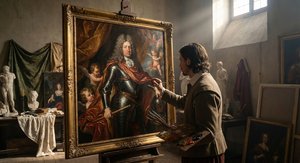
Giovanni Battista Caccioli: A Baroque Painter Rooted in Bolognese Tradition
Giovanni Battista Caccioli (1623 – 1675) stands as a testament to the flourishing artistic landscape of Bologna during the Baroque period, an Italian painter whose legacy resides primarily within collaborative quadratura projects and notable commissions across Parma and Mantua. Though overshadowed by more celebrated contemporaries, Caccioli’s contribution to Venetian art and decorative painting deserves recognition for its stylistic sophistication and adherence to established conventions.
Born in Budrio, near Bologna, Caccioli's formative years were spent under the tutelage of Domenico Maria Canuti, a prominent Bolognese artist known for his frescoes adorning churches throughout the city. This early training instilled in him a foundational understanding of disegno – Italian artistic technique emphasizing careful observation and anatomical accuracy – which would subsequently inform his own oeuvre. Crucially, Caccioli’s artistic sensibilities were profoundly shaped by Carlo Cignani, whose influence extended beyond mere stylistic imitation; Cignani championed a dramatic visual language characterized by dynamic compositions and expressive coloration, principles that undeniably permeated Caccioli's work.
Caccioli’s career unfolded in several key locations: Bologna remained his base of operations, where he honed his skills alongside fellow artists like Canuti and Cignani, actively participating in the ambitious quadratura schemes undertaken by Giovanni Giacomo Monti and Baldassare Bianchi – monumental decorative paintings that concealed architectural elements with illusionistic imagery. These collaborative endeavors demanded meticulous planning and execution, showcasing Caccioli’s mastery of perspective and spatial representation. His artistic output extended beyond quadratura; he undertook commissions for churches in Parma and Mantua, notably the Chapel of Palazzo del Podestà in Rome, where his frescoes exemplify the grandeur and spiritual fervor emblematic of Venetian Baroque art. The Chapel of Palazzo del Podestà is a remarkable achievement, demonstrating Caccioli’s ability to create immersive environments that captivated audiences with their illusionistic splendor.
Despite the fragmentary nature of surviving documentation—many of Caccioli’s paintings have vanished or deteriorated—scholarly research suggests a prolific artistic output spanning across various genres. His figures are rendered with remarkable detail and sensitivity, reflecting the humanist ideals prevalent during his time. Furthermore, Caccioli's son, Giuseppe Antonio Caccioli, continued the family tradition as a painter, ensuring that Caccioli’s artistic legacy endured beyond his lifetime. Giovanni Battista Caccioli remains an artist whose contribution to Baroque art deserves renewed appreciation for its stylistic integrity and its embodiment of Bolognese artistic heritage.
## Early Training and Influences
Caccioli's artistic education began in Budrio under Domenico Maria Canuti, a respected Bolognese painter who had established himself as a leading figure in the city’s artistic scene. Canuti’s workshop fostered an environment conducive to mastering disegno – the meticulous observation of nature and anatomical accuracy—a cornerstone of Baroque painting technique. This foundational training proved invaluable as Caccioli subsequently studied under Carlo Cignani, whose influence extended far beyond stylistic emulation. Cignani championed a theatrical visual language characterized by dynamic compositions and vibrant coloration, principles that profoundly shaped Caccioli’s artistic vision and informed his subsequent works. The impact of Cignani's teachings is evident in the dramatic gestures and expressive faces found throughout Caccioli’s oeuvre.
## Collaborative Quadratura Projects
Giovanni Battista Caccioli achieved considerable renown for his involvement in ambitious quadratura projects—elaborate decorative paintings that concealed architectural elements with illusionistic imagery—primarily undertaken by Giovanni Giacomo Monti and Baldassare Bianchi. These undertakings demanded exceptional skill in perspective, spatial representation, and meticulous planning, showcasing Caccioli’s mastery of the Baroque artistic idiom. The Chapel of Palazzo del Podestà in Rome stands as a testament to his dedication and ingenuity, demonstrating his ability to transform a simple space into an unforgettable experience for viewers.
## Commissions and Artistic Output
Caccioli received numerous commissions from ecclesiastical patrons across Parma and Mantua, securing his position as one of the most sought-after artists of his era. His frescoes in these churches—particularly those adorning Palazzo Canossa—display a masterful command of color and form, reflecting the stylistic conventions prevalent in Venetian art during Caccioli’s time. These commissions underscore Caccioli's versatility and his ability to adapt his artistic style to diverse contexts.
## Legacy and Historical Significance
Giovanni Battista Caccioli’s contribution to Baroque painting—particularly his role in collaborative quadratura projects and his expressive depictions of religious subjects—solidifies his place as a significant figure within Bolognese art history. Although overshadowed by more celebrated contemporaries, Caccioli's stylistic sophistication and adherence to established artistic traditions merit recognition for their enduring beauty and their testament to the humanist ideals that underpinned Baroque culture. His son Giuseppe Antonio Caccioli continued the family tradition as a painter, ensuring that Giovanni Battista Caccioli’s legacy persisted throughout subsequent generations.