Portrait de Everett Shinn

Peintures de Everett Shinn : les 100 plus célèbres, selon le regard d'une galerie

Mis à jour en novembre 2026 · classé selon notre score de popularité (recherches, visites et commandes pour chaque œuvre) · 139 œuvres de Everett Shinn dans notre catalogue

En bref

Aux yeux de la galerie, le tableau le plus célèbre de Everett Shinn est Premier rang à l'opéra (1942), dont l'original est exposé au Boca Raton Museum of Art, à Boca Raton. Baigneuses nues et L'East River de nuit (1906) complètent ce trio que tout le monde reconnaît. Parmi les 139 œuvres de Everett Shinn présentes dans notre catalogue, la galerie présente ci-dessous les 100 plus célèbres, chacune étant une œuvre originale avec son année, son musée et ce qui la rend unique.

1876 – 1953, Woodstown Realism Plus d'œuvres : Boca Raton Museum of Art

Les 10 meilleures peintures de Everett Shinn de la galerie

1
Premier rang à l'opéra (1942) de Everett Shinn

Premier rang à l'opéra

1942 · Peinture · Boca Raton Museum of Art, Boca Raton

Dans cette œuvre de 1942, nous sommes plongés dans l'atmosphère intime et concentrée d'une maison d'opéra. La scène est rendue dans une palette monochrome, dépouillant l'image de la distraction de la couleur pour accentuer l'énergie brute de la représentation. Une figure centrale se tient devant un public assis, tenant un microphone comme si elle était saisie en plein milieu d'un chant ou d'un monologue parlé. Il se dégage ici un…

2
Baigneuses nues de Everett Shinn

Baigneuses nues

Pastel

Dans Baigneuses nues, Everett Shinn nous présente un instant de loisir, calme et sans artifice. La scène se concentre sur quatre figures principales, toutes des femmes nues, réunies dans un parc. Elles sont installées sur l'herbe, semblant savourer un moment de repos partagé en plein air. L'atmosphère est empreinte de quiétude et de détente, capturant un intervalle privé de camaraderie.

3
L'East River de nuit (1906) de Everett Shinn

L'East River de nuit

1906

La nuit s'installe lourdement sur l'East River, plongeant le monde dans une étude d'ombres et d'argent. Deux embarcations dérivent sur la surface sombre, leurs silhouettes se découpant contre les profondeurs troubles de l'eau. Un bateau repose vers la gauche, tandis que l'autre occupe le centre, instaurant un sentiment d'équilibre dans l'immobilité. Près des vaisseaux, trois silhouettes se meuvent dans la pénombre, s'occupant peut-être de leurs embarcations ou s'arrêtant simplement pour…

4
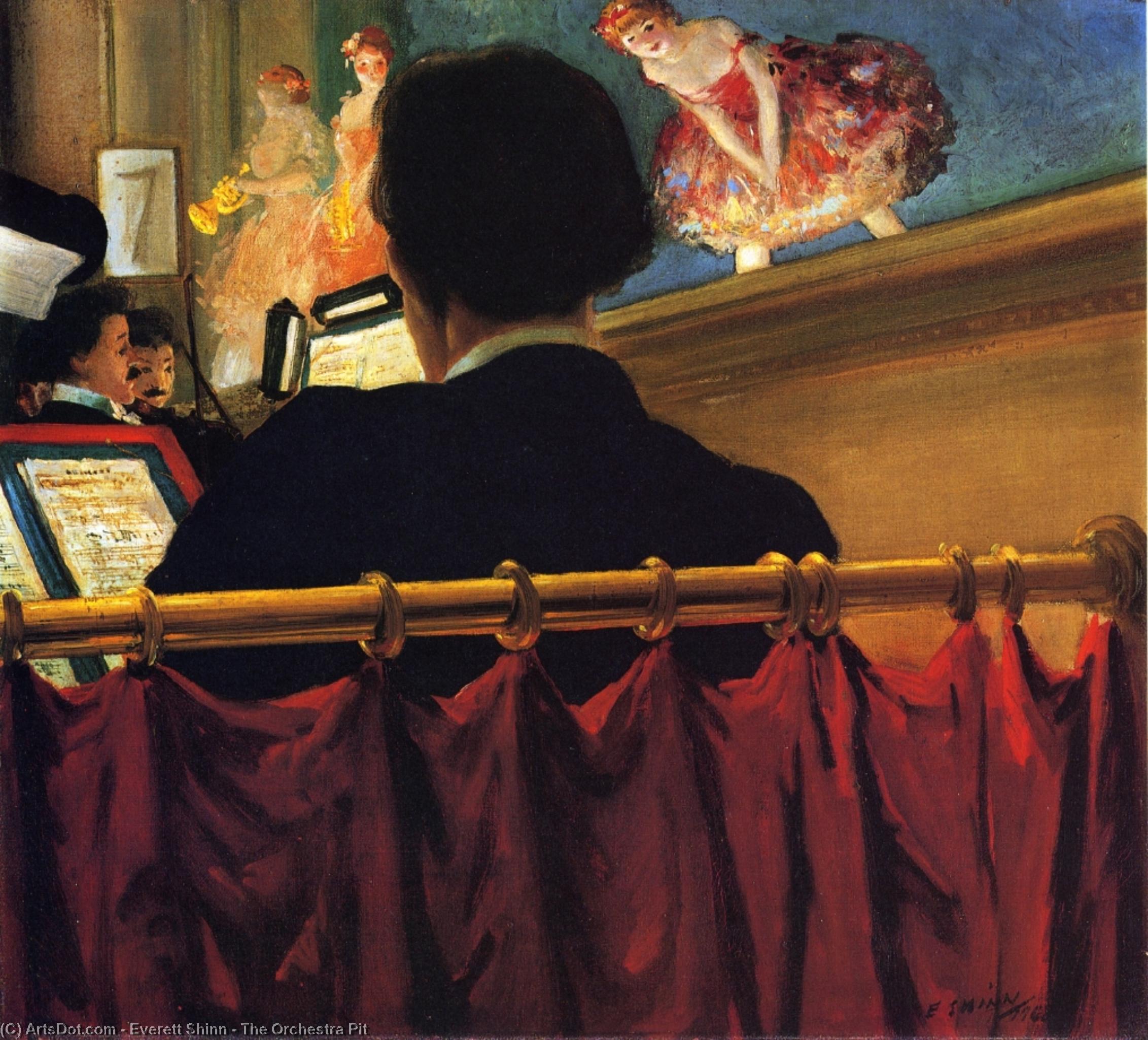
La fosse d'orchestre (1906) de Everett Shinn

La fosse d'orchestre

1906 · Huile sur toile

est une huile sur toile de l'artiste américain Everett Shinn. Peinte en 1906, cette œuvre capture un instant suspendu au cœur du Fifth Avenue Theater du vieux Proctor. La composition se concentre sur l'environnement singulier de la fosse d'orchestre, offrant une perspective plongeante sur cet espace situé sous le niveau de la scène.

5
Le Ballet blanc (1904) de Everett Shinn

Le Ballet blanc

1904 · Peinture à l'huile · Smithsonian American Art Museum, Washington, D.C.

Une loge de théâtre plongée dans l'obscurité offre le point de vue de cette peinture à l'huile de 1904, plaçant le spectateur au cœur d'un public silencieux. Depuis cette périphérie ombragée, le regard est dirigé vers une scène baignée de lumière où s'exécute un corps de ballet. La composition repose sur une tension marquée entre les tons sombres et feutrés des spectateurs au premier plan et la présence lumineuse et…

10
The Hippodrome, Londres (1902) de Everett Shinn

The Hippodrome, Londres

1902 · Huile sur toile · Art Institute of Chicago, Chicago

est une peinture à l'huile sur toile réalisée par Everett Shinn en 1902. Cette œuvre représente un moment charnière dans la carrière de l'artiste, agissant comme le souvenir précieux de son unique voyage en Europe. À travers cette pièce, Shinn parvient à capturer l'atmosphère singulière du divertissement international, marquant ainsi le début de son intérêt de longue date pour le spectacle de la scène.

Peintures de Everett Shinn, classées de 11 à 100

11Over the Audience de Everett ShinnOver the Audience 12Fifth Avenue de Everett ShinnFifth Avenue 13Girl On A Swing de Everett ShinnGirl On A Swing 14Paris Street No. 2 (1902) de Everett ShinnParis Street No. 21902 · New Britain Museum of American Art 15The Singer (1902) de Everett ShinnThe Singer1902 16The Fight (1899) de Everett ShinnThe Fight1899 17Saturday Night (1905) de Everett ShinnSaturday Night1905 18Rehearsal of the Ballet (1905) de Everett ShinnRehearsal of the Ballet1905 19Olympic Theater (1907) de Everett ShinnOlympic Theater1907 20The Argument de Everett ShinnThe Argument 21Trinity Church, New Year's Eve de Everett ShinnTrinity Church, New Year's Eve 22Figure de Everett ShinnFigure 23The Hatpin de Everett ShinnThe Hatpin 24Woman in a Bed de Everett ShinnWoman in a Bed 25Man Walking Through Snow Storm de Everett ShinnMan Walking Through Snow Storm 26Woman With Fox Collar de Everett ShinnWoman With Fox Collar 27Snow Storm de Everett ShinnSnow Storm 28Woman Getting Into Bed de Everett ShinnWoman Getting Into Bed 29The Mirror de Everett ShinnThe Mirror 30Study of Nude Woman de Everett ShinnStudy of Nude Woman 31Woman Combing Her Hair de Everett ShinnWoman Combing Her Hair 32Manon de Everett ShinnManon 33Julie Bonbon 1 de Everett ShinnJulie Bonbon 1 34Washington Square Park in Winter de Everett ShinnWashington Square Park in Winter 35Albert Pinkham Ryder de Everett ShinnAlbert Pinkham Ryder 36Matinée Crowd, Manhattan de Everett ShinnMatinée Crowd, Manhattan 37Broadway, late in the afternoon de Everett ShinnBroadway, late in the afternoon 38In the Boudoir de Everett ShinnIn the Boudoir 39The Princess de Everett ShinnThe Princess 40Street Scene, Paris de Everett ShinnStreet Scene, Paris 41Ballet Girls de Everett ShinnBallet Girls 42Julie Bonbon de Everett ShinnJulie Bonbon 43The Bright Shawl de Everett ShinnThe Bright Shawl 44Trapeze Artists Proctors Theatre de Everett ShinnTrapeze Artists Proctors Theatre 45Girl at her toilet de Everett ShinnGirl at her toilet 46The Magician de Everett ShinnThe Magician 47Boudoir scene de Everett ShinnBoudoir scene 48Study of a man in a fur collared coat smoking a cigar de Everett ShinnStudy of a man in a fur collared coat smoking a cigar 49Winter on 21st Street, New York de Everett ShinnWinter on 21st Street, New York 50Fifth Avenue 1 de Everett ShinnFifth Avenue 1 51Ballet Dancers de Everett ShinnBallet Dancers 52Fleishman's Bread Line de Everett ShinnFleishman's Bread Line 53The Mishap de Everett ShinnThe Mishap 54Nude (1910) de Everett ShinnNude1910 55Vaudeville Dancer (1912) de Everett ShinnVaudeville Dancer1912 56French Vaudeville (1917) de Everett ShinnFrench Vaudeville1917 57Girl with Japanese Lanterns (1912) de Everett ShinnGirl with Japanese Lanterns1912 58The Canfield Gambling House (1912) de Everett ShinnThe Canfield Gambling House1912 59Ladies on a Swing (1921) de Everett ShinnLadies on a Swing1921 60Café-concert espagnol de Everett ShinnCafé-concert espagnol 61Revue (1908) de Everett ShinnRevue1908 62Fire on 24th Street, New York City de Everett ShinnFire on 24th Street, New York City 63London Music Hall (1918) de Everett ShinnLondon Music Hall1918 · Metropolitan Museum of Art 64The Golden Lancet de Everett ShinnThe Golden LancetGeorgia Museum of Art 65Blossoms in a lacquered vase de Everett ShinnBlossoms in a lacquered vase 66Female Figure In Black Gown de Everett ShinnFemale Figure In Black Gown 67The Duel de Everett ShinnThe Duel 68Singer de Everett ShinnSinger 69Dancer With Fan de Everett ShinnDancer With Fan 70Winter, New York City de Everett ShinnWinter, New York City 71Street Carnival de Everett ShinnStreet Carnival 72Musicians de Everett ShinnMusicians 73The Cafe de Everett ShinnThe Cafe 74Young Woman and Her Maid de Everett ShinnYoung Woman and Her Maid 75Fifth Avenue Bus, 23rd Street and Broadway de Everett ShinnFifth Avenue Bus, 23rd Street and Broadway 76The Yellow Dancer de Everett ShinnThe Yellow DancerThiel Gallery 77Bonnie Glass de Everett ShinnBonnie Glass 78Bathing Wood Nymphs de Everett ShinnBathing Wood Nymphs 79Ballet de Everett ShinnBallet 80Nude With Green Fan de Everett ShinnNude With Green Fan 81City Scene de Everett ShinnCity Scene 82Women Seated In The Park de Everett ShinnWomen Seated In The Park 83View of Washington Square, New York de Everett ShinnView of Washington Square, New York 84French Maiden de Everett ShinnFrench Maiden 85Two men conversing from The Mystery of Edwin Drood, Chapter 9 de Everett ShinnTwo men conversing from The Mystery of Edwin Drood, Chapter 9 86The Dress Rehearsal de Everett ShinnThe Dress Rehearsal 87Canfields Gambling House de Everett ShinnCanfields Gambling House 88Washington Square de Everett ShinnWashington Square 89Clown With Big Pants de Everett ShinnClown With Big Pants 90Rooftop Cafe de Everett ShinnRooftop Cafe 91Flower Market Paris de Everett ShinnFlower Market Paris 92Music Hall Scene de Everett ShinnMusic Hall Scene 93Geen Park London de Everett ShinnGeen Park London 94Washington Square Park New York de Everett ShinnWashington Square Park New York 95Man seen from behind from The Mystery of Edwin Drood, Chapter Head de Everett ShinnMan seen from behind from The Mystery of Edwin Drood, Chapter Head 96Interior-Man in Red Vest de Everett ShinnInterior-Man in Red Vest 97Alley Cat de Everett ShinnAlley Cat 98He Is The Man For Me de Everett ShinnHe Is The Man For Me 99The Clown de Everett ShinnThe Clown 100Working at 21st Street and 4th Avenue de Everett ShinnWorking at 21st Street and 4th Avenue

Les peintures célèbres de Everett Shinn, période par période

Les sujets qui ont captivé Everett Shinn

Les quatre thèmes qui reviennent le plus souvent dans ces œuvres originales, chacun illustré par son plus bel exemple.

Les musées qui conservent les œuvres originales de Everett Shinn

Les 7 musées qui détiennent la plupart des peintures de cette page.

Musées Ville Œuvres de Everett Shinn Peintures de cette liste
Boca Raton Museum of Art, Boca RatonBoca Raton Museum of Art Boca Raton 1 Premier rang à l'opéra
Smithsonian American Art Museum, Washington, D.C.Smithsonian American Art Museum Washington, D.C. 1 Le Ballet blanc
Art Institute of Chicago, ChicagoArt Institute of Chicago Chicago 1 The Hippodrome, Londres
New Britain Museum of American Art, New BritainNew Britain Museum of American Art New Britain 1 Paris Street No. 2
Metropolitan Museum of Art, New YorkMetropolitan Museum of Art New York 1 London Music Hall
Georgia Museum of Art, AthènesGeorgia Museum of Art Athènes 1 The Golden Lancet
Thiel Gallery, StockholmThiel Gallery Stockholm 1 The Yellow Dancer

Everett Shinn, une œuvre emblématique par décennie

Œuvres par décennie

Choisissez une décennie pour découvrir l'œuvre originale qui la définit.

Les peintures de Everett Shinn : la galerie répond

Quelle est la peinture la plus célèbre de Everett Shinn ?Révéler la réponse

Premier rang à l'opéra (1942), Boca Raton Museum of Art, Boca Raton. Suivus de Baigneuses nues et L'East River de nuit (1906).

Quel âge avait Everett Shinn lors de la création de Premier rang à l'opéra ?Révéler la réponse

66 ans : Premier rang à l'opéra date de 1942, et Everett Shinn est né(e) en 1876.

Quelles sont les 10 plus grands tableaux de Everett Shinn ?Révéler la réponse

Premier rang à l'opéra, Baigneuses nues, L'East River de nuit, La fosse d'orchestre, Le Ballet blanc, Theatre Box, Mrs A Stewart Walker in a Fur, Girl on Stage, The Revue (c. 1915) et The Hippodrome, Londres. Le classement ci-dessus indique l'année et le musée de chacun.

Combien d'œuvres Everett Shinn a-t-il créées ?Révéler la réponse

Notre catalogue comprend 139 œuvres de Everett Shinn, datées de 1899 à 1942.

Où sont exposées les œuvres originales les plus célèbres de Everett Shinn ?Révéler la réponse

Principalement dans Boca Raton Museum of Art (Boca Raton), Smithsonian American Art Museum (Washington, D.C.) et Art Institute of Chicago (Chicago). Le tableau des musées ci-dessus les répertorie tous.

Quand Everett Shinn a-t-il créé ses peintures les plus célèbres ?Révéler la réponse

En 1900s : 12 des 100 œuvres de cette page ont été créées à cette époque, dont L'East River de nuit.

Quelles sont les premières et les dernières œuvres célèbres de Everett Shinn ?Révéler la réponse

Sur cette page, la plus ancienne date de The Fight (1899) et la plus récente de Premier rang à l'opéra (1942).

Quels sont les sujets que Everett Shinn a le plus explorés ?Révéler la réponse

New york (10), Music (8) et Men (8), à travers les 100 œuvres de cette page.

Avec quel médium Everett Shinn a-t-il le plus travaillé ?Révéler la réponse

Huile sur toile, pour 3 des 100 œuvres de cette page.

À quel mouvement Everett Shinn est-il associé ?Révéler la réponse

Realism, à en juger par les originaux de cette page.

Everett Shinn : l'artiste

A Chronicler of Urban Life: The World of Everett Shinn

Everett Shinn, born in Woodstown, New Jersey, in 1876, wasn’t simply a painter; he was a visual poet of the burgeoning metropolis. He captured the raw energy, the vibrant spectacle, and often, the underlying grit of early 20th-century America with an immediacy that set him apart. From his beginnings as a newspaper illustrator to his prominence within the Ashcan School, Shinn’s artistic journey reflects a commitment to portraying life as it was lived – unvarnished, compellingly real. Art historian Sam Hunter affectionately dubbed him “the dandy of the realists,” a moniker reflecting both his refined aesthetic and his embrace of the city’s pleasures. His early training at the Spring Garden Institute and later, the Pennsylvania Academy of the Fine Arts in Philadelphia, provided a solid foundation, but it was his work as an artist-reporter for Philadelphia newspapers – *The Press*, *The Inquirer*, and *The Ledger* – that truly honed his observational skills. This experience instilled in him a fascination with urban life and a knack for capturing fleeting moments before they vanished.

From Philadelphia Streets to New York Stages

The move to New York City in 1897 marked a turning point. Shinn quickly found work as an illustrator, contributing to publications like *Harper’s Weekly*, but it was his burgeoning friendships with fellow artists – George Luks, John Sloan, William J. Glackens, and Robert Henri – that truly shaped his artistic direction. These connections led him to the heart of the Ashcan School, a group dedicated to depicting the everyday realities of urban existence, often focusing on scenes overlooked by more traditional art circles. While many of his peers embraced oil paints, Shinn distinguished himself through his masterful use of pastels, a medium that allowed for a unique blend of spontaneity and delicate detail. He found particular inspiration in the city’s theaters, captivated by their dazzling displays of light, color, and performance. Works like “Olympic Theater” and “Revue” are not merely depictions of entertainment; they are vibrant studies of human interaction, capturing the energy and excitement of a night out in the city. The theatrical world offered Shinn a stage for exploring themes of illusion, spectacle, and the complex relationship between performer and audience. He wasn’t merely recording what he saw; he was interpreting it through a lens of dramatic flair and psychological insight.

The Ashcan School and Beyond

Shinn's association with the Ashcan School was crucial to his artistic development, challenging academic conventions and rejecting idealized representations in favor of honest portrayals of urban life – its poverty, its vibrancy, its struggles, and its joys. Their work often focused on working-class neighborhoods, saloons, and dance halls, subjects previously considered unworthy of serious artistic attention. Shinn’s participation in the landmark exhibition “The Eight” in 1908 solidified his position within this movement, though he always maintained a slightly more refined aesthetic than some of his colleagues. He wasn’t solely focused on social commentary; he was equally interested in capturing the spectacle and allure of modern life. His versatility extended beyond painting, as demonstrated by his murals for private homes and public spaces, including those at the Stuyvesant Theatre and the Plaza Hotel. Even as his work evolved beyond the strict tenets of the Ashcan School, a commitment to realism and an acute observation of human behavior remained central to his artistic vision. He continued to explore themes of urban life, but with an increasing emphasis on its glamour and theatricality.

A Life Marked by Passion and Turmoil

Everett Shinn’s personal life was as dynamic and complex as the scenes he depicted in his art. He experienced multiple marriages – four in total – and a reputation for enjoying the pleasures of city life, contributing to his “dandy” persona. These personal challenges often intersected with his artistic pursuits, influencing his subject matter and adding layers of emotional depth to his work. Despite periods of financial hardship, particularly during the Depression, Shinn continued to paint and exhibit, receiving recognition from institutions like the National Academy of Design and the American Academy of Arts and Letters later in his career. He passed away in 1953, leaving behind a legacy that continues to resonate with audiences today. His life was a testament to the power of artistic vision and the enduring appeal of capturing life as it truly is, even amidst personal struggles and societal changes.

Enduring Legacy

Everett Shinn’s influence on American art remains significant.
  • Influence on American Realism: Shinn’s work significantly contributed to the development of American realism, paving the way for future generations of artists who sought to depict everyday life with honesty and authenticity.
  • Capturing a Moment in Time: His paintings and pastels offer invaluable insights into the social and cultural landscape of early 20th-century America, providing a visual record of a rapidly changing world.
  • Masterful Technique: Shinn’s innovative use of pastel as a fine art medium expanded the possibilities of this often-underappreciated technique.
  • Theatricality and Spectacle: His depictions of theater scenes are not merely representations of entertainment; they are explorations of human psychology, social dynamics, and the allure of illusion.
His art serves as a powerful reminder of a pivotal moment in American art history – a time when artists dared to look beyond conventional beauty and embrace the raw, unfiltered realities of modern life. He remains a vital figure for understanding the complexities of urban experience and the enduring power of artistic observation.