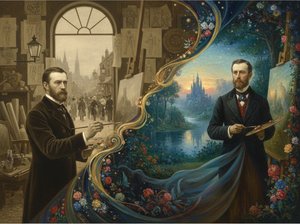
Eugen Napoleon Neureuther: A Bavarian Romantic Landscape Painter
Eugen Napoleon Neureuther (1806-1882) occupies a significant place in the annals of German art history, revered for his exquisitely detailed landscapes and evocative illustrations that perfectly encapsulate the tenets of Romanticism. Born in Munich, he inherited an artistic predisposition from his father, Ludwig Neureuther—a respected painter himself—a lineage imbued him with a deep appreciation for visual storytelling and meticulous craftsmanship. His formative years were spent honing his skills at the Munich Academy under Wilhelm von Kobell, absorbing foundational principles of academic painting while simultaneously cultivating a distinctive artistic vision.
Kobell’s influence instilled in Neureuther a reverence for classical aesthetics – a harmonious balance between form and color – yet he persistently pursued an expressive style that transcended mere imitation. This duality is evident in his early canvases, which demonstrate Kobell's meticulous technique but harbor an underlying yearning for emotional depth. Recognizing this potential, Cornelius secured him prestigious commissions adorning monumental frescoes within Munich’s Glyptothek and Königsplatz—projects demanding both technical virtuosity and imaginative conceptualization. These assignments solidified Neureuther’s reputation as a masterful decorator and cemented his connection to Bavaria's burgeoning artistic milieu.
A pivotal moment in Neureuther’s career arrived through his collaboration with Johann Wolfgang Goethe, specifically in the publication of “Romances and Ballads.” His meticulously crafted marginal drawings breathed vibrant life into Goethe’s poetic narratives—a partnership that garnered him widespread acclaim and propelled him to national prominence. This marked a decisive transition toward Romanticism – characterized by heightened emotional intensity, an ardent fascination with nature's sublime grandeur, and a profound exploration of psychological complexities. The illustrations for “Romances and Ballads” stand as undisputed masterpieces of Romantic art, showcasing remarkable precision in detail and conveying palpable emotional resonance—a testament to Neureuther’s ability to translate literary ideas into visual form.
Beyond Goethe’s influence, Neureuther undertook ambitious undertakings like "Marginal Drawings to Bavari Poets," delving into the artistic interpretation of literary themes – demonstrating his versatility as an artist and illustrator. His etching technique achieved its zenith in “Dornröschen,” a breathtaking plate that exemplifies his mastery of line engraving—a medium prized for its capacity to achieve remarkable tonal subtlety and textural richness. This work, housed within the Pinakothek Museum in Munich, embodies Neureuther’s signature style: serene beauty, refined linearity, and an unwavering commitment to capturing the essence of Bavarian scenery. Furthermore, he contributed six canvases to the Schack Gallery, showcasing his artistic prowess alongside fellow Romantic luminaries.
Neureuther's legacy extends far beyond mere aesthetic achievement; it represents a profound engagement with the Romantic spirit – a celebration of nature’s majesty and a poignant contemplation of human emotion. His enduring influence can be discerned in subsequent generations of German landscape painters who sought to emulate his meticulous observation and expressive rendering—confirming his position as one of the foremost figures of his time and securing his place within the broader tapestry of European art history. He passed away peacefully in Munich in 1882, leaving behind a body of work that continues to captivate audiences with its understated elegance and profound emotional depth.