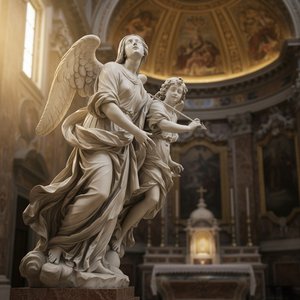
Christophe Veyrier : Un sculpteur façonné par Puget et Gênes
Christophe Veyrier (25 juin 1637 – 10 juin 1689) s'érige comme un témoignage vibrant de la ferveur artistique du Baroque français, profondément ancré dans l'héritage de Pierre Puget tout en étant marqué par ses années de formation passées à Gênes. Né à Trets, en Provence, il hérita d'un talent pour la sculpture de son oncle, Pierre Puget — artiste illustre reconnu pour ses figures de marbre expressives et sa maîtrise magistrale des drapés — s'inscrivant ainsi dans une lignée artistique prestigieuse. Ce lien avec l'œuvre de Puget allait sans aucun doute façonner les propres sensibilités stylistiques de Veyerier.- Jeunesse et formation : La formation formelle de Veyrier débuta à Aix-en-Provence, où il perfectionna ses compétences sous la tutelle de Jean Baptiste Tourte, un sculpteur éminent qui défendait les idéaux classiques aux côtés du dynamisme baroque. Cette double influence — une retenue classique tempérée par la fougue baroque — devint la marque de fabrique de l'approche artistique de Veyrier.
- Gênes et l'éveil artistique : Un moment charnière survint en 1663 lorsque Veyrier s'installa à Gênes, en Italie, une cité renommée pour son mécénat artistique et son milieu culturel vibrant. Durant son séjour, il s'immergea dans les traditions humanistes de la sculpture de la Renaissance, puisant son inspiration auprès d'artistes tels que Michel-Ange et Bernin — des figures qui avaient révolutionné la technique sculpturale et l'exploration conceptuelle. La rencontre avec ces maîtres élargit indubitablement les horizons artistiques de Veyrier.
Rome : Affiner la technique et embrasser le mécénat religieux
Entre 1668 et 1670, Veyrier entreprit un voyage vers Rome — l'épicentre de l'art baroque — où il poursuivit son développement artistique. Cette période fut marquée par un engagement profond envers les conventions stylistiques de la sculpture papale, particulièrement celles promues par le Bernin. Il étudia méticuleusement les œuvres monumentales du maître, absorbant des leçons de composition dramatique, de geste expressif et de rendu illusionniste magistral. L'influence du Bernin est palpable dans les sculptures ultérieures de Veyrier, où il emploie avec brio des techniques visant à transmettre l'émotion et la grandeur.- Commandes notables et accomplissements artistiques : La carrière de Veyrier acquit une renommée considérable grâce à des commandes prestigieuses, notamment la création de statues religieuses pour la chapelle du Corpus Domini de la cathédrale de Toulon. Cette entreprise ambitieuse exigeait une compétence technique et une vision artistique exceptionnelles — un véritable témoignage du dévouement et du talent de Veyrier. En outre, il produisit des sculptures illustrant des sujets mythologiques, dont la célèbre « Famille de Darius » conservée à Stowe House, démontrant ainsi sa polyvalence d'artiste. Ses œuvres sont aujourd'hui conservées par des institutions de renommée mondiale : le Musée d’art de Toulon, le Musée Granet à Aix-en-Provence, le Musée du Louvre à Paris, le Victoria & Albert Museum à Londres et le Metropolitan Museum of Art à New York.
Héritage et influence
Les sculptures de Christophe Veyrier perdurent comme des symboles éternels du Baroque français, incarnant à la fois l'élégance classique et la ferveur dramatique. Son attention méticuleuse aux détails — particulièrement dans la capture de l'émotion humaine — consolide sa position parmi les plus grands sculpteurs de son époque. À l'instar de Puget avant lui, Veyrier a su marier avec talent les idéaux humanistes et l'innovation artistique, laissant une empreinte indélébile dans l'histoire de la sculpture. Sa contribution à l'iconographie de la cathédrale de Toulon demeure particulièrement significative, reflétant un engagement envers l'art religieux qui continue d'inspirer l'admiration.- Pour aller plus loin : Pour approfondir vos connaissances sur l'œuvre artistique et les détails biographiques de Christophe Veyrier, consultez l'article Wikipédia lié ci-dessus : Wikipedia.
Questions et réponses
Puis-je trier les œuvres de Christophe Veyrier par couleur ?
La page Par couleur organise les œuvres de Christophe Veyrier par couleur.
Comment puis-je trouver des œuvres de Christophe Veyrier par palette de couleurs ?
Pour trouver des œuvres de Christophe Veyrier dans une palette spécifique, consultez la page Par palette de couleurs de l'artiste.
Puis-je parcourir les œuvres de Christophe Veyrier par technique ?
Les œuvres de Christophe Veyrier peuvent être consultées par technique sur la page Par technique de l'artiste.