Early Life and Education
Charles Herbert Woodbury, a renowned American marine painter, was born on July 14, 1864, in Lynn, Massachusetts. His early work was part of the oeuvre of the group later known as the Lynn Beach Painters. While an undergraduate at the Massachusetts Institute of Technology (MIT), Woodbury became a regular exhibitor at the Boston Art Club, earning the title of youngest member at just 19 years old. He relied on sales of his paintings and on giving art lessons to support himself and his parents. Upon graduating from MIT with honors in mechanical engineering in 1886, he began teaching art classes in Boston and devoting himself to painting, finding great success painting along the new england coast and in the towns and beaches of nova scotia. He studied at the Académie Julian in Paris from January to June 1891, followed by a stint in Holland, where he learned the techniques of modern dutch painters. Woodbury's work was influenced by his contemporaries, including John Singer Sargent, with whom he maintained a close friendship. He also had a pleasant acquaintance with J. Alden Weir and Childe Hassam.
Artistic Career and Influences
After graduating from MIT in 1886, Woodbury had great success painting along the new england coast and in the towns and beaches of nova scotia. He studied at the Académie Julian in Paris from January to June 1891, followed by a stint in Holland, where he learned the techniques of modern dutch painters. Woodbury's work was influenced by his contemporaries, including John Singer Sargent, with whom he maintained a close friendship. He also had a pleasant acquaintance with J. Alden Weir and Childe Hassam. Woodbury was president of the Boston Watercolor Society and became an associate of the National Academy of Design in 1906, with full membership in 1907. His maxim, “Paint in verbs, not nouns,” reflects his emphasis on movement and understanding. He believed that every student, no matter the degree of talent, could benefit from his drawing and painting courses. His schools attracted both professional and amateur artists. Woodbury engaged in over 100 solo exhibitions throughout his career, and was included in all of the major invitational and juried shows throughout the country. See: Howlett, D. Roger. “The Lynn Beach Painters.” Boston: Copley Square Press, 1998. Loria, Joan, and Warren A. Seamans. “Earth, Sea and Sky – Charles H. Woodbury – Artist and Teacher, 1864-1940,” exhibition catalogue. Cambridge, Massachusetts: The MIT Museum, 1998.
Notable Works and Style
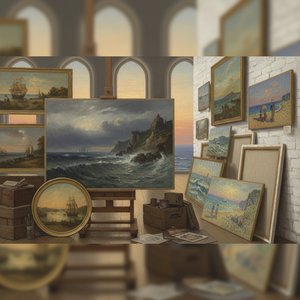
Woodbury's more than fifty years of professional life were marked by a strong and consistent vision. He became a master of compositions of the coast and sea, as seen in his on-the-spot sketches and etchings, which produce a sense of motion through quick, sure-handed strokes. His maxim, “Paint in verbs, not nouns,” reflects his emphasis on movement and understanding. Some notable works by Woodbury include:
- Mid Ocean, which earned him the second prize at the Tennessee Centennial Exposition in 1897.
- His watercolor studies of beaches and towns, backed by dramatic mountains and clouds, created during his later years spent in the Caribbean.
- Over 500 etching plates, showcasing his expressive skill in this medium.
Woodbury’s style was characterized by a meticulous attention to detail combined with an intuitive grasp of color and light—a distinctive approach that cemented his reputation as one of America's foremost marine artists. He taught for over thirty years at Ogunquit Summer School of Drawing and Painting, attracting many talented students who would go on to become influential figures in the art world.
Museums and Collections
Woodbury’s work can be found in various museums, including:
- The Art Institute of Chicago
- The Museum of Fine Arts, Boston
- New York's Metropolitan Museum of Art