Battista di Biagio Sanguigni: A Gothic Echo in Florentine Renaissance
Battista di Biagio Sanguigni, formerly known as the Master of 1419 (active 1393–1451), was an Italian painter hailing from Florence during the formative years of the fifteenth century. His artistic legacy resides primarily within a distinctive Gothic style interwoven with burgeoning influences from Masaccio and other pioneering artists of his era, marking him as a pivotal figure in bridging the gap between medieval tradition and the blossoming Renaissance aesthetic.Early Life and Artistic Formation
Born around 1393 in Vicchio, near Florence, Sanguigni’s origins remain somewhat obscure, though he joined the confraternity of San Niccolò al Carmine in 1415—a significant step for an artist seeking patronage and spiritual grounding. This affiliation profoundly shaped his worldview and artistic sensibilities, fostering a deep appreciation for religious iconography and meticulous craftsmanship. Evidence suggests that Sanguigni’s formative years were spent absorbing the stylistic precepts of Gherardo Starnina and Alvaro Pirez, artists who had skillfully blended Gothic grandeur with nascent perspectival innovations—a testament to the dynamic intellectual climate prevailing in Florence at the time. These masters instilled in him a profound understanding of how to convey emotion and grandeur through intricate ornamentation and masterful drapery folds.Notable Paintings: A Synthesis of Styles
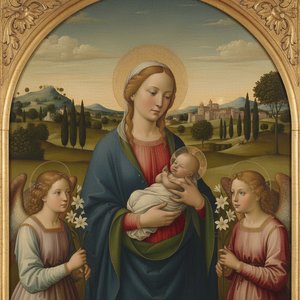
Sanguigni gained renown through his masterful execution of several monumental altarpieces that exemplify this stylistic fusion. The centerpiece is undoubtedly the Madonna and Child Enthroned (1419), commissioned by Antonio di Domenico Giugni for Santa Maria in Latera, now housed at the Cleveland Museum of Art—a painting lauded for its refined Gothic ornamentation and masterful depiction of drapery folds. Critics have praised its ethereal beauty and the subtle use of perspective, hinting at Masaccio’s groundbreaking innovations. Simultaneously, he undertook the creation of two outer panels depicting Saint James the Greater and Less alongside John the Baptist and Anthony Abbot (circa 1415), currently residing in a Swiss collection. These canvases demonstrate Sanguigni’s unwavering commitment to Gothic conventions while simultaneously incorporating Masaccio's pioneering approach to linear perspective—a decisive step toward establishing realism within Florentine painting. The meticulous detail with which he rendered the saints’ robes and gestures underscores his dedication to conveying spiritual significance through visual artistry.Influences and Collaborations
Sanguigni’s artistic development was significantly shaped by collaborations with Lorenzo Monaco, who served as a mentor and instilled in him a humanist perspective alongside traditional Gothic techniques. He also partnered closely with Fra Angelico, establishing a lasting bond that resulted in the creation of several iconic artworks together—most notably the Saint Julian Triptych (1425–1427), destined for San Gimignano. This collaboration exemplifies how artists can push boundaries while honoring established artistic traditions. Furthermore, Sanguigni’s work reflects the influence of Masolino da Panicale, whose expressive dynamism and compositional ingenuity contributed to the stylistic richness of Florentine painting during his time.Recognition and Legacy
A single side of a triptych was sold recently for over £400,000—a remarkable indicator of Battista di Biagio Sanguigni’s enduring artistic merit and the esteem in which his work is held by collectors worldwide. His contribution to Florentine art history cemented him as an important artist who bridged the Gothic and Renaissance eras. He remains a testament to the transformative power of artistic innovation rooted in deep respect for medieval heritage, resulting in artworks that continue to inspire awe and contemplation centuries later.Questions et réponses
Comment la carrière de Battista di Biagio Sanguigni est-elle divisée en périodes ?
La carrière de Battista di Biagio Sanguigni se dévoile période par période sur la page Parcours de carrière de l'artiste : une frise chronologique horizontale des œuvres, regroupées en chapitres correspondant aux différentes étapes de sa carrière.
Existe-t-il un aperçu de tous les sujets peints par Battista di Biagio Sanguigni ?
Retrouvez les œuvres de Battista di Biagio Sanguigni classées par sujet sur la page Index thématique de l'artiste.
Où puis-je voir les œuvres de Battista di Biagio Sanguigni par ordre chronologique ?
La page Chronologie des œuvres de l'artiste présente les œuvres de Battista di Biagio Sanguigni classées par date, année par année.