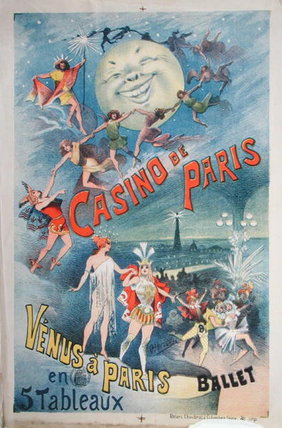
Alfred Choubrac: Pioneer of Parisian Poster Art
Alfred Choubrac (1853-1902) stands as a significant figure in the artistic landscape of the Belle Époque, primarily recognized for his contribution to the vibrant world of Parisian poster art. Born in Montmartre, Paris, he emerged from a family steeped in artistic tradition, with his elder brother Léon Choubrac sharing a formative training experience under the tutelage of renowned painters Charles Doërr and Isidore Pils at the École des Beaux-Arts. This early education instilled in him a foundational understanding of classical painting principles that would inform his subsequent endeavors.
The Choubrac brothers swiftly established themselves as innovators within the burgeoning field of poster design, commencing their artistic journey in 1875. Embracing the stylistic advancements championed by Jules Chéret – whom they affectionately termed “the father of the modern poster” – they skillfully harnessed the transformative potential of chromolithography. This technique revolutionized printing processes, allowing for unprecedented color vibrancy and detail, a crucial element in capturing the spirit of the era. Furthermore, the lifting of restrictions on bill-posting in 1881 coincided with a surge in media control within France, fostering an environment ripe for artistic experimentation and broadening the reach of advertising messages.
The pivotal year of 1884 witnessed the Paris City Council initiating a groundbreaking initiative: renting out municipal spaces for advertising purposes – a decisive step towards accelerating the proliferation of posters throughout the city. These posters, characterized by bold colors and dynamic imagery, became emblematic of the Belle Époque’s exuberant atmosphere, reflecting its optimism and cultural dynamism. The Choubrac brothers collaborated extensively with printing presses like F. Appel and G. Massias, establishing ateliers that served as incubators for innovative graphic design concepts. Notably, their association with imprimerie Bourgerie & Cie further solidified their position at the forefront of Parisian artistic circles.
Choubrac’s artistic focus centered on theatrical productions in Paris during the Belle Époque, securing commissions for venues such as Théâtre des Variétés, Théâtre du Châtelet, Folies Bergère, Opéra Comique and Moulin Rouge. Alongside Chéret and Toulouse-Lautrec, he represented one of the most influential poster artists of his time, skillfully blending artistic vision with technical prowess. His magnum opus remains “Au Joyeux Moulin Rouge,” a breathtaking chromolithograph inspired by the legendary Parisian nightclub – an enduring testament to his ability to encapsulate the allure and excitement of Belle Époque nightlife. This masterpiece exemplifies Choubrac’s mastery of color and composition, capturing the vibrant energy of the Moulin Rouge with remarkable precision.
- Notable Achievements: Choubrac’s prolific output encompassed posters for Wagner's ‘Lohengrin,’ showcasing meticulous detail and capturing the grandeur of opera productions.
- Technique: He championed chromolithography, elevating poster design with vibrant colors and striking imagery – a technique that profoundly impacted visual culture.
Alfred Choubrac’s legacy extends beyond his individual artworks; he fundamentally reshaped the aesthetic conventions of advertising and theatrical promotion. His pioneering use of chromolithography established new standards for color printing, while his artistic sensibility contributed to defining the visual language of the Belle Époque—a period celebrated for its artistic innovation and cultural fervor. He remains an enduring symbol of Parisian creativity and a cornerstone in the history of graphic design.