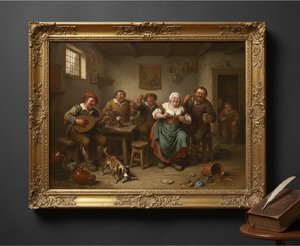
Le Maître de la Grâce Méticuleuse : La Vie d'Adriaen van der Werff
Dans la grande tapisserie de l'Âge d'Or néerlandais, peu de fils brillent avec autant d'éclat poli que l'œuvre d'Adriaen van der Werff. Né à La Haye en 1659, Van der Werff est issu d'une lignée de talents artistiques ; fils de peintre, il a bénéficié d'une introduction précoce et intime aux nuances de la lumière et de la forme. Ses années de formation furent façonnées par le tutorat rigoureux d'Eglon van der Neer, un maître du costume et des draperies dont l'influence est encore visible dans les textures de soie exquises qui définissent les compositions ultérieures de Van der Werff. Ce premier apprentissage a instillé en lui un dévouement à la précision, transformant son pinceau en un instrument capable de capturer les transitions les plus délicates de la peau et du tissu.
Au fil de sa carrière, Van der Werff a dépassé la simple maîtrise technique pour atteindre une profondeur psychologique qui a captivé l'aristocratie européenne. Aux côtés de son frère et élève, Pieter van der Werff, il a établi un studio formidable à Rotterdam. Son ascension au sein de la communauté artistique fut marquée par sa direction de la Guilde de Saint-Luc, un poste d'immense prestige qui lui permit de capter l'attention des protecteurs les plus influents de l'époque. Son travail est devenu un pont entre le réalisme brut des maîtres néerlandais précédents et les sensibilités raffinées et élégantes du mouvement rococo naissant.
Une Symphonie de Lumière et de Mythe
La véritable magie de l'œuvre de Van der Werff réside dans sa capacité à insuffler la vie aux récits mythologiques et bibliques de l'Antiquité. Il ne se contentait pas d'illustrer des histoires ; il les mettait en scène avec une intensité dramatique utilisant le clair-obscur pour évoquer une émotion profonde. Dans des œuvres telles que 'Lot et ses filles', on peut témoigner du jeu magistral entre l'ombre et la lumière, où chaque vacillement de la bougie sert à accentuer la tension et le poids symbolique de la scène. Ses toiles servent souvent de fenêtres sur un monde d'élégance classique, où la forme humaine est rendue avec une perfection de porcelaine qui semble à la fois éthérée et tangible.
Son répertoire technique était remarquablement diversifié, lui permettant de naviguer entre différents modes de portrait et de peinture narrative :
- Grandeur Mythologique : Ses représentations de dieux et de héros utilisaient souvent des compositions monumentales pour transmettre la puissance et la grâce.
- Portrait Intime : Dans des œuvres comme son 'Autoportrait', il a fait preuve d'une honnêteté sans faille, capturant la confiance et le caractère du sujet à travers un détail méticuleux.
- Genre et Groupements : Des pièces telles que 'Enfants jouant devant un groupe d'Hercule' illustrent sa capacité à mêler la tendresse domestique à la présence imposante de la sculpture classique, créant un récit complexe où l'innocence rencontre l'antiquité.
Héritage et Importance Historique
La portée d'Adriaen van der Werff s'est étendue bien au-delà des frontières des Pays-Bas. Sa réputation de « peintre fin » lui a valu le patronage des plus hauts échelons de la royauté européenne, notamment Johann Wilhelm, l'Électeur Palatin, et l'illustre Anna Maria Luisa de' Medici. La commande d'œuvres monumentales pour la cour florentine témoigne de son statut de figure internationale de l'ère baroque. Sa capacité à satisfaire les goûts sophistiqués de la famille Médicis a consolidé son héritage en tant qu'artiste capable d'allier la précision du Nord à l'élégance du Sud.
En fin de compte, la signification de Van der Werff réside dans son rôle de figure de transition. Il a pris les éléments fondamentaux du réalisme néerlandais — l'obsession pour la texture, la lumière et la vérité — et les a élevés vers un langage de cour raffiné qui allait influencer la trajectoire de l'art du XVIIIe siècle. Bien que l'ère des grands Maîtres néerlandais ait fini par céder la place à de nouveaux mouvements, le monde lumineux et poli créé par Van der Werff demeure un monument durable aux sommets de l'art baroque.
Questions et réponses
Puis-je explorer les œuvres de Adriaen Van Der Werff par mot-clé ?
Les œuvres de Adriaen Van Der Werff peuvent être explorées par mot-clé sur la page Par mots-clés de l'artiste. Chaque mot-clé regroupe les œuvres associées.
Combien d'œuvres de Adriaen Van Der Werff sont disponibles à la consultation ?
Vous pouvez parcourir 109 œuvres d'art œuvres de Adriaen Van Der Werff sur la page Toutes les œuvres.
Dans quelle ville et quel pays Adriaen Van Der Werff est-il/elle né(e) ?
Adriaen Van Der Werff est né à La Hague, en Pays-Bas.