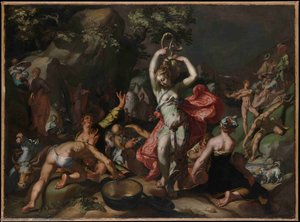
Abraham Bloemaert

1564 - 1651

L'essentiel

  • Also known as:
    • A Bloemart
    • A. Bloemaard
    • A. Bloemaart
    • A. Bloemaers
    • A. Bloemaert
  • Lifespan: 87 years
  • Gift suitability: mariage
  • Museums on this site:
    • Musée National de Varsovie
    • Mauritshuis
    • Musée du Louvre
    • Alte Pinakothek
    • Yale University Art Gallery
  • Art period: Renaissance
  • Creative periods: période de maturité
  • Vibe: dramatique
  • Emotional tone: dramatique

A Life Immersed in Art: The World of Abraham Bloemaert

Abraham Bloemaert, born in Gorinchem around 1564 and passing away in Utrecht in 1651, stands as a pivotal figure bridging the Mannerist and Baroque periods in Dutch painting. His long and prolific career unfolded against a backdrop of religious and political upheaval, yet he consistently produced works imbued with both dramatic intensity and subtle beauty. Bloemaert’s journey began under the tutelage of his father, Cornelis Bloemaert I, an architect who instilled in him a foundational understanding of form and composition. This early training was further refined through studies with Gerrit Splinter and Joos de Beer in Utrecht, laying the groundwork for his artistic explorations. A crucial period followed – three years spent in Paris from 1581 to 1583. There, he absorbed influences from Jehan Bassot and Maistre Herry, while also encountering the works of Hieronymus Francken, a fellow Dutch artist who broadened his stylistic horizons. This Parisian sojourn proved formative, exposing him to the refined elegance of the French School and setting the stage for his later innovations.

From Mannerism to Baroque: A Shifting Aesthetic

Initially, Bloemaert’s style aligned with the prevailing Haarlem Mannerism – characterized by elongated figures, elegant poses, and often complex allegorical narratives. Artists like Hieronymus Francken championed this aesthetic, emphasizing idealized beauty and refined drapery. However, he was not content to remain solely within this framework. As the 17th century dawned, Bloemaert began to embrace the emerging Baroque aesthetic, a shift marked by increased dynamism, emotional intensity, and a heightened sense of realism. This transition wasn’t abrupt; rather, it represented a gradual evolution, blending elements of both styles into a uniquely personal artistic language. He skillfully incorporated dramatic lighting effects – tenebrism—inspired by Caravaggio—and rich color palettes to convey powerful narratives and evoke profound emotions in his viewers. His paintings began to resonate with a new energy, reflecting the changing cultural landscape of the Dutch Republic.

A Master of Diverse Subjects and Techniques

Bloemaert’s artistic output was remarkably diverse. He excelled in history painting, bringing biblical stories and classical myths to life with compelling detail and emotional depth. Landscapes also held a special place in his repertoire, often serving as settings for religious or mythological scenes, but increasingly becoming subjects in their own right – picturesque vistas populated with figures engaged in everyday activities. Notable works such as “The Expulsion of Hagar and Ishmael,” “Venus and Adonis”, and "Warrior & Young Standard-Bearer" exemplify this range, showcasing his ability to handle complex compositions and convey nuanced emotions with equal skill. Beyond painting, Bloemaert was a highly skilled printmaker, proficient in both etching and engraving. These prints served to disseminate his artistic vision more widely, contributing significantly to his reputation and influence. His technical mastery extended to still lifes and animal paintings as well, demonstrating an exceptional versatility that set him apart from many of his contemporaries.

A Prolific Teacher and Lasting Legacy

Abraham Bloemaert was not only a gifted artist but also an influential teacher. He established a thriving workshop in Utrecht, attracting numerous students who would go on to become prominent artists themselves. Remarkably, his four sons – Hendrick, Frederick, Cornelis, and Adriaan – all followed in his footsteps, achieving considerable success as painters and engravers. His influence was particularly profound on the Utrecht Caravaggisti – a group of painters who embraced the dramatic realism and tenebrism pioneered by Caravaggio. Bloemaert’s teachings helped to shape their distinctive style, solidifying his position as a central figure in the development of Dutch Baroque painting. His legacy continues to resonate today, with his works admired for their technical brilliance, emotional power, and historical significance—a testament to a life dedicated to artistic exploration and innovation.

Quiz

Chaque question ne comporte qu'une seule bonne réponse.

Question 1:
Dans quelle ville est né Abraham Bloemaert ?
Question 2:
Abraham Bloemaert travaillait initialement dans le style de quel mouvement artistique avant de passer au baroque ?
Question 3:
Outre la peinture, quelle autre forme d’art pratiquait Abraham Bloemaert ?
Question 4:
Abraham Bloemaert était un professeur influent. Quel mouvement a-t-il particulièrement influencé grâce à ses étudiants ?
Question 5:
Dans quelle année est mort Abraham Bloemaert ?

Questions et réponses

Où puis-je voir les peintures de Abraham Bloemaert ?

Les peintures de Abraham Bloemaert sont exposées à Centraal Museum, Musée du Louvre et Mauritshuis.

Où et en quelle année Abraham Bloemaert est-il né ?

Abraham Bloemaert est né à Gorinchem en 1564.

L'œuvre de Abraham Bloemaert est-elle dans le domaine public ?

Oui. Abraham Bloemaert est décédé(e) en 1651, et ses œuvres sont dans le domaine public.

Puis-je étudier l'utilisation de la couleur par Abraham Bloemaert à travers l'ensemble de ses œuvres ?

Découvrez les couleurs les plus utilisées par Abraham Bloemaert, analysées à travers ses œuvres.

Combien de temps Abraham Bloemaert a-t-il vécu ?

Abraham Bloemaert a vécu environ 87 ans, de 1564 à 1651.

Quelles sont les peintures les plus célèbres de Abraham Bloemaert ?

Découvrez les peintures les plus célèbres de Abraham Bloemaert, classées par importance.

Quels sont les sujets de prédilection de Abraham Bloemaert ?

Les thèmes les plus fréquents dans les œuvres de Abraham Bloemaert listés ici sont homme, paysage et femme. Voir les sujets peints par Abraham Bloemaert.

Quel était le style de peinture de Abraham Bloemaert ?

Abraham Bloemaert peignait dans le style Retour Au Baroque, à l'instar des autres artistes célèbres du Retour Au Baroque.

Qui étaient les élèves de Abraham Bloemaert ?

Gerrit van Honthorst, Wybrand de Geest et Hendrik Schoock a étudié auprès de Abraham Bloemaert.