Ditch the Minimalism: Why Your Space Needs an Emotional Edge
 Expressionist Portraiture: A Procurement Guide to Bold Emotion and Powerful Brushwork for High-End Hotel Interiors
The Psychology of Expressionism: Leveraging Emotional Depth for Guest Engagement Emotional Design Emotional Design is both the title of a book by Donald Norman and the concept it represents. == Content == The main topic covered is how emotions have a...
For too long, the design world has been held hostage by the sterile grip of soft minimalism. We have seen a decade dominated by beige sanctuaries, muted tones, and a clinical pursuit of serenity that often borders on the forgettable. While there is a certain peace in emptiness, there is also a profound risk of creating a space that lacks a pulse. The modern urban professional, navigating a world of high-speed digital noise and constant connectivity, does not necessarily need another silent void; they need a visual anchor that resonates with the intensity of real life. This is where the rebellion begins. Moving away from the safe, predictable boundaries of neutral palettes allows for an infusion of character that turns a mere living space into a curated experience.
The shift toward an emotionally charged interior is not about creating clutter, but about embracing authenticity. When we reject the idea that a room must be a vacuum of sensation, we open the door to art that speaks. We move from decorating with objects to composing with emotions. By introducing elements that challenge the eye and stir the psyche, we create environments that reflect our own complexities. The goal is to move beyond the "safe" and toward the impactful, utilizing art that refuses to be ignored, much like the vibrant energy of a city street or the raw power of a cinematic climax.
The Expressionist Aesthetic: Raw Energy Meets High-Impact Design
 German Expressionism's 10 Defining Masterpieces | Art for Your Home
Introduction To gaze upon the canvases born from the heart of German Expressionism is to encounter a raw, visceral echo of a world on the brink. These weren’t paintings merely depicting reality; they were reality – or rather, the tumultuous inner lan...
To understand the power of this movement, one must look toward the visceral roots of Expressionism. This was never an art form about capturing a perfect likeness; it was about capturing a feeling. Emerging from the tumultuous landscapes of the early 20th century, artists like Kirchner and Munch sought to portray the inner landscape—the anxieties, the joys, and the sheer turbulence of the human condition. In a contemporary interior, this translates to a design language that prioritizes movement and texture over rigid geometry. It is an aesthetic that celebrates the imperfect and the unfiltered.
When you integrate Expressionist-inspired works into your home, you are introducing a sense of narrative depth. Unlike the static nature of traditional landscapes, these pieces possess a kinetic quality. The brushstrokes are not merely marks on a canvas; they are traces of an artist's physical struggle and emotional release. This energy flows through a room, breaking up the monotony of flat surfaces and straight lines. Whether it is the heavy, textured impasto of a neo-expressionist piece or the distorted, dreamlike perspectives found in more abstract works, the effect is immediate: your space gains a soul that feels alive, breathing, and perpetually in motion.
Color as Chaos: Using Saturated Palettes to Command Attention
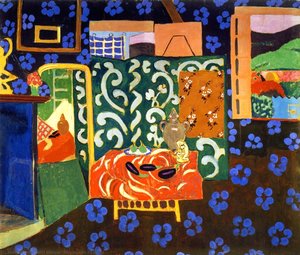 Interior with Eggplant
A Domestic Reverie: Unveiling Matisse’s “Interior with Eggplant” Henri Matisse's "Interior with Eggplant," painted in 1911, is far more than a depiction of a room; it’s an exploration of color, space, and the quiet poetry of everyday life. This fresc...
If minimalism is a whisper, Expressionism is a shout. The use of color in this movement serves as its most potent weapon. We are talking about hues that do not merely sit on the canvas but actively interact with the viewer. Think of the way Henri Matisse utilized Fauvist techniques to transform a simple domestic scene into a vibrant explosion of red, blue, and yellow. In these works, color is liberated from reality; a sky does not have to be blue, and a face does not have to be flesh-toned. It only needs to be emotionally correct.
In the context of high-end interior design, leveraging this "controlled chaos" requires confidence. Using saturated, non-naturalistic colors allows you to create focal points that command the entire room. A single, large-scale painting featuring deep ultramarines or fiery crimsons can act as the heartbeat of a lounge or a dining area. This approach works best when paired with intentionality—using the art to dictate the accent colors of your furniture or textiles. By embracing a palette that is unapologetically bold, you transform your walls from mere boundaries into windows of intense visual stimulation, ensuring that every time you enter the room, you are met with a fresh surge of inspiration.
::