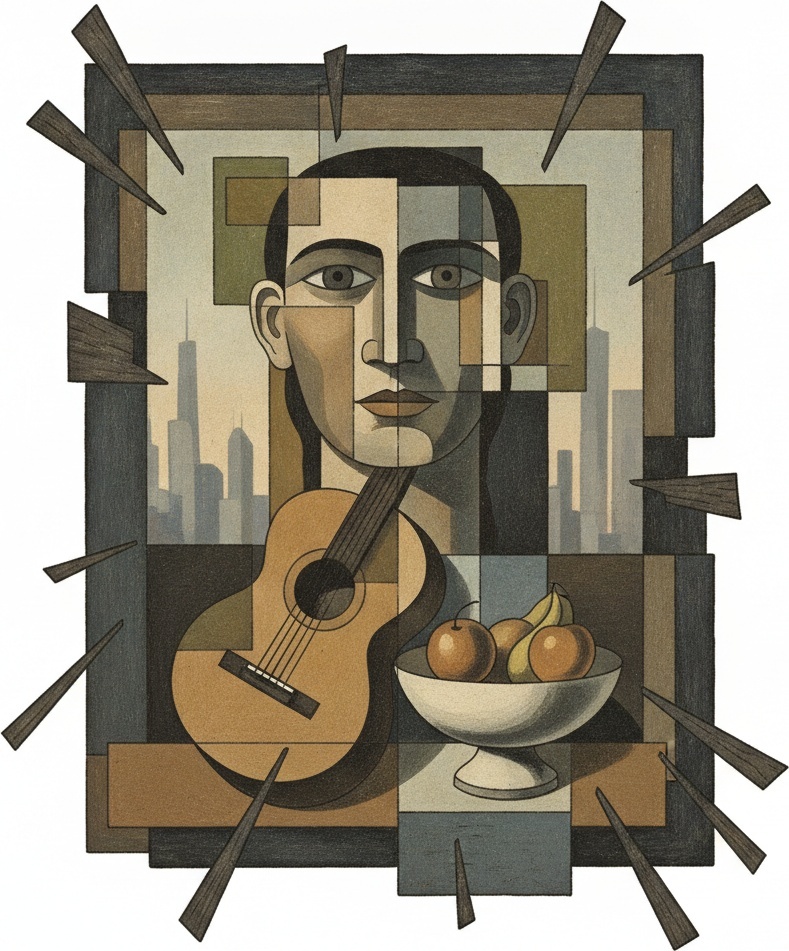
The Glitch in Reality: How Picasso and Braque Broke the Visual Code
 Cubism
Cubism is an early-20th-century avant-garde art movement which began in Paris. It revolutionized painting and the visual arts, and sparked artistic innovations in music, ballet, literature, and architecture. Cubist subjects are analyzed, broken up, a...
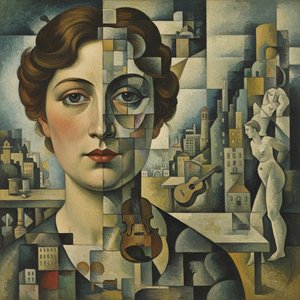
Imagine for a second that your entire reality just experienced a high-definition glitch. The smooth surfaces of your world suddenly fracture, edges overlap, and the single perspective you’ve relied on since birth simply vanishes. This wasn't a digital error or a bad trip; this was the seismic arrival of Cubism in early 20th-century Paris. Before this movement, art was essentially a mirror—a way to capture life as it appeared through a single, static lens. But then came Pablo Picasso and Georges Braque, two rebels who decided that mirroring the world was far too easy. They didn't want to show you what a subject looked like; they wanted to show you how it existed in space and time.
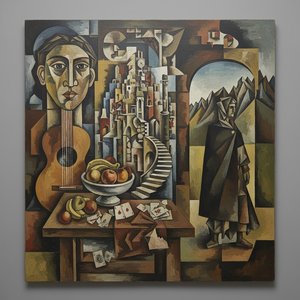
The atmosphere in Paris during this era was electric, charged with the tension of rapid industrialization and scientific breakthroughs that were fundamentally changing human perception. Picasso, with his legendary, restless spirit, and Braque, a master of structure and form, began an unlikely partnership that would dismantle centuries of artistic tradition. They looked at the world not as a collection of finished objects, but as a series of intersecting planes and shifting viewpoints. It was a visual revolution that felt less like a painting and more like a manifesto, challenging every viewer to stop looking with their eyes and start seeing with their minds.
Deconstructing the Lens: The Raw Power of Analytical Cubism
--- title: Analytical cubism | Tate url: https://www.tate.org.uk/art/art-terms/a/analytical-cubism hostname: tate.org.uk description: Tate glossary definition for analytical cubism: The early phase of cubism, generally considered to run from 1908–12,...
If you want to see the true "source code" of this revolution, you have to look at the phase known as Analytical Cubism. This wasn't about bright, flashy colors or easy recognition; it was a deep, intellectual dive into the very anatomy of sight. Between 1908 and 1912, the movement reached a fever pitch of complexity. Artists began dissecting subjects—a guitar, a glass, a human face—into their most basic geometric components. They stripped away the distractions of color, often working in a muted, monochromatic palette of ochres, grays, and deep browns, to ensure that nothing obscured the underlying structure.
In works like Juan Gris’s Glass and Ace of Clubs, we see the brilliance of this deconstruction. The painting doesn't just depict objects; it analyzes them. A glass isn't just a vessel; it is a collection of transparent shards and angular intersections. This technique allowed for "simultaneity"—the ability to represent multiple viewpoints of an object on a single, flat canvas at once. It was as if the artist had taken a photograph, shattered it, and then meticulously reassembled the pieces to reveal a deeper, more complex truth. This wasn't just art; it was a new way of processing reality, turning the canvas into a laboratory of perception.
Geometric DNA: From Fragmented Canvases to Modern Streetwear and Graphic Design
 Geometric Abstraction's 10 Defining Masterpieces | Art for Your Home - OriginalUniqueArt
Introduction Imagine a world stripped bare to its essential forms – lines, colors, and shapes resonating with an almost mathematical purity. This is the realm of Geometric Abstraction, a movement that dared to abandon representational art in favor of...
While the academics might focus on the philosophical shifts, the real impact of Cubism is visible in the very fabric of our modern visual culture. You see its fingerprints every time you look at a minimalist logo, a piece of bold graphic design, or even the structured silhouettes of high-end streetwear. The movement's obsession with geometric essentialism—reducing complex forms to lines, triangles, and circles—is the direct ancestor of the clean, impactful aesthetics we crave today. Cubism taught us that power lies in simplification and that impact comes from how shapes interact.
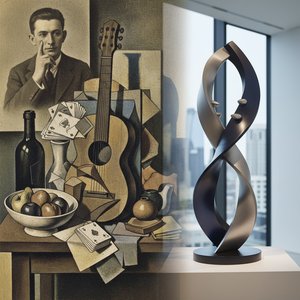
This "geometric DNA" has migrated far beyond the museum walls. The way a modern poster uses overlapping, semi-transparent layers to create depth is a direct nod to the fractured planes of Braque. The structural boldness found in contemporary digital art and even the character designs in high-concept animation owes its life to this era of deconstruction. We have moved from the literal to the symbolic, using the language of abstraction to communicate complex ideas instantly. Cubism provided the toolkit for the modern designer: the ability to break, rearrange, and rebuild reality into something more striking than the original.
The Remix Revolution: Why Cubist Perspectives Still Rule Contemporary Aesthetics
--- title: Cubism - The Metropolitan Museum of Art author: Sabine Rewald url: https://www.metmuseum.org/essays/cubism hostname: metmuseum.org description: The Cubist painters rejected the inherited concept that art should copy nature, or that they sh...
In an era defined by the "remix," Cubism feels more relevant than ever. We live in a culture of sampling, collage, and multi-layered digital manipulation. When we scroll through social media feeds or experience immersive AR environments, we are essentially living in a Cubist landscape—a constant stream of fragmented, overlapping perspectives that we must synthesize in real-time. The movement's core concept of taking existing elements and reassembling them into a new, more powerful context is the very definition of contemporary creativity.
This spirit of reinvention is what allows us to bridge the gap between the old and the new. We see it when digital artists use AI to reconstruct classical portraits through a fractured, abstract lens, or when street artists use stencil layers to create depth on urban concrete. The Cubist legacy is not about looking backward; it is about the permission to disrupt. It gave us the courage to take the familiar—a face, a landscape, a memory—and transform it into something entirely unexpected and visually arresting.
Mastering the Chaos: Bringing Bold, Abstract Energy into Your Urban Space
 Georges Braque's Masterpieces: 25 Paintings That Defined Cubism & Modern Art | OriginalUniqueArt
Introduction To gaze upon the canvases of Georges Braque is to witness a quiet revolution unfold. This collection of his top 25 artworks isn’t merely a survey of paintings; it's an intimate journey into the mind of an artist who dared to dismantle an...
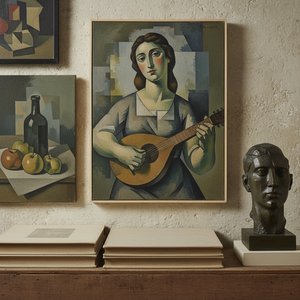
So, how do you bring this level of high-impact energy into your own environment? Designing an urban space requires more than just picking furniture; it requires a curation of visual tension. Incorporating elements inspired by Cubism—bold geometric prints, monochromatic textures, and works that play with depth—can transform a standard room into a sophisticated gallery of modern thought. It’s about finding that balance between the structured and the chaotic, much like the masters did on their canvases.
Whether you are looking for a massive multi-panel installation to anchor a wide wall or a single, striking abstract piece to serve as a focal point, the goal is to create a conversation. At OriginalUniqueArt.com, we specialize in this exact kind of high-impact, contemporary energy. We move away from the predictable and toward the vivid, offering pieces that capture the same revolutionary spirit that Picasso and Braque pioneered. From digital-age graphics to bold, textured abstractions, our collection is curated for those who don't just want to decorate a room, but want to redefine it. Embrace the fracture, celebrate the fragment, and bring the revolution home.