The Cubist Revolution: Breaking the Single Perspective
 Cubism Unveiled: How Picasso and Braque Redefined Reality Through Geometric Abstraction
The Fracture of Perspective: The Birth of a Revolution Cubism - Tate --- title: Cubism | Tate author: Clarrie Wallis url: https://www.tate.org.uk/art/art-terms/c/cubism hostname: tate.org.uk description: Tate glossary definition for cubism: A revolut...
To understand the seismic shift that Cubism brought to the twentieth century, one must first envision the world as it was perceived before 1907. For centuries, Western art had been anchored by the Renaissance ideal of a single, fixed viewpoint—a window into a three-dimensional reality governed by linear perspective and the illusion of depth. However, as the dawn of the new century arrived, marked by rapid industrialization and the mind-bending scientific revelations of Einstein, the traditional canvas began to feel insufficient. The artists who would become the architects of Cubism felt a profound need to move beyond mere imitation of nature, seeking instead a more permanent, structural truth.
The movement emerged not as a sudden rupture, but as an intellectual evolution born in the vibrant, often chaotic studios of Paris. It was a rejection of the Impressionist obsession with fleeting light and the Fauvist embrace of unbridled color, seeking instead to capture what the eye knows rather than just what the eye sees. By dismantling the subject, pioneers like Pablo Picasso and Georges Braque shattered conventions by deconstructing objects into multiple perspectives simultaneously. This technique defied conventional notions of depth, replacing the singular viewpoint with a multifaceted view where different angles of a subject are brought together in the same picture, suggesting a greater, more complex context.
Analytical vs. Synthetic Cubism: Understanding Form and Texture
 Mujer con zítara o guitarra
A Fragmented Portrait of Musical Expression Pablo Picasso’s “Mujer con zítara o guitarra” (Woman with Guitar) stands as a quintessential example of Analytic Cubism, born from the crucible of artistic experimentation in 1914. More than just a depictio...
As the movement matured, it branched into two distinct phases that redefined the boundaries of visual language. The first, Analytic Cubism, represents the period of intense dissection. During this phase, artists meticulously analyzed their subjects, breaking them down into geometric planes—cubes, cylinders, and cones. In works such as Picasso’s Mujer con zítara o guitarra, we see a reduction to fundamental forms, where the palette is often muted with tones of gray, brown, and ochre to prioritize tonal relationships over color vibrancy. This phase is characterized by a cerebral, structured reality that prioritizes the architecture of the subject over its surface appearance.
In contrast, Synthetic Cubism introduced a more decorative and additive approach. Rather than breaking objects down, artists began to build them up using varied textures and materials, effectively co-inventing the modern art form of collage. This style utilizes flatter planes of color and an intricate, puzzle-like composition that can appear as if it were made of cutout paper. A prime example is Picasso’s Three Musicians, where the use of flat color planes creates a vibrant, layered effect. For the professional designer, understanding this distinction is vital: Analytic Cubism offers a sophisticated, monochromatic depth suitable for understated elegance, while Synthetic Cubism provides a bold, rhythmic energy perfect for focal points in contemporary interiors.
Geometric Abstraction in Modern Architecture and Interior Design
 Geometric abstraction
Geometric abstraction is a form of abstract art based on the use of geometric forms sometimes, though not always, placed in non-illusionistic space and combined into non-objective (non-representational) compositions. Although the genre was popularize...
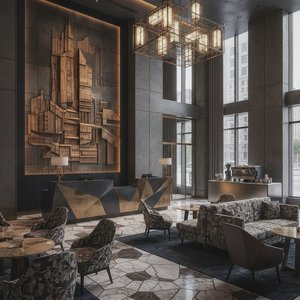
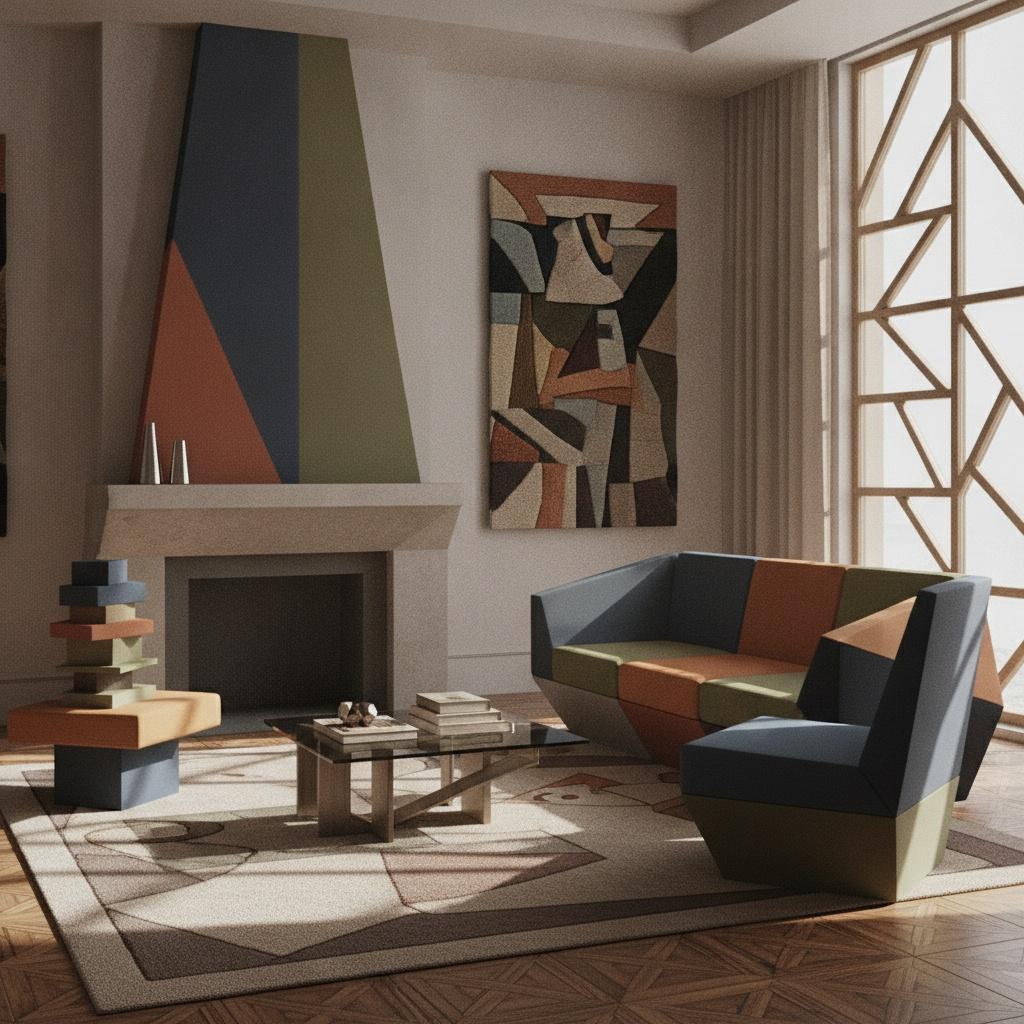
The legacy of Cubism extends far beyond the canvas, providing a foundational vocabulary for modern architectural and interior design. The movement’s emphasis on geometric abstraction—the use of geometric forms in non-illusionistic space—resonates deeply with the clean lines and structural integrity of contemporary spaces. The fragmentation of form seen in Cubist works mirrors the way modern architecture utilizes glass, steel, and intersecting planes to create dynamic environments. When a space is designed around these principles, it moves away from the romanticized perceptions of nature toward a more structured, intentional reality.
Integrating these motifs allows for a sophisticated interplay between light and shadow. The Cubist rejection of traditional modeling and foreshortening encourages designers to embrace the two-dimensional flatness of surfaces, using texture and pattern to create interest without relying on heavy, traditional ornamentation. Whether through the use of angular furniture, tessellated floor patterns, or large-scale geometric wall treatments, the spirit of Cubism can be used to evoke a sense of intellectual rigor and modern permanence within a built environment.
Integrating Cubist Masterpieces into Hospitality and Corporate Spaces
 Cubism
Cubism is an early-20th-century avant-garde art movement which began in Paris. It revolutionized painting and the visual arts, and sparked artistic innovations in music, ballet, literature, and architecture. Cubist subjects are analyzed, broken up, a...
For procurement managers and designers furnishing hotels, restaurants, and corporate headquarters, selecting art is an exercise in brand identity and atmosphere. Cubist reproductions offer a unique advantage: they provide a sense of prestige and historical weight without the overwhelming sentimentality of classical portraiture. In a luxury hotel lobby or a high-end restaurant, a large-scale Cubist piece can act as a sophisticated anchor, stimulating conversation through its complex, multi-layered perspectives.
In corporate environments, the structured nature of Cubism aligns perfectly with themes of innovation and precision. The movement’s roots in scientific observation and mathematical clarity make it an ideal choice for spaces that wish to project intelligence and forward-thinking values. Furthermore, the versatility of the style allows for seamless integration into various color palettes. From the somber, monochromatic depths of an Analytic piece to the vibrant, multi-colored energy of a Synthetic work, Cubist art can be curated to match the specific aesthetic requirements of a large-scale project, ensuring that the artwork complements rather than competes with the architectural elements.
Customizing Cubist Aesthetics: From AI Transformations to Hand-Painted Commissions
 Three Musicians (Picasso)
Three Musicians, also known as Musicians with Masks or Musicians in Masks, is a large oil painting created by Spanish artist Pablo Picasso. He painted two versions of Three Musicians. Both versions were completed in the summer of 1921 in Fontaineblea...
The modern era offers unprecedented opportunities to personalize the Cubist experience. Through advanced technology, such as AI Masterpiece Transformation, it is now possible to reconstruct personal or corporate imagery into the fractured, geometric styles of the early twentieth century. This allows designers to create bespoke visual narratives that are uniquely tied to a property’s history or brand, which can then be elevated through the medium of traditional oil painting.
For those seeking the ultimate level of distinction, commissioning a Handmade Oil Reproduction provides a tactile depth that digital prints simply cannot replicate. These works feature visible brushstrokes and an impasto texture that catches the light, offering a much deeper tonal range than standard posters. Whether it is a multi-panel arrangement designed to span a grand staircase or a custom-sized mural for a hotel ceiling, the ability to "remix" art history ensures that every commission is a singular event. By combining the structural brilliance of Cubism with the artisanal mastery of hand-painted oils, designers can transform any space into a curated gallery of modern innovation.