Hudson River School · 1847
Prometheus Bound (Thomas Cole, 1847)
Thomas Cole (1801–1848) a réalisé Prometheus Bound. Elle date de 1847. Il appartient au mouvement Hudson River School. Réalisée en Peinture à l'huile. Il est conservé au Fine Arts Museums of San Francisco à San Francisco, États-Unis d'Amérique. Ses dimensions sont 162 × 243 cm.
- 1847
- Peinture à l'huile
- 162 × 243 cm
- Fine Arts Museums of San Francisco

 Aperçu en situation

 Peinture à l'huile faite main
 Envoyer
 Partager
 Fiche pédagogique


 Télécharger l'image
 Articles similaires
 Radiographie
 Diaporama
 Questions et réponses

 Statistiques
Prometheus Bound, en bref
- Titre
- Prometheus Bound
- Artiste
- Thomas Cole (1801–1848)
- Lieu de naissance de l'artiste
- Bolton, Royaume-Uni
- Date
- 1847
- Technique
- Peinture à l'huile
- Dimensions
- 162 × 243 cm
- Où le voir
- Fine Arts Museums of San Francisco, San Francisco, États-Unis d'Amérique
- Mouvement
- Hudson River School
Que représente Prometheus Bound ?
The Weight of Myth: Thomas Cole’s “Prometheus Bound”
Thomas Cole's "Prometheus Bound," painted in 1847, isn’t merely a landscape; it’s a profound meditation on defiance, punishment, and the enduring human spirit. This monumental canvas, now residing within the Fine Arts Museums of San Francisco, transcends its subject matter to become a powerful allegory for the struggles inherent in challenging authority and forging one's own destiny. Cole, a pivotal figure in the Hudson River School movement, masterfully blends Romanticism with an underlying moral urgency, creating an image that continues to resonate deeply with viewers today.
The scene depicts Prometheus, chained to a towering rock formation amidst a desolate, snow-laden mountainscape. The composition is strikingly dramatic – a vast expanse of jagged peaks dominates the background, dwarfing the solitary figure of the Titan and emphasizing his isolation and vulnerability. A vulture circles overhead, a constant reminder of Zeus’s relentless retribution, while a subtle hint of Jupiter, the Roman equivalent of Zeus, watches from above, embodying the cold indifference of divine power. Cole's use of light is particularly masterful; a diffused, almost ethereal glow illuminates the scene, casting long shadows and creating an atmosphere of both grandeur and despair. The color palette—primarily cool blues, grays, and whites—reinforces this sense of bleakness, punctuated by the fiery red underpaint used to render the snow-covered mountains – a deliberate choice that subtly hints at Prometheus’s stolen fire.
A Myth Made Manifest: Exploring the Narrative
The painting draws directly from Aeschylus's Greek tragedy, “Prometheus Bound,” a story of rebellion against the gods. Prometheus, in this narrative, is not simply a titan but a symbol of humanity’s relentless pursuit of knowledge and progress. He steals fire from Mount Olympus, gifting it to mankind – an act of defiance that ultimately earns him eternal torment at the hands of Zeus. Cole doesn't shy away from the brutality of the punishment; the stark depiction of Prometheus’s chains and the looming threat of the vulture vividly convey the weight of his transgression. However, within this scene of suffering, there is also a palpable sense of resilience. Prometheus’s gaze, fixed upon the viewer, exudes an almost defiant serenity—a refusal to succumb to despair.
The inclusion of the chorus, comprised of figures emerging from the depths of the mountains, adds another layer of complexity to the narrative. They represent the forces of nature, witnesses to Prometheus's plight, and perhaps even a subtle acknowledgment of his heroic struggle. Their hesitant approach, marked by curiosity and apprehension, suggests that even those seemingly untouched by divine wrath recognize the significance of Prometheus’s actions.
The Hudson River School: A New American Vision
“Prometheus Bound” is a quintessential example of the Hudson River School's artistic philosophy. Unlike earlier European landscape paintings that often focused on idyllic pastoral scenes, Cole sought to capture the raw power and sublime beauty of the American wilderness. He employed a technique known as “atmospheric perspective,” subtly blurring distant elements to create a sense of depth and vastness. This approach wasn’t simply about replicating reality; it was about conveying an emotional response—a feeling of awe and reverence for nature's grandeur.
Cole’s work also reflects the burgeoning American identity of the mid-19th century, grappling with themes of independence, self-reliance, and the relationship between humanity and the natural world. The painting can be interpreted as a metaphor for America’s own struggle to assert its sovereignty against established powers – a sentiment particularly relevant in the context of westward expansion and the nation's growing tensions with European empires.
A Timeless Masterpiece: Reproduction & Beyond
Reproductions of “Prometheus Bound” offer an exceptional opportunity to bring this powerful image into any setting. The meticulous detail, evocative atmosphere, and profound symbolism ensure that a high-quality reproduction will serve as both a beautiful work of art and a compelling conversation piece. Consider framing the artwork in a manner that complements its dramatic scale and reinforces its thematic resonance – perhaps within a contemporary interior space to juxtapose the ancient myth with modern life.
For those seeking an authentic experience, exploring the original painting at the Fine Arts Museums of San Francisco is highly recommended. It’s a truly immersive encounter with one of America's most significant artistic achievements—a testament to Thomas Cole’s genius and a timeless exploration of human courage in the face of overwhelming adversity.
Dans quel musée se trouve Prometheus Bound ?
Fine Arts Museums of San Francisco
San Francisco, États-Unis d'Amérique
L'histoire des Fine Arts Museums of San Francisco L'épopée des Fine Arts Museums of San Francisco prend racine dès leur fondation en 1871. Au fil des décennies, l'institution a déployé son envergure, marquée par l'inauguration du de Young Museum en 1895, puis par l'ouverture de la Légion d'Honneur en 1924. Ces deux entités, longtemps indépendantes, ont suivi des trajectoires singulières avant de s'unir officiellement en 1972, sous l'impulsion de la direction d'Ian McKibbin White.


Images haute résolution de Prometheus Bound

Domaine public : l'artiste est décédé en 1848.
Autres formats, recadrages et citations →Thomas Cole, Prometheus Bound (1847), Fine Arts Museums of San Francisco. Domaine public
Questions sur Prometheus Bound, réponses
Où puis-je voir l'original de «Prometheus Bound» de Thomas Cole ?
L'original de «Prometheus Bound» de Thomas Cole est conservé au Fine Arts Museums of San Francisco, San Francisco, États-Unis d'Amérique. Une reproduction permet d'exposer l'œuvre chez soi.
En quelle année «Prometheus Bound» de Thomas Cole a-t-il été créé ?
L'œuvre «Prometheus Bound» de Thomas Cole date de 1847.
Quelle est la technique utilisée pour « Prometheus Bound » ?
Thomas Cole a utilisé la technique du Peinture à l'huile pour « Prometheus Bound ». Cette technique définit la nature matérielle de l'œuvre originale.
Quelles sont les dimensions de l'original «Prometheus Bound» de Thomas Cole ?
L'œuvre originale «Prometheus Bound» de Thomas Cole mesure 243 x 162 cm.
L'œuvre « Prometheus Bound » est-elle dans le domaine public ?
Concernant les droits d'auteur, « Prometheus Bound » est dans le dans le domaine public - ses droits d'auteur sont tombés dans le domaine public.
À quel artiste est attribuée l'œuvre "Prometheus Bound" ?
L'artiste à l'origine de « Prometheus Bound » est Thomas Cole. L'œuvre est répertoriée sous le nom de Thomas Cole.
À quel courant artistique «Prometheus Bound» de Thomas Cole appartient-il ?
«Prometheus Bound» de Thomas Cole appartient au mouvement Hudson River School. Ce mouvement apporte le contexte stylistique de l'œuvre.
À quelle période de la carrière de Thomas Cole se situe « Prometheus Bound » ?
« Prometheus Bound » est représentatif de la période Late Period de Thomas Cole.
Quel âge avait Thomas Cole lors de la création de « Prometheus Bound » en 1847 ?
Thomas Cole avait 46 ans lors de la création de « Prometheus Bound » en 1847. L'âge est calculé à partir de l'année de naissance de l'artiste, 1801.
À propos de l'artiste, Thomas Cole

1801–1848, Royaume-Uni
Thomas Cole
La vie et l'art de Thomas Cole Né le 1er février 1801 à Bolton le Moors, dans le Lancashire, en Angleterre, Thomas Cole commença son existence loin des paysages qui allaient finir par définir son nom. Sa famille émigra aux États-Unis en 1818, en quête d'un nouveau départ sur une terre de territoires vastes et inexplorés. Durant ces premières années, il fut un homme aux multiples talents, travaillant d'abord comme graveur avant de trouver une activité stable en tant que portraitiste à partir de 1822. Largement autodidacte, il affina son regard par l'observation et l'étude des livres plutôt que par une formation académique formelle.
Autres œuvres de Thomas Cole
 L'Oxbow
 Le rêve de l'architecte1840
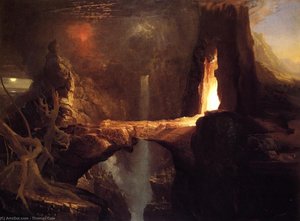 Expulsion. Lune et Lumière de la Feuille1828
 Vue de Florence depuis San Miniato1837

Essais sur Prometheus Bound
 Les 25 chefs-d'œuvre de Duccio di Buoninsegna : l'éveil du sacréExplorez les 25 chefs-d'œuvre de Duccio di Buoninsegna et l'éclat de l'art siennois. Découvrez toute la collection sur OriginalUniqueArt.co…
 Nature's Nation: The Hudson River School and the Art of the American SublimeExplore the spiritual depth of the Hudson River School through its masters. Discover the power of the American Sublime today.
 Les 10 Chefs-d'œuvre de la Haute Renaissance : Artistes et Décor d'ExceptionPlongez au cœur de la Haute Renaissance avec les 10 chefs-d'œuvre incontournables de Léonard de Vinci, Michel-Ange et Raphaël. Découvrez l'…