Art Nouveau
Blarney (Sergueï Solomko)
Sergueï Solomko (1867–1928) a réalisé Blarney. Il appartient au mouvement Art Nouveau.

 Aperçu en situation

 Peinture à l'huile faite main
 Envoyer
 Partager
 Fiche pédagogique


 Télécharger l'image
 Articles similaires
 Radiographie
 Diaporama
 Questions et réponses

 Statistiques
Blarney, en bref
- Titre
- Blarney
- Artiste
- Sergueï Solomko (1867–1928)
- Lieu de naissance de l'artiste
- Saint Petersburg, Russie
- Mouvement
- Art Nouveau
- Période
- Modern
- Sujet
- people, woman, man, blue dress, orange robe, embroidery
Que représente Blarney ?
Identification of the Artwork Blarney
The scene unfolds within the work titled Blarney, a piece that carries the original title Сладкие речи. This genre painting captures a specific, suspended moment of interaction between figures. Sergey Solomko, the artist behind this composition, brings a sense of narrative to the canvas through his distinct approach to storytelling.
The style of the work belongs to the Art Nouveau (Modern) movement. This aesthetic influence shapes the visual language of the piece, emphasizing the decorative and flowing qualities characteristic of the era. Through the hand of Sergey Solomko, the painting moves beyond simple representation to inhabit a space defined by the elegance of the Art Nouveau style.
Visual Composition and Subject Matter
Two figures occupy the center of the scene, caught in a moment that feels pulled from a forgotten legend or a distant fantasy. On the left, an individual is draped in a blue dress, its surface alive with intricate patterns and shimmering gold trim. A pointed headdress or hat rests upon their head, adding to the sense of a historical or otherworldly setting. Their hands are positioned as if reaching for something just out of sight, perhaps a cluster of flowers, lending a sense of quiet movement to their pose.
Facing them, a second figure reaches out in a gesture of interaction or assistance. This person wears an orange robe adorned with elaborate embroidery and complex patterns, layered over a green vest. A hat that matches the hue of the robe sits atop a short haircut. The interaction between these two souls suggests a narrative unfolding, a silent dialogue held in the space between them. Their costumes, heavy with detail, anchor the viewer in a specific, albeit imagined, era.
The background remains purposefully minimal, consisting of a light beige or off-white expanse. This lack of environmental detail pushes the figures forward, ensuring the eye remains fixed on the textures of the silk, the embroidery, and the subtle tension of their gestures. The simplicity of the surroundings allows the complexity of the attire to speak, turning the composition into a focused study of character and costume within a dreamlike space.
Images haute résolution de Blarney
Domaine public : l'artiste est décédé en 1928.
Sergueï Solomko, Blarney. Domaine public
Questions sur Blarney, réponses
Que représente « Blarney » ?
Les thèmes présents dans «Blarney» de Sergueï Solomko incluent people, woman, man, blue dress, orange robe, embroidery, headdress. Ensemble, ils résument le sujet de l'œuvre.
L'œuvre «Blarney» de Sergueï Solomko est-elle dans le domaine public ?
Statut des droits d'auteur pour «Blarney» de Sergueï Solomko : l'œuvre est dans le dans le domaine public - ses droits d'auteur sont tombés dans le domaine public. Cela détermine si les reproductions de l'image peuvent être réalisées librement.
Qui est l'artiste derrière « Blarney » ?
« Blarney » a été créé par Sergueï Solomko. Les informations présentes sur cette page décrivent l'œuvre originale de Sergueï Solomko.
À quel courant artistique «Blarney» de Sergueï Solomko appartient-il ?
« Blarney » est une œuvre issue du Art Nouveau. Ce mouvement définit la tradition artistique à laquelle l'œuvre appartient.
L'œuvre « Blarney » de Sergueï Solomko est-elle dans le domaine public, et pourquoi ?
«Blarney» de Sergueï Solomko est dans le dans le domaine public - ses droits d'auteur sont tombés dans le domaine public. La durée du droit d'auteur court à partir du décès de l'artiste, survenu en 1928.
Comment « Blarney » s'inscrit-il dans les thèmes et le style de Sergueï Solomko ?
«Blarney» partage avec les autres œuvres de Sergueï Solomko son style Art Nouveau ainsi que ses thèmes récurrents : art nouveau style, old russian culture, imperial russia themes, genre painting.
« Blarney » est-il représentatif de l'œuvre habituelle de Sergueï Solomko ?
Parmi les thèmes récurrents de Sergueï Solomko — art nouveau style, old russian culture, imperial russia themes, genre painting — « Blarney » met l'accent sur people, woman, man, blue dress, orange robe, embroidery, headdress.
À propos de l'artiste, Sergueï Solomko

1867–1928, Russie
Sergueï Solomko
Sergey Solomko : Vie et Héritage Né dans les élégants quartiers du Palais Konstantinovski à Saint-Pétersbourg en 1867, fils du Colonel Sergueï Solomko, officier au service du Grand-Duc Constantin Nikolaïevitch, Sergey Solomko bénéficia d’une éducation privilégiée et fut exposé dès son jeune âge aux valeurs esthétiques de l'aristocratie russe. Cette richesse familiale lui ouvrit les portes de l’École Supérieure des Beaux-Arts de Moscou où il étudia peinture entre 1883 et 1887 avant de poursuivre ses études à l’Académie Impériale des Beaux-Arts pendant une année cruciale pour son développement artistique. Débuts professionnels comme illustrateur : Une voix nouvelle dans la littérature russe Solomko débuta sa carrière artistique en tant qu'illustrateur pour les magazines littéraires, notamment *Север (Nord)*, un hebdomadaire engagé dans la défense des valeurs traditionnelles et patriotiques. Cette première expérience lui permit de maîtriser les techniques du dessin et de l’interprétation visuelle, ouvrant ainsi la voie à une collaboration fructueuse avec des auteurs importants tels que Pouchkine, Tchekhov et Lermontov.
À propos de Sergueï Solomko Œuvres notables de Sergueï Solomko
Autres œuvres de Sergueï Solomko
 Mémoire1910
 Esquisse de l'affiche. Pilori.1916
 Prêtresse1915
 Glowworm
Essais sur Blarney
 Œuvres russes des années 1910Plongez dans l'avant-garde russe des années 1910 avec Kandinsky et Petrov-Vodkin. Explorez la collection complète sur OriginalUniqueArt.com.
 Artistes ukrainiens et avant-garde des années 1910Plongez dans l'avant-garde de Malevich et Repin. Découvrez ces chefs-d'œuvre sur OriginalUniqueArt.com.
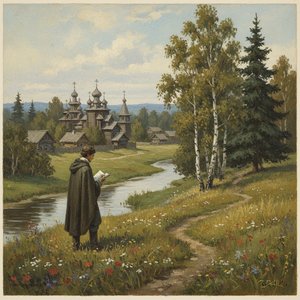 Sergey Solomko: Rediscovering the Poetic Landscape of Old RussiaExplore the captivating world of Sergey Solomko (1867-1928), a master of Russian Art Nouveau. Discover his stunning paintings, illustration…