Expressionism
Self-portrait (Paula Modersohn-Becker)
Paula Modersohn-Becker (1876–1907) a réalisé Self-portrait. Il appartient au mouvement Expressionism. Réalisée en Oil On Canvas.
- Oil On Canvas

 Aperçu en situation

 Peinture à l'huile faite main
 Envoyer
 Partager
 Fiche pédagogique


 Télécharger l'image
 Articles similaires
 Radiographie
 Diaporama
 Questions et réponses

 Statistiques
Self-portrait, en bref
- Titre
- Self-portrait
- Artiste
- Paula Modersohn-Becker (1876–1907)
- Lieu de naissance de l'artiste
- Dresde, Allemagne
- Technique
- Oil On Canvas
- Mouvement
- Expressionism
- Période
- Modern
- Sujet
- woman, red hair, green shirt, face, eyes, wall
Que représente Self-portrait ?
Identification of the Self-portrait
Self-portrait is a creation by the German Expressionist painter and draftswoman Paula Modersohn-Becker. This specific piece belongs to a vast body of work produced during her active life. The artist was born on 8 February 1876 in Dresden, Germany, and passed away on 30 November 1907 in Worpswede.
In this work, Paula Modersohn-Becker turns her gaze toward the viewer. The image captures a moment of quiet intensity through the artist's own likeness. It remains a direct encounter with her presence.
The Composition and Visual Details
The subject is positioned in front of a plain wall, seated in a manner that brings her face into sharp prominence. She wears a green shirt that contrasts with her red hair. Her hair is styled in an unconventional manner, contributing to the singular presence of the figure. The composition focuses heavily on the facial features, emphasizing a directness of gaze. Her eyes are open wide, looking straight ahead to meet the viewer's eyes with quiet intensity.
The arrangement of the figure against the background creates a sense of immediate, unmediated encounter. There is a notable focus on the psychological weight of the stare. The simplicity of the setting ensures that the viewer's attention remains fixed on the subject's expression and the specific arrangement of her features. This directness removes any sense of artifice from the encounter.
Technique and Artistic Medium
Executed in oil on canvas, this work exemplifies the principles of Expressionism. The medium allows for a directness of form that prioritizes the psychological state over mere physical likeness. Through the application of pigment, the artist achieves a sense of quiet intensity, focusing on the essential features of the face and the gaze to facilitate a moment of introspection.
The application of paint emphasizes a recognizable simplicity of form. This approach moves away from the atmospheric concerns of Impressionism, opting instead for a more structured and subjective visual language. The surface carries the weight of the artist's presence, using color and composition to explore the nuances of identity.
Where to See This Artwork Today
This work is held at the Paula Modersohn-Becker Museum in Bremen, Germany. The institution serves as a primary repository for the artist's output, housing a significant portion of her creative legacy.
Founded in 1927, the museum holds a unique position in art history as the first museum in the world devoted solely to a female artist. Its collection provides a comprehensive view of her development from her early training to her final years in Paris.
Related Works by the Artist
The artist's exploration of the self continued through several distinct phases of her career. In 1906, she produced Self-Portrait Looking Slightly Left, a work that shares a similar searching quality with her other studies of identity. During that same year, she completed Self-Portrait at 6th Wedding Anniversary, a piece that captures a specific moment of transition. This work is also known as Self-portrait on the sixth anniversary of marriage.
Earlier compositions reveal a different focus on objects and the female form. Around 1904, she created Self-Portrait with a bowl and a glass. Her interest in the intersection of the female form and the natural world is further evidenced in Self-Portrait with Two Flowers, where she cradles blossoms with a deliberate, steady intention.
Images haute résolution de Self-portrait
Domaine public : l'artiste est décédé en 1907.
Paula Modersohn-Becker, Self-portrait. Domaine public
Questions sur Self-portrait, réponses
Quelle est la technique utilisée pour «Self-portrait» de Paula Modersohn-Becker ?
« Self-portrait » est réalisé en Oil On Canvas.
Que représente «Self-portrait» de Paula Modersohn-Becker ?
L'œuvre « Self-portrait » représente woman, red hair, green shirt, face, eyes, wall.
L'œuvre «Self-portrait» de Paula Modersohn-Becker est-elle dans le domaine public ?
Statut des droits d'auteur pour «Self-portrait» de Paula Modersohn-Becker : l'œuvre est dans le dans le domaine public - ses droits d'auteur sont tombés dans le domaine public. Cela détermine si les reproductions de l'image peuvent être réalisées librement.
Qui est l'auteur de "Self-portrait" ?
L'artiste à l'origine de « Self-portrait » est Paula Modersohn-Becker. L'œuvre est répertoriée sous le nom de Paula Modersohn-Becker.
À quel mouvement artistique appartient «Self-portrait» de Paula Modersohn-Becker ?
Le mouvement associé à «Self-portrait» de Paula Modersohn-Becker est Expressionism. Cette classification situe l'œuvre parmi des artistes et des œuvres d'art apparentés.
Pourquoi le statut du droit d'auteur de « Self-portrait » est-il tel qu'il est ?
Le statut du droit d'auteur de « Self-portrait » - dans le domaine public - ses droits d'auteur sont tombés dans le domaine public - découle du décès de l'artiste en 1907.
En quoi "Self-portrait" s'inscrit-il dans l'œuvre de Paula Modersohn-Becker ?
«Self-portrait» s'inscrit dans l'œuvre Expressionism de Paula Modersohn-Becker, dont les thèmes récurrents incluent cézanne, gauguin, van gogh, identity and femininity, self-exploration and agency, pioneer of expressionism.
Quel est le rapport entre le sujet de « Self-portrait » et les thèmes habituels de Paula Modersohn-Becker ?
Parmi les thèmes récurrents de Paula Modersohn-Becker — cézanne, gauguin, van gogh, identity and femininity, self-exploration and agency, pioneer of expressionism — « Self-portrait » met l'accent sur woman, red hair, green shirt, face, eyes, wall.
À propos de l'artiste, Paula Modersohn-Becker

1876–1907, Allemagne
Paula Modersohn-Becker
Une Vision Intérieure Révolutionnaire : La Vie et l’Œuvre de Paula Modersohn-Becker Paula Modersohn-Becker, un nom qui résonne d'une puissance tranquille dans les annales de l'art moderne, fut une artiste qui osa regarder à l'intérieur d'elle-même. Née Minna Hermine Paula Becker le 8 février 1876 à Dresde, en Allemagne, sa vie fut tragiquement courte – elle décéda le 30 novembre 1907 à Worpswede – mais durant ces trois décennies, elle traça un chemin d'innovation artistique et de courage personnel remarquable. Son histoire n’est pas celle d’une gloire immédiate ou d’une reconnaissance généralisée de son vivant ; c’est plutôt le témoignage de la force durable d’une voix individuelle qui a défié les conventions et exploré les profondeurs de l’expérience humaine avec une honnêteté implacable. Issue d'un milieu relativement privilégié, mais marqué par une ombre subtile – son oncle avait tenté d'assassiner le roi de Prusse – les inclinations artistiques de Paula furent encouragées, bien que soumises aux attentes sociales de l’époque.
À propos de Paula Modersohn-Becker Œuvres notables de Paula Modersohn-Becker
Autres œuvres de Paula Modersohn-Becker
 Portrait d'une jeune femme au chapeau rouge1900
 Portrait en buste d'un vieux fermier1903
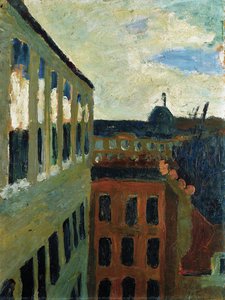 Vue de la fenêtre de l'atelier de l'artiste à Paris1900
 Nature morte avec plante, citron et orange1906
Essais sur Self-portrait
 Artistes polonais des années 1900Découvrez l'art polonais des années 1900, de Malczewski à Boznańska. Explorez notre collection de reproductions sur OriginalUniqueArt.com.
 Les œuvres allemandes des années 1900Plongez dans l'expressionnisme allemand avec Max Beckmann et Franz Marc. Explorez la collection complète sur OriginalUniqueArt.com.
 Les 25 chefs-d'œuvre d'Egon Schiele : l'émotion brute de l'expressionnismePlongez dans l'expressionnisme d'Egon Schiele à travers ses 25 chefs-d'œuvre. Explorez la collection complète sur OriginalUniqueArt.com.