Cubism · 1914
Landscape (Man Ray, 1914)
Man Ray (1890–1976) a réalisé Landscape. Elle date de 1914. Il appartient au mouvement Cubism. Ses dimensions sont 13 × 18 cm.
- 1914
- 13 × 18 cm

 Aperçu en situation

 Peinture à l'huile faite main
 Envoyer
 Partager
 Fiche pédagogique


 Télécharger l'image
 Articles similaires
 Radiographie
 Diaporama
 Questions et réponses

 Statistiques
Landscape, en bref
Que représente Landscape ?
Composition and Style
The painting depicts a village scene with houses and buildings in the background, set against a cloudy sky. The use of geometric forms and bold lines creates a sense of depth and texture, while the vibrant colors add life and vibrancy to the scene. The Landscape painting is characterized by its abstracted representation, aligning with the avant-garde and experimental ethos of the Cubist movement. Key Features:- The painting features a mix of grays, blues, and browns, creating a sense of balance and harmony.
- The use of watercolor as the medium adds a level of transparency and fluidity to the artwork.
- The village scene is depicted in a simplified and abstracted manner, emphasizing the artist's focus on form and composition.
Artist and Museum
Man Ray was an American artist known for his contributions to the Dada and Surrealist movements. His work can be found in various museums around the world, including the Musée d'Orsay in Paris, France. For more information on Man Ray and his artwork, visit /art/list/?Filter=man+ray,man,ray. Similar Paintings: For fans of Man Ray and Cubism, other notable paintings include The Lime Kiln by Paul Cézanne, available on /art/list/?Filter=8YDDSE-Paul-Cezanne-The-Lime-Kiln-(also-known-as-The-Mill-at-the-Pont-des-Trois-Sa..The Landscape painting by Man Ray is a captivating watercolor artwork that showcases the artist's unique style and perspective. With its abstracted representation and emphasis on form and composition, this piece is a must-have for any art enthusiast. Visit https://OriginalUniqueArt.com to explore more hand-made oil paintings reproductions of famous artworks, including those by Man Ray and other notable artists.
Images haute résolution de Landscape

Protected by copyright: these files are for personal reference, not a licence to republish.
Man Ray, Landscape (1914).
Questions sur Landscape, réponses
En quelle année «Landscape» de Man Ray a-t-il été créé ?
Quelles sont les dimensions réelles de «Landscape» de Man Ray ?
Que représente « Landscape » ?
L'image de «Landscape» de Man Ray peut-elle être librement reproduite ?
À quel mouvement artistique appartient «Landscape» de Man Ray ?
« Landscape » est une œuvre issue du Cubism. Ce mouvement définit la tradition artistique à laquelle l'œuvre appartient.
À quelle période de la carrière de Man Ray appartient « Landscape » ?
Quel âge avait Man Ray lors de la création de « Landscape » ?
Pourquoi le statut du droit d'auteur de « Landscape » est-il tel qu'il est ?
Le statut du droit d'auteur de « Landscape » - toujours protégé par le droit d'auteur - découle du décès de l'artiste en 1976.
À propos de l'artiste, Man Ray

1890–1976, États-Unis
Man Ray
Emmanuel Radnitzky : Un Artiste Défiant, Entre Dada et Surréalisme Emmanuel Radnitzky, plus connu sous le nom de Man Ray, fut un artiste aux multiples facettes, un explorateur audacieux des frontières de la perception et de l’expression artistique. Né en 1890 à Philadelphie, fils d'immigrants russes juifs, son parcours, marqué par une quête incessante de liberté créative et une rupture constante avec les conventions, témoigne d’une époque de bouleversements artistiques et sociaux. Son nom, Man Ray, lui-même un choix délibéré, symbolise cette volonté de se définir à l'écart des normes établies, une identité façonnée par la rébellion et l'innovation. Son enfance dans le quartier de Williamsburg à Brooklyn, au cœur d’une communauté juive dynamique, lui apporta une sensibilité particulière à la culture et aux tensions sociales de son époque.
Autres œuvres de Man Ray
 La Galerie Surréaliste, rue Jacques Callot
 Poissons1938
 Rayogramme (Le Baiser)1922
 Solarisation1931
Essais sur Landscape
 Comparaison entre l'impressionnisme américain et l'impressionnisme françaisDécouvrez les nuances entre l'impressionnisme français et américain. Explorez les différences de style dès maintenant.
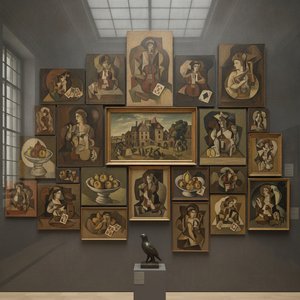 Maîtriser le Cubisme : Les 25 chefs-d'œuvre incontournables de Georges BraqueExplorez les 25 chefs-d'œuvre de Georges Braque et l'essence du cubisme. Découvrez ces trésors sur OriginalUniqueArt.com.
 Whispers in the Sky: Capturing the Ethereal Beauty of Impressionist CloudscapesDiscover the ethereal beauty of Impressionist cloudscapes. Explore how masters like Monet captured fleeting light and atmosphere through so…