
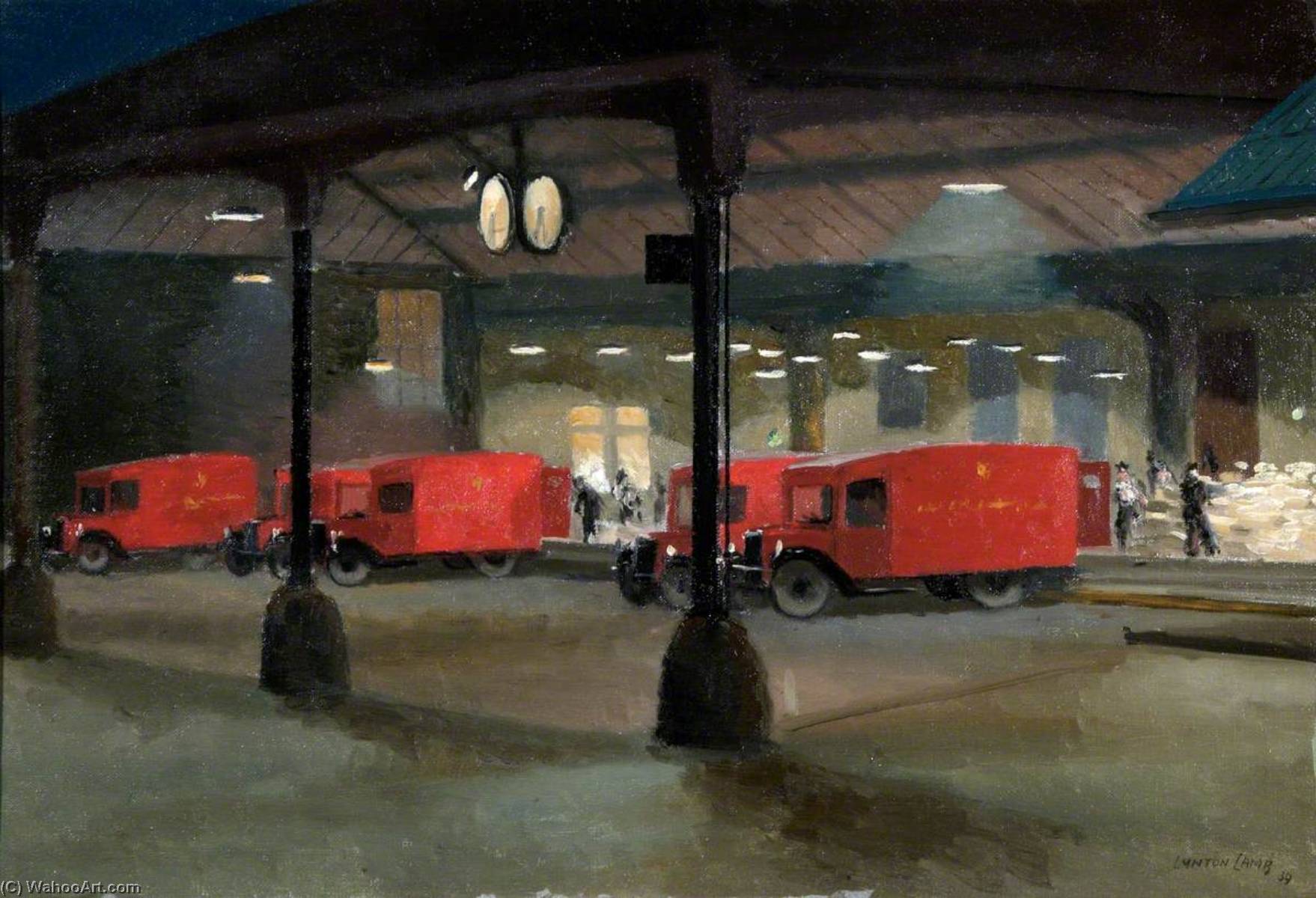
 Aperçu en situation
 Envoyer
 Partager
 Détails de l'œuvre
 Guide
Guide

 Télécharger l'image
 Articles similaires
 Radiographie
 Diaporama
 Statistiques
Post Office Loading Platform
 1939
1939 40.0 x 58.0 cm
 Le Musée et l’Archives Postales Britanniques
 Lire la suite
Obtenez un fichier prêt pour l'impression qui dépasse de loin l'aperçu web. Chaque image numérique que nous vendons provient d'un fichier maître haute résolution issu de notre base de données — mesurant généralement entre 5 000 et 15 000 pixels de large — afin que vous puissiez imprimer en grand format, recadrer précisément ou reproduire les détails les plus fins en toute confiance.
Aucun fichier ne quitte notre studio sans être retouché. Un expert numérique vérifie la colorimétrie par rapport à l'œuvre originale et la corrige si nécessaire, puis améliore la clarté et les détails à l'aide d'outils de retouche professionnels — tout en restant toujours fidèle au coup de pinceau et au style de l'artiste. Le résultat est une image qui ressemble au tableau, et non à un simple scan filtré.
Vous validez avant de finaliser : notre expert vous envoie l'image par e-mail sous 72 heures pour examen. Non satisfait ? Demandez des améliorations ou des corrections, ou demandez un remboursement si la qualité ne répond pas à vos attentes.
C'est une qualité sur laquelle s'appuient éditeurs, studios de création, galeries et ateliers d'impression.
Image numérique
Téléchargez un fichier haute résolution pour votre usage personnel, l'impression et vos projets créatifs. ( Passer au format impression Commander la reproduction peinte à la main)
Inclus avec chaque commande d'image numérique
Livraison numérique experte, garantie.
En choisissant OriginalUniqueArt.com, vous n'obtenez pas seulement une simple image : vous recevez une œuvre numérique sublimée avec professionnalisme, conçue avec précision et accompagnée d'une garantie de satisfaction. Voici tout ce qui accompagne automatiquement votre commande :

Envoi rapide par e-mail
Votre fichier d'image numérique haute résolution vous sera envoyé par e-mail sous 72 heures après votre commande — prêt à un usage immédiat.

Fichier numérique optimisé par l'IA
Votre œuvre d'art bénéficie d'une optimisation professionnelle grâce à des outils d'IA avancés et une retouche manuelle, garantissant un niveau maximal de détail, de clarté et de fidélité chromatique.

Réexpédition gratuite à vie
Vous avez accidentellement supprimé ou perdu votre fichier ? Pas d'inquiétude — nous vous le renverrons gratuitement, quand vous le souhaitez.

Aucuns frais de douane — À jamais
Profitez de votre œuvre d'art instantanément sans frais de douane ni de livraison — les téléchargements numériques sont toujours exonérés de taxes.

Garantie de fidélité des couleurs
Nous garantissons que votre image numérique reproduit les couleurs de l'original aussi fidèlement que possible grâce à des outils professionnels et une gestion rigoureuse des couleurs.

Garantie de satisfaction 100 jours
Si vous n'êtes pas satisfait de votre image numérique, nous la retoucherons ou vous rembourserons 100% sous 100 jours — sans poser de questions.

Garantie de remboursement à 100%
Pas satisfait ? Obtenez un remboursement intégral dans les 100 jours suivant la réception de votre fichier numérique — sans aucune question posée.

Réductions sur les commandes groupées
Achetez 3 images, économisez 10% - Achetez 5, économisez 15% - Achetez 10+, économisez 20%. Idéal pour les projets créatifs, les galeries et les agences.
Biographie de l'artiste
Lynton Harold Lamb: A Londoner’s Eye for the Everyday
Lynton Harold Lamb, a name perhaps less familiar than many of his contemporaries in early 20th-century British art, nevertheless possessed a remarkable talent for capturing the essence of urban life. Born in Hyderabad, India, in 1907 – a detail often overlooked – and returning to England as a young boy, Lamb’s artistic journey was deeply intertwined with London itself. His work isn't grand landscapes or heroic portraits; instead, he offered intimate glimpses into the city’s streets, its people, and the quiet moments that defined daily existence. This unassuming approach, coupled with his meticulous attention to detail and a subtly evocative style, has earned him recognition as a significant chronicler of London’s Victorian and Edwardian periods.
Lamb's early life was shaped by his father’s role as a Wesleyan Methodist minister. This upbringing instilled in him a keen observation of human nature and a respect for the ordinary – qualities that would profoundly influence his artistic vision. After his father’s death, Lamb moved to London and pursued formal training at Camberwell School of Arts and Crafts, studying under influential figures like Noel Rooke and Bernard Meninsky. It was here he honed his skills in lithography and illustration, disciplines that proved crucial to his later career. Notably, during World War II, Lamb’s artistic abilities were put to a different purpose – designing camouflage patterns for the military, demonstrating a versatility often underestimated by those who only knew him for his civilian work.
The Book Jacket and Beyond
Lamb's most enduring legacy lies in his contributions to the world of book design. He quickly established himself as a sought-after illustrator for publishers like Oxford University Press, creating striking and memorable book jackets that became instantly recognizable. His style was characterized by a precise realism, often employing a limited palette of muted tones – browns, greys, and ochres – to create a sense of understated elegance and atmosphere. He wasn’t interested in flamboyant displays; rather, he aimed for an almost photographic quality, capturing the subtle nuances of light and shadow, and the expressions on people's faces.
Beyond book jackets, Lamb expanded his repertoire into posters, architectural decoration, and postage stamp designs. His work for Orient Lines ships, particularly during the 1930s and 40s, showcased his ability to translate complex visual information into engaging and aesthetically pleasing compositions. The ‘Queen Elizabeth II Castle series’ stamps, designed in 1953-54, are a testament to his skill – each stamp depicting a majestic castle framed by an evocative stone wall, a design that quickly became iconic.
A Portrait of London Life
While book jackets and posters often represent the breadth of Lamb’s work, it's in his portraits that he truly shines. His depiction of Professor Sir Percy Nunn, commissioned in 1937, offers a particularly compelling example of his talent. The portrait captures not just the subject’s likeness but also his character – a sense of dignity and quiet reflection conveyed through subtle details like the arrangement of his hands and the expression in his eyes. Lamb's portraits are often set against London backdrops, subtly anchoring them to the city’s atmosphere and history.
His work frequently featured scenes from everyday London life – street corners bustling with activity, market stalls overflowing with goods, and individuals engaged in their daily routines. He wasn’t interested in romanticizing or idealizing these scenes; instead, he presented them with a frankness and honesty that revealed the beauty and complexity of urban existence. Consider his depiction of Sandon Place, a poignant image capturing a moment frozen in time – a scene of quiet domesticity amidst the city's relentless energy.
Legacy and Influence
Lynton Harold Lamb’s career spanned several decades, during which he consistently produced work of remarkable quality and enduring appeal. He was recognized with numerous awards, including the Royal Designer for Industry in 1974, a testament to his significant contribution to British design. While he may not be as widely celebrated as some of his contemporaries, Lamb’s meticulous observation, understated elegance, and profound understanding of London's character have secured his place as a vital chronicler of a bygone era. His work continues to resonate with viewers today, offering a valuable glimpse into the heart and soul of Victorian and Edwardian London – a city he captured with an artist’s eye and a poet’s sensibility.
Lynton Harold Lamb
1907 - 1977
En bref
- Full Name: Lynton Harold Lamb
- Nationality: British
- Date Of Birth: 1907
- Date Of Death: 1977
- Place Of Birth: Nizambabad, India
- Notable Artworks:
- Sandon Place
- Professor Nunn (1937)
- Artistic Movement Or Style: Urban art UK, Victorian realism
- Artists Who Influenced This Artist: ['Noel Rooke']
- Artists Or Movements Influenced By This Artist: ['Book jackets']