Passer au format impression
 Lire la suite







































 Pour les œuvres ou reproductions dont un côté mesure plus de 105 cm (environ 41 pouces), le cadre sera expédié sous forme de kit démonté. Cette méthode garantit une livraison sécurisée et prévient tout dommage pendant le transport.


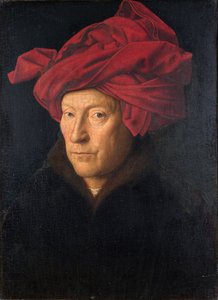
Portrait of Giovanni Arnolfini : A Window Into Renaissance Wealth
Jan van Eyck’s Portrait of Giovanni Arnolfini stands as an unparalleled achievement in Early Netherlandish painting—a testament to meticulous observation and revolutionary artistic innovation. Painted around 1438 in Bruges, Belgium, this double portrait transcends mere representation; it’s a carefully crafted symbol of status, marriage, and the burgeoning mercantile spirit of the Burgundian court.
- The Painting's Scale & Detail: Measuring just under 30 cm by 20 cm, the painting commands attention with its astonishing realism. Every surface—from the textured woollen drapery to the polished brass chandelier—is rendered with painstaking accuracy using oil paint, a technique pioneered by Van Eyck and his brother Hubert that allowed for unprecedented depth and luminosity.
- A Celebration of Prosperity: The opulent furnishings within the room speak volumes about Giovanni Arnolfini’s wealth. Consider the crimson velvet cushions on the bed, the intricately woven oriental carpet beneathfoot, and the single candle flickering in the chandelier—symbols of solemnity and divine grace. These elements underscore the painting's overarching theme: a declaration of affluence.
- Symbolism Beyond Appearance: The Arnolfini Portrait is rife with symbolic gestures that extend far beyond its surface beauty. The man’s raised hand signifies greeting, while the woman subtly adjusts her gown—a gesture interpreted as acknowledging the presence of witnesses to their union. The convex mirror reflects not only the room but also two additional figures entering from the doorway, adding a layer of complexity and intrigue.
- Technique & Innovation: Van Eyck’s mastery of *alla prima*, or wet-on-wet painting—applying thin layers of pigment simultaneously—created an illusion of three dimensions that was revolutionary for its time. The subtle gradations of light and shadow imbue the figures and surroundings with palpable warmth, capturing a moment frozen in time.
More than just a portrait, Portrait of Giovanni Arnolfini is an emblem of the Renaissance spirit—a fusion of humanist observation and artistic virtuosity that continues to captivate audiences centuries later. Its enduring appeal lies in its ability to convey not only visual splendor but also profound ideas about marriage, faith, and the pursuit of worldly success.
For those seeking inspiration or contemplating a stunning reproduction, explore Jan Van Eyck: The Arnolfini Portrait (detail) and Jan Van Eyck: The Arnolfini Portrait (detail) on OriginalUniqueArt for a deeper appreciation of this masterpiece.
Questions et réponses
Pourquoi le statut du droit d'auteur de « Portrait de Giovanni Arnolfini » est-il tel qu'il est ?
Le statut du droit d'auteur de « Portrait de Giovanni Arnolfini » - dans le domaine public - ses droits d'auteur sont tombés dans le domaine public - découle du décès de l'artiste en 1441.
Sous quels autres noms Jan van Eyck est-il/elle connu(e) ?
L'artiste Jan van Eyck, créateur de « Portrait de Giovanni Arnolfini », est également connu sous d'autres noms, notamment Hubert van Eyck.
Quelle est la teinte dominante de «Portrait de Giovanni Arnolfini» de Jan van Eyck ?
«Portrait de Giovanni Arnolfini» tend vers une nuance Nuances chaudes de coucher de soleil.
 Aperçu en situation
 Envoyer
 Partager
 Détails de l'œuvre
 Guide
Guide

 Télécharger l'image
 Articles similaires
 Radiographie
 Diaporama
 Q&A
Q&A Statistiques