Wilhelm Sonmans muotokuva

29 tunnetuinta Wilhelm Sonmans -maalausta, jokainen ainutlaatuinen

Päivitetty lokakuu 2026 · järjestetty suosituimmuuspisteiden mukaan (jokaisen teoksen haut, vierailut ja tilaukset) · 29 teosta taiteilijalta Wilhelm Sonmans luettelossamme

Lyhyesti

Dervorguilla of Galloway (d.1290), Lady of Balliol (1670) on se Wilhelm Sonmans -maalaus, joka herättää eniten huomiota; alkuperäisteos kuuluu museolle Bodleian Libraries, Oxford. Sen jälkeen katse siirtyy kohteisiin John de Balliol (d.1269) (1670) ja Richard Wightwick (1547 –1629) (1670). Wilhelm Sonmansin 29 teoksemme joukosta nämä 29 ovat kuuluisimpia; jokainen on ainutlaatuinen alkuperäisteos, joka on esitelty vuosiluvun, museon ja sen syyn kera, miksi teos on säilyttänyt suosionsa.

1650 – 1708 Baroque Eniten teoksia: Bodleian Libraries

Wilhelm Sonmans -taiteilijan 10 parasta maalausta gallerian silmin

1
Dervorguilla of Galloway (d.1290), Lady of Balliol (1670) tekijä Wilhelm Sonmans

Dervorguilla of Galloway (d.1290), Lady of Balliol

1670 · Oil On Canvas · Bodleian Libraries, Oxford

The room feels heavy with the weight of centuries as the woman sits, her hands clasped in a quiet, steady gesture of composure. She wears a white veil that catches the light, framing a face that carries the gravity of her station. This is Dervorguilla of Galloway, a figure of substance from a vanished age, captured here in the soft, luminous glazes that define the Baroque style. Around her, the…

2
John de Balliol (d.1269) (1670) tekijä Wilhelm Sonmans

John de Balliol (d.1269)

1670 · Oil On Canvas · Bodleian Libraries, Oxford

The portrait depicts John de Balliol, a man who held the title of King of Scotland from 1292 to 1306. He is positioned in a standing posture, clad in a suit of metal armor. A helmet and a sword are visible as part of his attire. The subject is situated near a structure composed of brick, which resembles a castle wall. Two other figures occupy the periphery of the composition;…

3
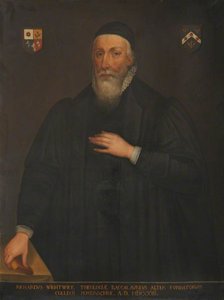
Richard Wightwick (1547 –1629) (1670) tekijä Wilhelm Sonmans

Richard Wightwick (1547 –1629)

1670 · Oil On Canvas · Bodleian Libraries, Oxford

In this portrait, we encounter Richard Wightwick, a man whose life was deeply intertwined with the foundations of Pembroke College, Oxford. He is presented as an elderly figure, his presence defined by a long, white beard that flows over a dark robe. There is a quiet gravity in his gaze, suggesting a life spent in study and religious devotion. He holds a book in his left hand, a gesture that…

4
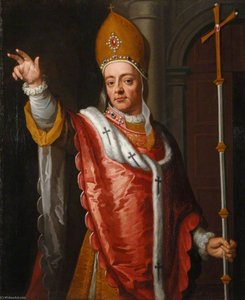
William of Waynflete (1398–1486) (1670) tekijä Wilhelm Sonmans

William of Waynflete (1398–1486)

1670 · Oil On Canvas · Bodleian Libraries, Oxford

The figure of William of Waynflete commands the space, his presence heavy and dignified within the frame. He sits as a man of immense ecclesiastical weight, his gaze steady and serious, reflecting a life spent navigating the corridors of power and prayer. Light spills from the upper left, washing over the intricate folds of his robes and catching the metallic glint of his insignia. This illumination does more than reveal…

5
Walter de Stapledon (1261–1326) (1670) tekijä Wilhelm Sonmans

Walter de Stapledon (1261–1326)

1670 · Oil On Canvas · Bodleian Libraries, Oxford

A figure of ecclesiastical power occupies the center of this oil on canvas portrait. Dressed in heavy, layered robes, the subject is presented in a frontal pose that demands immediate recognition of his status. The lighting is directional, carving deep shadows into the folds of the fabric and defining the contours of a face marked by gravity. A prominent mitre sits atop the head, while a crosier is held as…

6
Richard Fleming (d.1431) (1670) tekijä Wilhelm Sonmans

Richard Fleming (d.1431)

1670 · Oil On Canvas · Bodleian Libraries, Oxford

The portrait of Richard Fleming (d.1431) emerges from the canvas as a presence that commands the space it occupies. Created by Wilhelm Sonmans, this oil on canvas work captures the likeness of the subject with a focused intensity. The figure of Richard Fleming (d.1431) remains fixed in a moment of quiet dignity, his presence felt through the careful application of pigment that defines his form. It is a work that…

Wilhelm Sonmansn kuuluisia maalauksia, numerot 11–29

Aiheet, jotka vangitsivat Wilhelm Sonmansin katseen

Nämä neljä aihetta toistuvat näissä alkuperäisteoksissa useimmin, jokaisesta löytyy hienoin esimerkki.

Museot, joissa Wilhelm Sonmans'n alkuperäisteokset sijaitsevat

Tämän sivun teoksista eniten sisältävät 5 museota.

Museo Kaupunki Wilhelm Sonmans teokset Tämän listan maalaukset
Bodleian Libraries, OxfordBodleian Libraries Oxford 20 Dervorguilla of Galloway (d.1290), Lady of Balliol, John de Balliol (d.1269), Richard Wightwick (1547 –1629)
Wadham College, OxfordWadham College Oxford 3 Mrs Alice George (1582 –1691), Dorothy Wadham (1534–1618), Nicholas Wadham (1532–1609)
The Library And Museum of Freemasonry, LondonThe Library And Museum of Freemasonry London 1 William Talman (c.1650–1719)
Oriel College, OxfordOriel College Oxford 1 John Hudson, Librarian and Principal of St Mary's Hall
National Trust, YorkNational Trust York 1 Portrait of an Unknown Virtuoso Holding a Drawing over a Plinth with the Relief of a River God

Wilhelm Sonmans vuosikymmenten varrelta: jokaisesta yksi ainutlaatuinen alkuperäisteos

Teokset vuosikymmenittäin

Valitse vuosikymmen nähdäksesi sen määrittäneen alkuperäisteoksen.

Wilhelm Sonmansn maalaukset: kysymyksiä gallerialle

Mikä on Wilhelm Sonmans tunnetuin teos?Paljasta vastaus

Dervorguilla of Galloway (d.1290), Lady of Balliol (1670), Bodleian Libraries, Oxford. Seuraavina ovat John de Balliol (d.1269) (1670) ja Richard Wightwick (1547 –1629) (1670).

Missä iässä Wilhelm Sonmans loi teoksen Dervorguilla of Galloway (d.1290), Lady of Balliol?Paljasta vastaus

20 vuotta vanha: Dervorguilla of Galloway (d.1290), Lady of Balliol on peräisin vuodelta 1670, ja Wilhelm Sonmans on syntynyt vuonna 1650.

Mitkä ovat Wilhelm Sonmans kymmenen kuuluisinta maalausta?Paljasta vastaus

Dervorguilla of Galloway (d.1290), Lady of Balliol, John de Balliol (d.1269), Richard Wightwick (1547 –1629), William of Waynflete (1398–1486), Walter de Stapledon (1261–1326), Richard Fleming (d.1431), Thomas Tesdale (1547–1610), Nicholas Wadham (1532–1609), Dorothy Wadham (1534–1618) ja Richard Fox (1448 –1528). Yllä oleva sijoitus kertoo kunkin teoksen vuosiluvun ja museon.

Kuinka monta Wilhelm Sonmans -teosta tunnetaan?Paljasta vastaus

Katalogissamme on 29 teosta taiteilijalta Wilhelm Sonmans, aikaväliltä 1670–1705.

Missä voi nähdä tunnetuimmat Wilhelm Sonmans -alkuperäisteokset?Paljasta vastaus

Pääasiassa Bodleian Libraries (Oxford), Wadham College (Oxford) ja The Library And Museum of Freemasonry (London). Yllä oleva museotaulukko listaa ne kaikki.

Mihin ajanjaksoon Wilhelm Sonmans tunnituimmat maalauksensa sijoittuvat?Paljasta vastaus

Aikakaudella 1670s: 17 sivun 29 teoksista on tehty silloin, joista Dervorguilla of Galloway (d.1290), Lady of Balliol.

Mikä on Wilhelm Sonmans kuuluisimmista maalauksista varhaisin ja mikä uusin?Paljasta vastaus

Tällä sivulla vanhin on Dervorguilla of Galloway (d.1290), Lady of Balliol (1670) ja uusin Welbore Ellis (1651–1734), Bishop of Meath (1705).

Mitä aiheita Wilhelm Sonmans suosi?Paljasta vastaus

Portrait (3), Religious figure (3) ja People (2), yhteensä 29 teosta tällä sivulla.

Mitä materiaaleja Wilhelm Sonmans käytti eniten?Paljasta vastaus

Oil On Canvas, 6 teoksesta sivun 29 teoksesta.

Mihin taidesuuntaukseen Wilhelm Sonmans kuuluu?Paljasta vastaus

Baroque, tämän sivun alkuperäisteosten perusteella.

Mitä Wilhelm Sonmans alkuperäisteoksia voin nähdä museossa Bodleian Libraries?Paljasta vastaus

Dervorguilla of Galloway (d.1290), Lady of Balliol, John de Balliol (d.1269) ja Richard Wightwick (1547 –1629): Bodleian Libraries, Oxford -ssä on 20 tämän sivun teoksista.

Wilhelm Sonmans: taiteilijan muotokuva

The Baroque Visionary: The Life and Legacy of Wilhelm Sonmans

In the grand, sweeping tapestry of European art history, certain names flicker with a particular, haunting brilliance, even if they remain tucked within the shadows of more famous contemporaries. Wilhelm Sonmans (1650–1708) is such a figure—a painter whose work serves as a profound window into the spiritual and dramatic essence of the Baroque era. Born in Cologne, Germany, Sonmans emerged from an age defined by movement, light, and intense emotionality. While much of his early life remains shrouded in the mists of time, his artistic journey is anchored by his formative apprenticeship under Johann Baptist Lingwerde, a distinguished painter in Düsseldorf. This period of rigorous training provided the foundation for a career defined by technical mastery and an uncanny ability to breathe life into both the human countenance and the natural landscape.

The stylistic DNA of Sonmans’ work is a sophisticated dialogue between the masters who preceded him. Through his lineage of training, he absorbed the dramatic chiaroscuro—the interplay of deep shadow and brilliant light—that defined the Dutch master Rembrandt, alongside the muscular dynamism and fluid energy characteristic of Rubens. This synthesis allowed Sonmans to develop a technique that was uniquely his own: a method of applying glazes to achieve luminous, skin-like surfaces and an atmospheric depth that seems to pull the viewer into the canvas. His brushwork, while precise enough to capture the intricate textures of ecclesiastical vestments, never lost the rhythmic vitality required to convey the spiritual fervor of the seventeenth century.

Mastery of Portraiture and the Sacred Landscape

Sonmans found his greatest acclaim in the realms of portraiture and religious iconography, where he could utilize his command of symbolism to communicate power and piety. His portraits of the nobility and high-ranking clergy were more than mere likenesses; they were carefully constructed narratives of authority and grace. A preeminent example is his 1705 depiction of Bishop Welbore Ellis. In this work, Sonmans achieves a level of neoclassical realism that borders on the transcendent, using rich textures and symbolic elements to underscore the subject's ecclesiastical importance. The painting stands as a testament to his ability to marry the physical reality of a sitter with the metaphysical weight of their office.

Beyond the structured confines of the portrait studio, Sonmans possessed a deeply contemplative relationship with the natural world. His landscapes, particularly those capturing the serene and mist-laden valleys of the Rhine, reveal an artist seeking the divine within the earthly. These works are characterized by:

  • Atmospheric Depth: A masterful use of light to create a sense of infinite distance and seasonal mood.
  • Spiritual Quietude: Landscapes that function as sites of meditation rather than mere topographical records.
  • Technical Precision: The delicate rendering of foliage, water, and sky through sophisticated glazing techniques.

A Lasting Influence on the Düsseldorf School

The historical significance of Wilhelm Sonmans extends far beyond the frames of his individual masterpieces. He was a pivotal figure in the cultural evolution of Düsseldorf, helping to transform the city into a vital hub for Baroque art production. By establishing a workshop that functioned as a crucible for talent, he ensured that the stylistic innovations of his apprenticeship—the blend of German precision and Flemish energy—would be disseminated to a new generation of artists. His legacy is not merely found in museums across Cologne, Düsseldorf, and Munich, but in the very fabric of the regional artistic identity he helped weave. Through his devotion to capturing the interplay of light, shadow, and soul, Sonmans remains an essential voice for those seeking to understand the profound spiritual landscape of the Baroque period.