Marjorie Strider: taiteilija
Marjorie Strider – A Pioneer of Pop & Beyond: The Life and Art of Marjorie Strider
Marjorie Virginia Strider, born in Guthrie, Oklahoma, in 1931, emerged as a vital force in the American art landscape, challenging conventions with a boldness that resonated through the Pop Art movement and beyond. Her childhood spent amidst the rural landscapes of Oklahoma instilled within her an observant eye and a sensibility that would later inform her artistic explorations. This foundation was solidified by formal training at the Kansas City Art Institute, where she honed her technical skills and absorbed diverse artistic influences—a formative experience that shaped her lifelong dedication to experimentation and innovation. Even before fully embracing her identity as a fine artist, Strider demonstrated a creative flair working on window displays for the Robinson Shoe Company in Kansas City—an early indication of her ability to capture attention and translate vision into compelling visual statements. This practical engagement with visual communication foreshadowed her later mastery of three-dimensional form and spatial engagement, characteristics that would define her distinctive artistic style.
Subverting the Gaze: Strider’s Emergence in the 1960s
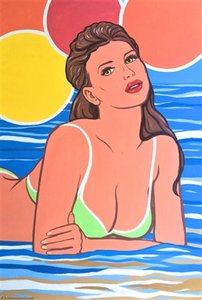
The early 1960s marked a pivotal shift as Strider relocated to New York City—a dynamic epicenter of artistic ferment at the time—where she swiftly established herself as a trailblazer, recognized for paintings that confronted prevailing representations of women with uncompromising honesty. Her signature works featured voluptuous female figures—often depicted in bikinis—rendered with exaggerated curves and a playful yet unsettling energy. These weren’t mere celebrations of femininity; they were deliberate subversions of the objectifying gaze prevalent in popular culture during this era, reflecting a growing awareness of gender dynamics within society. Strider didn't shy away from confronting uncomfortable imagery, amplifying it rather than concealing it—transforming passive objects into assertive presences that demanded attention and provoked viewers to reconsider their own perceptions of beauty and representation. Her participation in the groundbreaking “First International Girlie Show” at Pace Gallery in 1964 cemented her place among a generation of artists—including Rosalyn Drexler, Roy Lichtenstein, Andy Warhol, and Tom Wesselmann—who were redefining artistic boundaries and challenging societal norms. The exhibition’s provocative aesthetic mirrored Strider's own artistic ethos: a refusal to accept conventional standards and an insistence on exploring complex themes related to gender identity and visual culture. Girl with Radish, showcased at this pivotal event, became an enduring symbol of Strider’s artistic vision—a bold declaration against objectification and a celebration of female physicality.
Exploring Three-Dimensional Form & Spatial Engagement
Strider's artistic approach extended beyond painting into sculpture and installation art, demonstrating her profound understanding of materiality and spatial relationships. Influenced by artists like Claes Oldenburg and Patty Oldenburg, she embraced innovative techniques—particularly the use of polyurethane foam—to create monumental sculptures that defied gravity and disrupted traditional notions of artistic form. These pieces weren’t static objects; they pulsed with energy and invited viewers to contemplate their surroundings, blurring the distinction between art and environment. Strider's fascination with spatial exploration stemmed from her belief that art could transcend visual boundaries, engaging audiences on a visceral level—a conviction that underpinned her groundbreaking work in performance art as well. Her involvement in happenings—collaborative artistic events that questioned conventions and embraced spontaneity—reflected her commitment to pushing creative frontiers and fostering dialogue about social issues.
From Happenings to Site-Specific Art: Expanding Artistic Horizons
Around the late 1960s and early 1970s, Strider’s artistic trajectory took an exciting turn toward site-specific art installations—a radical departure from traditional studio practice that signaled her willingness to engage with public spaces and challenge viewers' expectations. Inspired by the work of Vito Acconci and Allan Kaprow, she created artworks designed for particular locations—often transforming ordinary environments into immersive experiences that provoked contemplation and questioned perceptions of space and time. Her piece *Building Work*, presented at MoMa PS1 in 1976, exemplifies this approach—featuring foam tumbling out of windows to disrupt the visual landscape and invite viewers to reconsider their surroundings. Similarly, *Blue Sky*, installed on a spiral staircase at MoMa in 1976, explored the interplay between form and movement, creating an evocative sensory experience for visitors.
Legacy & Continuing Influence
From the 1980s onward, Strider’s artistic focus shifted toward abstract expressionism while retaining her signature tactile surfaces and expressive brushstrokes—a testament to her enduring commitment to experimentation and her ability to adapt her style to evolving aesthetic sensibilities. A retrospective of her career toured museums across the United States from 1982 to 1985, introducing her work to a wider audience and solidifying its place in art history. Even as she explored new mediums and techniques—including textured paintings inspired by artists like Joan Mitchell—Strider never relinquished her pioneering spirit or her unwavering belief in the transformative power of art. Her contribution to Pop Art and the development of soft sculpture remains influential, inspiring contemporary artists to embrace innovation and challenge conventional artistic paradigms. Marjorie Strider’s legacy extends beyond her individual achievements; it resides in her enduring impact on the broader artistic landscape—a reminder that true creativity lies in daring to defy expectations and forging new paths toward expressive exploration.