Franz Defregger muotokuva

89 tunnetuinta Franz Defregger -maalausta, jokainen ainutlaatuinen

Päivitetty marraskuu 2026 · järjestetty suosituimmuuspisteiden mukaan (jokaisen teoksen haut, vierailut ja tilaukset) · 92 teosta taiteilijalta Franz Defregger luettelossamme

Lyhyesti

Going to School on se Franz Defregger -maalaus, joka herättää eniten huomiota. Sen jälkeen katse siirtyy kohteisiin Tyrolean Farmer (1860) ja Zither Player and Two Girls (1860). Franz Defreggerin 92 teoksemme joukosta nämä 89 ovat kuuluisimpia; jokainen on ainutlaatuinen alkuperäisteos, joka on esitelty vuosiluvun, museon ja sen syyn kera, miksi teos on säilyttänyt suosionsa.

1835 – 1921, Strohn Realism Eniten teoksia: Bavarian State Painting Collections

Franz Defregger -taiteilijan 10 parasta maalausta gallerian silmin

1
Going to School tekijä Franz Defregger

Going to School

In Going to School, Franz Defregger captures a lively moment of daily life as a group of nine children makes their way up a hill. The children are dressed for their lessons, some carrying books tucked under their arms. Their movement toward the schoolhouse suggests the start of a busy day.

2
Tyrolean Farmer (1860) tekijä Franz Defregger

Tyrolean Farmer

1860 · Oil On Board

In "Tyrolean Farmer" by Franz Defregger, the world narrows to a single, weathered face. This close-up bust portrait centers an elderly man against a dark, indistinct background that offers no distraction from his presence. He wears a wide-brimmed hat, a silhouette that frames a thick, white beard. The subject, likely a Tyrolean farmer, stares forward from an eye-level perspective. This direct gaze establishes an immediate, quiet emotional connection between the…

3
Zither Player and Two Girls (1860) tekijä Franz Defregger

Zither Player and Two Girls

1860 · Oil

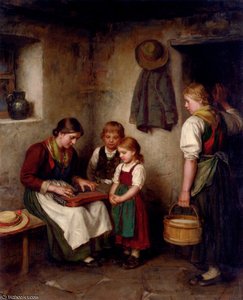
In the painting Zither Player and Two Girls by Franz Defregger, a quiet, domestic scene unfolds within a rustic interior. The composition is centered around three human figures and a dog, arranged in a triangular formation that directs the eye toward the central subject. A man sits on a bench, focused on playing a zither. He is accompanied by two young women dressed in traditional Tyrolean folk attire. In the…

4
Reclining female nude (1860) tekijä Franz Defregger

Reclining female nude

1860 · Oil

In "Reclining female nude" by Franz Defregger, the composition centers on a single figure. The body is positioned diagonally across the frame, leaning against a draped structure. This arrangement creates a sense of quiet repose. The subject rests in a state of stillness, framed by the heavy, vertical folds of fabric that contrast with the organic lines of the anatomy. The perspective is a close-up, eye-level view that draws the…

5
Girl reading (1860) tekijä Franz Defregger

Girl reading

1860 · Oil On Canvas

In "Girl reading" by Franz Defregger, the composition settles into a close-up, medium shot. The subject is captured from the chest up, positioned slightly off-center against a void of deep blacks. This darkness pushes the figure forward, creating a sense of intimacy and quietude. The grayscale palette strips away the distraction of color, leaving only the essential interplay of light and shadow. It is a study of stillness.

6
Portr. of a man with decorations (1860) tekijä Franz Defregger

Portr. of a man with decorations

1860 · Oil

The oil portrait titled Portr. of a man with decorations is a work by the Austrian artist Franz Defregger. Created about 1860, this piece captures an elderly man in a moment of quietude. The subject is rendered with a focus on the weight of years and the presence of his distinction.

7
Liesal girl (half- length ) (1860) tekijä Franz Defregger

Liesal girl (half- length )

1860 · Oil

The artwork titled Liesal girl (half- length ) is a painting by the Austrian artist Franz Defregger. This specific piece was created about 1860. The composition focuses on a single human figure, presented in a half-length format that centers the subject within the frame.

8
Portrait of a young girl (1860) tekijä Franz Defregger

Portrait of a young girl

1860 · Oil On Canvas

Franz Defregger’s Portrait of a young girl, created about 1860, presents a centered, bust-length study of a single subject. The girl is positioned against a dark, indistinct background that pushes her figure toward the viewer. She possesses wavy, dark hair and gazes directly at the observer, establishing an intimate connection through her steady, frontal orientation. This directness is framed by the soft focus and classical realism that define the work's…

9
Peasants in front of the house (1860) tekijä Franz Defregger

Peasants in front of the house

1860 · Oil On Canvas

The scene known as Peasants in front of the house emerges from the brush of Franz Defregger, an artist whose life was deeply rooted in the rugged landscapes of his homeland. Born in Iselsberg-Stronach, Austria, Defregger carries the spirit of the Tyrolean countryside into his work. This particular piece dates to about 1860, a period when the artist was beginning to find his voice amidst the realities of rural existence.…

10
Peasant-scene ( Talk over the marriage ) (1860) tekijä Franz Defregger

Peasant-scene ( Talk over the marriage )

1860 · Oil On Canvas · Deutsches Museum, Berliini

In Peasant-scene ( Talk over the marriage ), Franz Defregger centers the gravity of the room upon a single wooden table. Six peasants gather in a tight semi-circle, their bodies leaning inward to form a closed ring of intimacy. This arrangement traps the viewer within the rustic interior, making the social interaction feel immediate and private. The figures are locked in a serious discussion, perhaps negotiating the terms of a…

Franz Defreggern kuuluisia maalauksia, numerot 11–89

11The Blacksmith (1850) tekijä Franz DefreggerThe Blacksmith1850 · Minneapolis Institute of Art 12the bath of a child (1868) tekijä Franz Defreggerthe bath of a child1868 13The Last Muster (Oil Sketch) (1872) tekijä Franz DefreggerThe Last Muster (Oil Sketch)1872 · Bavarian State Painting Collections 14Tyrolean Home Guard returning from the war of 1809. (1876) tekijä Franz DefreggerTyrolean Home Guard returning from the war of 1809.1876 · Alte Nationalgalerie 15The Visit (1875) tekijä Franz DefreggerThe Visit1875 · Bavarian State Painting Collections 16The Last Contingent (1874) tekijä Franz DefreggerThe Last Contingent1874 17Children with a bird + cage. (1874) tekijä Franz DefreggerChildren with a bird + cage.1874 18Family scene in front of the house (1872) tekijä Franz DefreggerFamily scene in front of the house1872 19Die Kraftprobe (1878) tekijä Franz DefreggerDie Kraftprobe1878 20The Storming of the Roter Turm in the Sendling Bauernschlacht 1705 (1881) tekijä Franz DefreggerThe Storming of the Roter Turm in the Sendling Bauernschlacht 17051881 · Lenbachhaus 21The Storming of the Roter Turm in München by the Oberländer Peasants on Christmas Morning 1705 (1881) tekijä Franz DefreggerThe Storming of the Roter Turm in München by the Oberländer Peasants on Christmas Morning 17051881 · Bavarian State Painting Collections 22Female Portrait in Black (1885) tekijä Franz DefreggerFemale Portrait in Black1885 23Young Peasant Girl (1885) tekijä Franz DefreggerYoung Peasant Girl1885 24Peasant Girl (1885) tekijä Franz DefreggerPeasant Girl1885 25Portrait of a Peasant Girl (1885) tekijä Franz DefreggerPortrait of a Peasant Girl1885 26Tyrolean Woman with Hat (1885) tekijä Franz DefreggerTyrolean Woman with Hat1885 27Man with Beard (1879) tekijä Franz DefreggerMan with Beard1879 28Tyrolean Peasant Woman with Hat (1885) tekijä Franz DefreggerTyrolean Peasant Woman with Hat1885 29The Salon Tyrolean (1882) tekijä Franz DefreggerThe Salon Tyrolean1882 30merry society of young peasants in an inn (1882) tekijä Franz Defreggermerry society of young peasants in an inn1882 31portrait of a girl (1885) tekijä Franz Defreggerportrait of a girl1885 32The young Mother (1884) tekijä Franz DefreggerThe young Mother1884 33Young Girl (1890) tekijä Franz DefreggerYoung Girl1890 34Portrait of a Young Girl (1888) tekijä Franz DefreggerPortrait of a Young Girl1888 35Assembly of Tyrolean Freedom Fighters (1886) tekijä Franz DefreggerAssembly of Tyrolean Freedom Fighters1886 36Tyrolean Hunter (1887) tekijä Franz DefreggerTyrolean Hunter1887 · Augustiner Museum 37portrait of an old man (1890) tekijä Franz Defreggerportrait of an old man1890 38Young man with pipe (1892) tekijä Franz DefreggerYoung man with pipe1892 39The War Council of Andreas Hofer in the Year 1809 (1897) tekijä Franz DefreggerThe War Council of Andreas Hofer in the Year 18091897 · Bavarian State Painting Collections 40The Painter Franz von Lenbach (1895) tekijä Franz DefreggerThe Painter Franz von Lenbach1895 · Lenbachhaus 41The Strength Test (1898) tekijä Franz DefreggerThe Strength Test1898 42interior scene with peasants (1896) tekijä Franz Defreggerinterior scene with peasants1896 43Scene in a country- inn (1899) tekijä Franz DefreggerScene in a country- inn1899 44group of peasant people in a cottage (1899) tekijä Franz Defreggergroup of peasant people in a cottage1899 45The sick dachshund (1903) tekijä Franz DefreggerThe sick dachshund1903 46Girl Portrait with Headscarf (1907) tekijä Franz DefreggerGirl Portrait with Headscarf1907 47Young peasant-girl (1913) tekijä Franz DefreggerYoung peasant-girl1913 48Girl with rake + letter (1915) tekijä Franz DefreggerGirl with rake + letter1915 49Andreas Hofer - Franz von Defregger (2026) tekijä Franz DefreggerAndreas Hofer - Franz von Defregger2026 50The Story Of St. Nicholas tekijä Franz DefreggerThe Story Of St. Nicholas 51The Salon-Tyrolean (1882) tekijä Franz DefreggerThe Salon-Tyrolean1882 · Alte Nationalgalerie 52The Burning Seppenhaus in Reith (1890) tekijä Franz DefreggerThe Burning Seppenhaus in Reith1890 · Lenbachhaus 53Head of girl (1890) tekijä Franz DefreggerHead of girl1890 · Regional Gallery in Liberec 54Bust Portrait of a Tyrolean Peasant tekijä Franz DefreggerBust Portrait of a Tyrolean PeasantBavarian State Painting Collections 55Portrait of a girl tekijä Franz DefreggerPortrait of a girl 56portrait of a peasant tekijä Franz Defreggerportrait of a peasant 57Brand in Reith tekijä Franz DefreggerBrand in Reith 58Schauspieler tekijä Franz DefreggerSchauspieler 59Alte Strasse tekijä Franz DefreggerAlte Strasse 60Erstürmung des Roten Turmes tekijä Franz DefreggerErstürmung des Roten Turmes 61Portrait of the artist tekijä Franz DefreggerPortrait of the artist 62Kindbildnis tekijä Franz DefreggerKindbildnis 63Poacher in the Alpine dairy hut tekijä Franz DefreggerPoacher in the Alpine dairy hut 64Difficult question tekijä Franz DefreggerDifficult questionRegional Gallery in Liberec 65Portrait of a Man tekijä Franz DefreggerPortrait of a ManBavarian State Painting Collections 66Nicolaus Gysis tekijä Franz DefreggerNicolaus Gysis 67Portrait of a girl tekijä Franz DefreggerPortrait of a girl 68Training of monkeys Affendresur tekijä Franz DefreggerTraining of monkeys Affendresur 69Wallfahrer tekijä Franz DefreggerWallfahrer 70Bauernbursch Mit Pfeife tekijä Franz DefreggerBauernbursch Mit Pfeife 71A Pan tekijä Franz DefreggerA Pan 72The Zither Player tekijä Franz DefreggerThe Zither Player 73A tyrolean peasant tekijä Franz DefreggerA tyrolean peasant 74The Last Contingent tekijä Franz DefreggerThe Last ContingentBavarian State Painting Collections 75Hunter And Maid In The Kuchl At Happy Geplauder tekijä Franz DefreggerHunter And Maid In The Kuchl At Happy Geplauder 76A Bavarian Peasant Girl - tekijä Franz DefreggerA Bavarian Peasant Girl - 77Girl Portrait tekijä Franz DefreggerGirl PortraitBavarian State Painting Collections 78A Bavarian Peasant Girl tekijä Franz DefreggerA Bavarian Peasant Girl 79Defegger Franz von Jungen Bauern tekijä Franz DefreggerDefegger Franz von Jungen Bauern 80Ein junges Mädchen (The Little Girl) tekijä Franz DefreggerEin junges Mädchen (The Little Girl) 81Die marchenerzahlerin tekijä Franz DefreggerDie marchenerzahlerin 82The music lesson tekijä Franz DefreggerThe music lesson 83Mother's Pride tekijä Franz DefreggerMother's Pride 84Die erste studienreise tekijä Franz DefreggerDie erste studienreise 85Idle Hours in the Harem tekijä Franz DefreggerIdle Hours in the Harem 86Abschied der jager tekijä Franz DefreggerAbschied der jager 87Der zitherspieler Auf Der Alm tekijä Franz DefreggerDer zitherspieler Auf Der Alm 88A young man in tyrolean costume tekijä Franz DefreggerA young man in tyrolean costume 89The happy family tekijä Franz DefreggerThe happy family

Franz Defreggern kuuluisat maalaukset aikakausittain

Aiheet, jotka vangitsivat Franz Defreggerin katseen

Nämä neljä aihetta toistuvat näissä alkuperäisteoksissa useimmin, jokaisesta löytyy hienoin esimerkki.

Museot, joissa Franz Defregger'n alkuperäisteokset sijaitsevat

Tämän sivun teoksista eniten sisältävät 7 museota.

Museo Kaupunki Franz Defregger teokset Tämän listan maalaukset
Bavarian State Painting Collections, MünchenBavarian State Painting Collections München 8 The Last Muster (Oil Sketch), The Visit, The Storming of the Roter Turm in München by the Oberländer Peasants on Christmas Morning 1705
Lenbachhaus, MünchenLenbachhaus München 3 The Storming of the Roter Turm in the Sendling Bauernschlacht 1705, The Painter Franz von Lenbach, The Burning Seppenhaus in Reith
Alte Nationalgalerie, BerliiniAlte Nationalgalerie Berliini 2 Tyrolean Home Guard returning from the war of 1809., The Salon-Tyrolean
Regional Gallery in Liberec, LiberecRegional Gallery in Liberec Liberec 2 Head of girl, Difficult question
Deutsches Museum, BerliiniDeutsches Museum Berliini 1 Peasant-scene ( Talk over the marriage )
Minneapolis Institute of Art, MinneapolisMinneapolis Institute of Art Minneapolis 1 The Blacksmith
Augustiner Museum, FreiburgAugustiner Museum Freiburg 1 Tyrolean Hunter

Franz Defregger vuosikymmenten varrelta: jokaisesta yksi ainutlaatuinen alkuperäisteos

Teokset vuosikymmenittäin

Valitse vuosikymmen nähdäksesi sen määrittäneen alkuperäisteoksen.

Franz Defreggern maalaukset: kysymyksiä gallerialle

Mikä on Franz Defregger tunnetuin teos?Paljasta vastaus

Going to School. Seuraavina ovat Tyrolean Farmer (1860) ja Zither Player and Two Girls (1860).

Mitkä ovat Franz Defregger kymmenen kuuluisinta maalausta?Paljasta vastaus

Going to School, Tyrolean Farmer, Zither Player and Two Girls, Reclining female nude, Girl reading, Portr. of a man with decorations, Liesal girl (half- length ), Portrait of a young girl, Peasants in front of the house ja Peasant-scene ( Talk over the marriage ). Yllä oleva sijoitus kertoo kunkin teoksen vuosiluvun ja museon.

Kuinka monta Franz Defregger -teosta tunnetaan?Paljasta vastaus

Katalogissamme on 92 teosta taiteilijalta Franz Defregger, aikaväliltä 1850–1915.

Missä voi nähdä tunnetuimmat Franz Defregger -alkuperäisteokset?Paljasta vastaus

Pääasiassa Bavarian State Painting Collections (München), Lenbachhaus (München) ja Alte Nationalgalerie (Berliini). Yllä oleva museotaulukko listaa ne kaikki.

Mihin ajanjaksoon Franz Defregger tunnituimmat maalauksensa sijoittuvat?Paljasta vastaus

Aikakaudella 1880s: 16 sivun 89 teoksista on tehty silloin, joista The Storming of the Roter Turm in the Sendling Bauernschlacht 1705.

Mikä on Franz Defregger kuuluisimmista maalauksista varhaisin ja mikä uusin?Paljasta vastaus

Tällä sivulla vanhin on The Blacksmith (1850) ja uusin Girl with rake + letter (1915).

Mitä aiheita Franz Defregger suosi?Paljasta vastaus

Woman (24), Man (18) ja Portrait (13), yhteensä 89 teosta tällä sivulla.

Mitä materiaaleja Franz Defregger käytti eniten?Paljasta vastaus

Oil On Canvas, 28 teoksesta sivun 89 teoksesta.

Mihin taidesuuntaukseen Franz Defregger kuuluu?Paljasta vastaus

Realism ja Munich school, tämän sivun alkuperäisteosten perusteella.

Mitä Franz Defregger alkuperäisteoksia voin nähdä museossa Bavarian State Painting Collections?Paljasta vastaus

The Last Muster (Oil Sketch), The Visit ja The Storming of the Roter Turm in München by the Oberländer Peasants on Christmas Morning 1705: Bavarian State Painting Collections, München -ssä on 8 tämän sivun teoksista.

Franz Defregger: taiteilijan muotokuva

Early Life and Artistic Awakening in the Tyrolean Landscape

Franz von Defregger emerged from the rugged beauty of Tyrol, Austria, born on April 30, 1835, in the small hamlet of Strohn. His beginnings were deeply rooted in the realities of rural life; his parents, Michael and Maria Defregger, were farmers who instilled within him a profound connection to the land. However, his early years were marked by hardship—a devastating typhoid epidemic tragically claimed the lives of his mother and two sisters when he was still young, casting a long shadow over his childhood. Despite these sorrows, a spark of creativity ignited within him. He displayed an aptitude for music, finding solace and expression in playing the flugelhorn in local bands, a skill that would later inform the rhythmic quality of some of his compositions. Simultaneously, a natural talent for drawing and woodcarving began to blossom as he worked alongside his father on the farm, honing his observational skills and developing a tactile understanding of materials. These early artistic endeavors were entirely self-taught, born from keen observation and a desire to capture the world around him—the changing seasons, the faces of his neighbors, the textures of the mountains. The decision to pursue art professionally came after his father’s death in 1858, a pivotal moment that demanded both courage and sacrifice. Defregger bravely sold the family farm, relinquishing financial security for the uncertain path of an artist—a testament to his unwavering passion and commitment.

Formal Training and the Embrace of Munich

Defregger's artistic journey began in Innsbruck, where he apprenticed with the renowned sculptor Michael Stolz, meticulously refining his skills in woodcarving. However, Stolz quickly recognized that Defregger’s true calling lay not in three-dimensional form but in capturing light and color on a two-dimensional surface. He facilitated an introduction to the influential Karl von Piloty at the Academy of Fine Arts in Munich—a move that proved transformative. From 1860 to 1861, Defregger attended preparatory classes under Hermann Dyck, laying the foundational groundwork for his formal artistic education. This period exposed him to the principles of academic painting and provided a structured framework for developing his technical abilities. A crucial step in his development was a period of study at the École des Beaux-Arts in Paris (1863-1865), where he encountered the Barbizon school—a movement characterized by its emphasis on plein air painting, naturalism, and a rejection of academic conventions. The Barbizon painters’ focus on capturing the essence of nature and their use of loose brushwork profoundly influenced Defregger's style, leading him to prioritize atmospheric effects and a more direct engagement with the landscape. He participated in the Salon des Refusés, an exhibition showcasing works deemed unsuitable by the official Salon jury—a bold move that demonstrated his willingness to challenge established norms and embrace avant-garde approaches.

A Style Rooted in Tyrolean Life and Historical Narrative

Franz von Defregger’s artistic style is instantly recognizable for its realistic depictions of Tyrolean peasant life and significant historical events. His paintings are imbued with a profound sense of nostalgia and sentimentality, resonating deeply with audiences of his time—and continuing to captivate viewers today. He became closely associated with the Munich School, known for its meticulous realism, narrative focus, and often idealized portrayal of rural life. The influence of the Barbizon school is evident in his landscape paintings, which capture the atmospheric beauty of the Tyrolean mountains and valleys with a remarkable sensitivity to light and color. However, Defregger’s true mastery lay in his ability to portray the lives and stories of ordinary people—farmers, storytellers, musicians—with dignity, empathy, and an unwavering attention to detail. Mother’s Pride (1872), for example, offers a tender glimpse into domestic life, while The Storyteller (1876) beautifully captures the warmth of family connection and shared traditions. He frequently returned to scenes from the Tyrolean national uprising of 1809—a defining moment in Tyrolean history—particularly focusing on the heroic figure of Andreas Hofer, a symbol of resistance and cultural identity. Andreas Hofer mit seinen Beratern in Innsbruck (1879) stands as a powerful depiction of this pivotal event, conveying both the drama of battle and the resilience of the human spirit. Other notable works such as Beauty of the Tyrol (1880) and Der Zitherspieler (1876) further showcase his ability to celebrate the beauty of his homeland and capture the essence of traditional Tyrolean culture—a culture deeply intertwined with music, folklore, and a strong sense of community.

Recognition, Legacy, and Enduring Appeal

Defregger’s talent did not go unnoticed. In 1878, he achieved a significant milestone by becoming a professor of history painting at the Munich Art Academy—a position he held until 1910, profoundly influencing generations of aspiring artists. During this time, he fostered a spirit of realism and narrative storytelling, encouraging his students to observe closely, capture emotion authentically, and tell compelling stories through their art. He received numerous accolades throughout his career, including the Order of Merit of Bavaria (1883) and the Prussian Order of Merit for Science and the Arts—recognizing his contributions to both artistic excellence and civic engagement. His work was prominently displayed at the Century of German Art exhibition in Berlin (1906), further solidifying his national recognition as one of Austria’s leading painters. Beyond his artistic achievements, Defregger demonstrated a deep connection to his homeland by building both a private home in Munich (the Defregger House) and a residence in Bolzano (Villa Defregger)—a testament to his enduring love for Tyrol. Streets were even named in his honor in Vienna, Bolzano, and Gries am Brenner—a lasting tribute to the esteem in which he was held. Franz von Defregger passed away on January 2, 1921, in Munich at the age of 85, leaving behind a rich artistic legacy that continues to inspire and captivate audiences today. His paintings serve as poignant reminders of a bygone era—a time when rural life was deeply intertwined with tradition, community, and a profound connection to the land.