


1


Päivitetty lokakuu 2026 · järjestetty suosituimmuuspisteiden mukaan (jokaisen teoksen haut, vierailut ja tilaukset) · 44 teosta taiteilijalta Robert Hope luettelossamme
Lyhyesti
Gallerian silmissä Robert Hopen tunnetuin maalaus on The Presentation by King James III and Queen Margaret of the Banner Known as the Blue Blanket to the Craftsmen in the Year 1482 (1912). Kilmeny ja Edinburgh from Craiglockhart täydentävät kolmikon, jonka jokainen silmä tunnistaa. Galleria esittelee Robert Hope teoksista 44 tunnetuimmat 40 teosta alla; jokainen on alkuperäisteos, josta kerrotaan vuosi, museo sekä teoksen erityispiirteet.


In the quiet intimacy of 1924, Robert Hope captured a scene of profound serenity that transcends the mere depiction of a person. Glints of Gold (Miss Dorothy Salvesen) is more than a portrait; it is an invitation into a private sanctuary of thought and repose. The painting presents a woman draped in a luminous yellow dress, reclining gracefully upon a bed with her head resting softly against a pillow. As…


 Portrait of a Lady with a Motoring Veil1915 · Harris Museum - Art Gallery
12
 A Victorian Debutante1922
13
 A Pageant of the Sea1929
14
 Alderman Eaton1944
15
 Lord Leverhulme and Alderman R. Williams, Mayor of Bebington1945
16
 Melrose
17
 Idle Hours
18
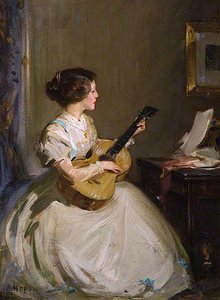 The Guitar Lesson
19
 The Fountain, Princes Street Gardens, EdinburghMcmanus: Dundee's Art Galleries And Museums
20
 A Quiet Pool, Evening
21
 Edinburgh from the ArboretumCity Art Centre
22
 Melrose
23
 The Guitar Lesson
24
 The Blue Veil
25
 Stream in Galloway
26
 An Old Herd
27
 No.8 Howard Place, Edinburgh, 1914
28
 Back of Standing Female NudeEdinburgh College of Art
29
 The Silken Gown
30
 The Glee Maiden
31
 Willows, East LintonJohn Muir House
32
 The Charm
33
 Before the Looking GlassThe Stirling Smith Art Gallery - Museum
34
 The Vanity GlassThe National Trust For Scotland
35
 The Return of the Sardine Fishers, Concarneau
36
 Swanston Cottage, Edinburgh
37
 The Green Door, CulrossThe Stewartry Museum
38
 The Remnant Stall
39
 Woman with BasketJohn Muir House
40
 Workers in a Hay FieldThe Stewartry Museum
Nämä neljä aihetta toistuvat näissä alkuperäisteoksissa useimmin, jokaisesta löytyy hienoin esimerkki.
Tämän sivun teoksista eniten sisältävät 8 museota.
| Museo | Kaupunki | Robert Hope teokset | Tämän listan maalaukset |
|---|---|---|---|
 City Art Centre |
Edinburgh | 2 | Edinburgh from Craiglockhart, Edinburgh from the Arboretum |
 John Muir House |
Haddington | 2 | Willows, East Linton, Woman with Basket |
 The Stewartry Museum |
Cairns | 2 | The Green Door, Culross, Workers in a Hay Field |
 Borders Textile Townhouse |
Hawick | 1 | Kilmeny |
 Royal Scottish Academy of Art - Architecture |
Edinburgh | 1 | Glints of Gold (Miss Dorothy Salvesen) |
 Paisley Art Institute Collection |
Paisley | 1 | The Golden Apple |
 Harris Museum - Art Gallery |
Preston | 1 | Portrait of a Lady with a Motoring Veil |
 Mcmanus: Dundee's Art Galleries And Museums |
Dundee | 1 | The Fountain, Princes Street Gardens, Edinburgh |
Valitse vuosikymmen nähdäksesi sen määrittäneen alkuperäisteoksen.
In the quiet intimacy of 1924, Robert Hope captured a scene of profound serenity that transcends the mere depiction of a person. Glints of Gold (Miss Dorothy Salvesen) is more than a portrait; it is an invitation into a private sanctuary of thought and repose. The painting presents a woman draped in a luminous yellow dress, reclining gracefully upon a bed with her head resting softly against a pillow. As…
The Presentation by King James III and Queen Margaret of the Banner Known as the Blue Blanket to the Craftsmen in the Year 1482 (1912). Seuraavina ovat Kilmeny ja Edinburgh from Craiglockhart.
43 vuotta vanha: The Presentation by King James III and Queen Margaret of the Banner Known as the Blue Blanket to the Craftsmen in the Year 1482 on peräisin vuodelta 1912, ja Robert Hope on syntynyt vuonna 1869.
The Presentation by King James III and Queen Margaret of the Banner Known as the Blue Blanket to the Craftsmen in the Year 1482, Kilmeny, Edinburgh from Craiglockhart, Glints of Gold (Miss Dorothy Salvesen), Inverkeithing, Inverkeithing, The Fountain, Princes Street Gardens, Edinburgh, The Glee Maiden, The Golden Apple ja Swanston Farm, Edinburgh. Yllä oleva sijoitus kertoo kunkin teoksen vuosiluvun ja museon.
Katalogissamme on 44 teosta taiteilijalta Robert Hope, aikaväliltä 1905–1929.
Pääasiassa City Art Centre (Edinburgh), John Muir House (Haddington) ja The Stewartry Museum (Cairns). Yllä oleva museotaulukko listaa ne kaikki.
Aikakaudella 1910s: 3 sivun 40 teoksista on tehty silloin, joista The Presentation by King James III and Queen Margaret of the Banner Known as the Blue Blanket to the Craftsmen in the Year 1482.
Tällä sivulla vanhin on Inverkeithing (1905) ja uusin A Pageant of the Sea (1929).
Elegant woman (3), Victorian era (3) ja Scottish landscape (2), yhteensä 40 teosta tällä sivulla.
Academic realism ja Impressionism, tämän sivun alkuperäisteosten perusteella.
Edinburgh from Craiglockhart ja Edinburgh from the Arboretum: City Art Centre, Edinburgh -ssä on 2 tämän sivun teoksista.

