The Ethereal Landscapes of Ovidio Murguía de Castro
In the fleeting twilight of the nineteenth century, the Spanish art scene was graced by a talent whose life was as brief as it was luminous. Ovidio Murguía de Castro, born in 1871 in the historic enclave of Lestrange, Spain, emerged as a painter capable of capturing the profound soul of the Iberian landscape. Though his career was tragically cut short by his untimely passing in 1900, the works he left behind serve as a poignant window into a bygone era, reflecting a deep, almost spiritual connection to the earth and the atmosphere of his homeland.
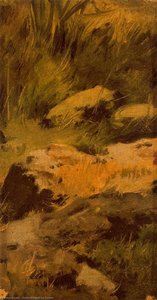
Murguía de Castro’s artistry is characterized by an evocative mastery of light and shadow, a technique that allows the viewer to feel the dampness of the Spanish mist or the warmth of a setting sun. His compositions often transcend mere topographical representation, moving instead toward a romanticized interpretation of nature. Through his brush, the landscapes of Lestrange and beyond become more than just scenery; they become emotional territories where the boundaries between reality and memory seem to blur.
Artistic Vision and Technical Mastery
The development of Murguía de Castro’s style suggests an artist deeply attuned to the nuances of the natural world. His work often features a delicate interplay of textures, where the ruggedness of terrain meets the softness of the sky. This duality creates a sense of movement within his still landscapes, as if the wind itself were captured mid-breath upon the canvas. His influence can be traced back to the broader traditions of Spanish landscape painting, yet he infused his work with a personal sensitivity that distinguishes him from his contemporaries.
To understand the depth of his contribution, one must look at the elements that define his aesthetic:
- Atmospheric Perspective: The use of light to create depth and a sense of vast, breathing space.
- Tonal Harmony: A sophisticated palette that emphasizes the subtle shifts in color found in natural environments.
- Emotional Resonance: An ability to imbue quiet scenes with a sense of nostalgia and profound stillness.
Legacy and Historical Significance
Though Ovidio Murguía de Castro lived only twenty-nine years, his impact on the perception of Spanish landscape art remains significant for collectors and historians alike. He belonged to a generation of artists who sought to find the sublime within their local surroundings, elevating the provincial beauty of Spain to the level of high art. His ability to capture the ephemeral qualities of light makes his paintings timeless, offering a sense of continuity to the nineteenth-century tradition.
Today, his works are cherished not only for their technical merit but as historical artifacts that preserve the essence of late 19th-century Spain. For those exploring the market of fine art reproductions or studying the evolution of Spanish landscape painting, Murguía de Castro represents a vital, albeit brief, chapter of artistic brilliance. His legacy endures through the evocative power of his imagery, reminding us that true artistry can leave an indelible mark on the world, even when the artist's time is tragically short.