


1


Päivitetty lokakuu 2026 · järjestetty suosituimmuuspisteiden mukaan (jokaisen teoksen haut, vierailut ja tilaukset) · 32 teosta taiteilijalta Morris Graves luettelossamme
Lyhyesti
Gallerian silmissä Morris Gravesn tunnetuin maalaus on Bird Singing in the Moonlight (1938). Crow, Surf and Moon (1943) ja Logged Mountains (1943) täydentävät kolmikon, jonka jokainen silmä tunnistaa. Galleria esittelee Morris Graves teoksista 32 tunnetuimmat 30 teosta alla; jokainen on alkuperäisteos, josta kerrotaan vuosi, museo sekä teoksen erityispiirteet.


The Logged Mountains painting by Morris Graves is a thought-provoking artwork that showcases the artist's skill in combining natural elements with artistic expression. Created in 1943, this oil on canvas painting measures 66 x 92 cm and is currently housed at the Smithsonian American Art Museum in the United States. Artist Background Morris Graves was an American artist known for his delicate and contemplative drawings that capture the essence of…


 Woodpeckers1941
12
 Bird And Chalice1939
13
 Folded Wings Memory the Moon Weeping1943
14
 Night Sky No. 21944 · Art Museum
15
 South American Brush Bird1944
16
 Oregon, from the United States Series1948
17
 Young Gander Ready for Flight1952 · The Phillips Collection
18
 August Still Life1952 · The Phillips Collection
19
 Young Gander1952
20
 Bird Masking1953
21
 Marsh Orchids1955 · Art Museum
22
 Spirit Bird1956
23
 Bouquet1954
24
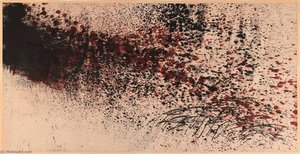 Spring with Machine Age Noise V1957
25
 Flowers1954
26
 Poverty Winter - Still Life1982 · Art Museum
27
 Summer Still Life1988
28
 Hibernation1954
29
 State of the World (Double Necked Vessel)
30
 Winter Flower (Ireland)
Tämän sivun teoksista eniten sisältävät 3 museota.
| Museo | Kaupunki | Morris Graves teokset | Tämän listan maalaukset |
|---|---|---|---|
 Art Museum |
Seattle | 6 | Crow, Surf and Moon, Bird in the Night, Sea, Fish and Constellation |
 The Phillips Collection |
Washington, D.C. | 3 | Surf and Bird, Young Gander Ready for Flight, August Still Life |
 Smithsonian American Art Museum |
Washington, D.C. | 1 | Logged Mountains |
Valitse vuosikymmen nähdäksesi sen määrittäneen alkuperäisteoksen.


Bird Singing in the Moonlight (1938). Seuraavina ovat Crow, Surf and Moon (1943) ja Logged Mountains (1943).
28 vuotta vanha: Bird Singing in the Moonlight on peräisin vuodelta 1938, ja Morris Graves on syntynyt vuonna 1910.
Bird Singing in the Moonlight, Crow, Surf and Moon, Logged Mountains, Surf and Bird, Snake and Moon, Wheelbarrow, Bird in the Night, Sea, Fish and Constellation, Bird in the Spirit ja Nestling. Yllä oleva sijoitus kertoo kunkin teoksen vuosiluvun ja museon.
Katalogissamme on 32 teosta taiteilijalta Morris Graves, aikaväliltä 1934–1988.
Pääasiassa Art Museum (Seattle), The Phillips Collection (Washington, D.C.) ja Smithsonian American Art Museum (Washington, D.C.). Yllä oleva museotaulukko listaa ne kaikki.
Aikakaudella 1940s: 11 sivun 30 teoksista on tehty silloin, joista Crow, Surf and Moon.
Tällä sivulla vanhin on Wheelbarrow (1934) ja uusin Summer Still Life (1988).
Crow, Surf and Moon, Bird in the Night ja Sea, Fish and Constellation: Art Museum, Seattle -ssä on 6 tämän sivun teoksista.