Milton Avery – A Quiet Revolution in Color
Milton Clark Avery, born March 7, 1885, in the small hamlet of Altmar, New York, wasn’t a painter who stormed the art world with manifestos or radical pronouncements. Instead, his revolution unfolded quietly, through a subtle yet profound exploration of color and form that would deeply influence generations of American artists. His early life was steeped in practicality; as the son of a tanner, Avery began working at sixteen to support his family after his father’s untimely death, taking on various blue-collar jobs while nurturing a burgeoning passion for art. This period instilled in him a grounded sensibility, a connection to everyday life that would permeate his work.
Early Life and Influences
Avery's formative years were marked by hardship—the loss of his brother-in-law in 1915 left him responsible for the care of nine female relatives—yet he persevered, pursuing formal training at the Connecticut League of Art Students and later at the Art Students League of New York. These experiences exposed him to the artistic currents of Europe, particularly the bold color palettes of French Fauvism championed by Henri Matisse and the expressive distortions of German Expressionism exemplified by Ernst Ludwig Kirchner. However, Avery didn’t simply imitate these styles; he absorbed their lessons and synthesized them into something uniquely his own—a distillation of observation and emotion that would become the hallmark of his artistic vision.
Developing His Distinctive Style
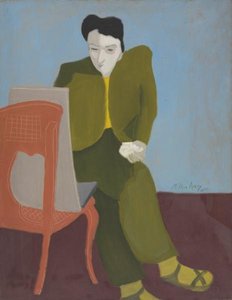
Avery's artistic journey wasn’t one of immediate acclaim. He worked in relative obscurity for decades, refining his technique through tireless experimentation. He began to simplify subjects – landscapes, figures, still lifes – prioritizing color relationships and emotional resonance over meticulous detail. This simplification wasn’t about a lack of skill but rather a deliberate choice to focus on conveying the essence of experience—the “ecstasy of the moment,” as Avery himself described it—through carefully considered hues and shapes. His palette became increasingly luminous, his compositions more spacious and serene.
Recognition and Collaboration with Rothko & Gottlieb
A pivotal moment arrived in 1943 when Avery secured representation from Paul Rosenberg Gallery, a partnership that would propel him to international prominence. Rosenberg recognized the exceptional quality of Avery’s paintings—including *Gaspé Landscape*, which became an instant sensation—and championed his work tirelessly. He collaborated closely with fellow artists Adolph Gottlieb and Mark Rothko, engaging in stimulating conversations about art and aesthetics that further honed Avery's artistic sensibilities. Their shared commitment to exploring color and form paved the way for groundbreaking developments in Color Field painting.
Legacy: An Enduring Influence on American Modernism
Milton Avery’s contribution to American art extends far beyond his own paintings. He served as a crucial bridge between representational painting and the abstract expressionist movement of the 1940s and 50s, inspiring artists like Rothko and Gottlieb. Avery's work demonstrated that a painting didn’t need to meticulously depict reality to convey profound emotional depth; it could achieve this through the expressive power of color, composition, and gesture. His paintings are not merely representations of landscapes or figures but rather evocations of mood, atmosphere, and personal experience—a testament to his unwavering belief in the transformative potential of art. Avery died on January 3, 1965, at Montefiore Hospital in New York City, leaving behind a legacy that continues to inspire artists today. Sally Avery continued to champion his work after his death, donating his papers to the Archives of American Art, ensuring that future generations would have access to the rich intellectual and artistic heritage he created.