Mestari Mateo muotokuva

44 tunnetuinta Mestari Mateo -maalausta, jokainen ainutlaatuinen

Päivitetty lokakuu 2026 · järjestetty suosituimmuuspisteiden mukaan (jokaisen teoksen haut, vierailut ja tilaukset) · 44 teosta taiteilijalta Mestari Mateo luettelossamme

Lyhyesti

The disappeared façade at the end of the Camino (1211) on se Mestari Mateo -maalaus, joka herättää eniten huomiota; alkuperäisteos kuuluu museolle Catedral de Santiago Foundationin museo, Santiago de Compostela. Sen jälkeen katse siirtyy kohteisiin Base of the mullion of the Portico of Glory (1188) ja Trinity of the Portico of Glory (1188). Mestari Mateoin 44 teoksemme joukosta nämä 44 ovat kuuluisimpia; jokainen on ainutlaatuinen alkuperäisteos, joka on esitelty vuosiluvun, museon ja sen syyn kera, miksi teos on säilyttänyt suosionsa.

1161 – 1217 Romanesque Eniten teoksia: Catedral de Santiago Foundationin museo

Mestari Mateo -taiteilijan 10 parasta maalausta gallerian silmin

2
Base of the mullion of the Portico of Glory (1188) tekijä Mestari Mateo

Base of the mullion of the Portico of Glory

1188 · Stone · Catedral de Santiago Foundationin museo, Santiago de Compostela

To stand before the Portico of Glory is to witness a profound shift in the language of stone. This specific base of the mullion, carved around 1188, offers a glimpse into the transition from the rigid forms of the Romanesque to a more fluid, naturalistic sensibility. Here, the stone does not merely exist; it breathes. The sculptor, Master Mateo, utilized a technique known as trabajo vivo, layering limestone to create…

3
Trinity of the Portico of Glory (1188) tekijä Mestari Mateo

Trinity of the Portico of Glory

1188 · Stone · Catedral de Santiago Foundationin museo, Santiago de Compostela

Divine Presence in Stone The capital features God the Father holding the Christ child upon his lap. Above them, the Holy Spirit takes form as a dove at the peak of the composition. Angels surround these central figures, carrying incense burners to complete the celestial scene. This sculptural arrangement uses the trabajo vivo technique, layering stone slabs to create textures that mimic flesh and fabric. The result is a sense…

4
Statue-column of king David (1188) tekijä Mestari Mateo

Statue-column of king David

1188 · Stone · Catedral de Santiago Foundationin museo, Santiago de Compostela

In the hallowed atmosphere of the Santiago Cathedral, where history and spirituality converge, stands a figure of profound majesty: the Statue-column of King David. Carved by the legendary Master Mateo around 1188, this Romanesque masterpiece is far more than a mere architectural ornament; it is a window into the soul of the twelfth century. The sculpture captures the biblical monarch in a moment of eternal resonance, seated upon a cross-frame…

5
The Glory, Central Arch, Portico of Glory (1211) tekijä Mestari Mateo

The Glory, Central Arch, Portico of Glory

1211 · Stone · Catedral de Santiago Foundationin museo, Santiago de Compostela

The Glory, Central Arch, Portico of Glory is a sculptural work by Master Mateo. It forms a primary component of the Portico of Glory, located at the Cathedral of Santiago de Compostela in Spain. This specific section of the portal was part of a complete three-piece set that reached its conclusion in 1211. The work is currently held at The Catedral de Santiago Foundation in Santiago de Compostela.

6
The Elders holding instruments, Central Arch, Portico of Glory (1211) tekijä Mestari Mateo

The Elders holding instruments, Central Arch, Portico of Glory

1211 · Stone · Catedral de Santiago Foundationin museo, Santiago de Compostela

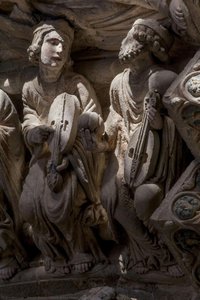
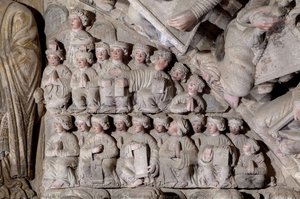
Within the sacred shadows of the Portico of Glory, a profound scene unfolds in stone. The Elders holding instruments, Central Arch, Portico of Glory emerges from the limestone, appearing as if caught in a moment of eternal preparation. This work, created by the hands of Master Mateo, brings the figures of the Apocalypse into a tangible, breathing presence. They sit amidst the radial archivolts, their bodies leaning toward one another…

8
Saint Matthew, Central Arch, Portico of Glory (1211) tekijä Mestari Mateo

Saint Matthew, Central Arch, Portico of Glory

1211 · Stone · Catedral de Santiago Foundationin museo, Santiago de Compostela

The stone breathes under the soft, diffuse light of the cathedral, revealing a figure caught in a moment of eternal devotion. Here, within the central arch of the Portico of Glory, Saint Matthew sits with a quiet, heavy presence. He is a winged presence, his form emerging from the granite with a startling sense of life. He leans over a desk, his knees supporting the weight of his task, as…

9
Saint Luke, Central Arch, Portico of Glory (1211) tekijä Mestari Mateo

Saint Luke, Central Arch, Portico of Glory

1211 · Stone · Catedral de Santiago Foundationin museo, Santiago de Compostela

The limestone relief of Saint Luke, carved around 1211, occupies a central position within the Portico of Glory at the Cathedral of Santiago de Compostela in Spain. The figure is depicted reclining on his right side, a posture that suggests both physical repose and deep introspection. In his left hand, he holds a book, while his head rests upon a lamb, a direct reference to his role as an Evangelist…

10
Arma Christi, Central Arch, Portico of Glory (1211) tekijä Mestari Mateo

Arma Christi, Central Arch, Portico of Glory

1211 · Stone · Catedral de Santiago Foundationin museo, Santiago de Compostela

The relief known as Arma Christi, Central Arch, Portico of Glory is a sculptural work by the artist Master Mateo. This specific piece is situated within the Central Arch of the Portico of Glory. It was created in 1211. The work is part of a larger architectural and sculptural program located at the Santiago de Compostela Cathedral in Galicia, Spain.

Mestari Mateon kuuluisia maalauksia, numerot 11–44

11Santo dos Croques of the Portico of Glory (1200) tekijä Mestari MateoSanto dos Croques of the Portico of Glory1200 · Catedral de Santiago Foundationin museo 12Saint Matthew (1200) tekijä Mestari MateoSaint Matthew1200 · Catedral de Santiago Foundationin museo 13Statues of David and Solomon (1188) tekijä Mestari MateoStatues of David and Solomon1188 · Catedral de Santiago Foundationin museo 14Portico de la Gloria (1168) tekijä Mestari MateoPortico de la Gloria1168 · Cathedral 15Portico de la Gloria (detail) (1168) tekijä Mestari MateoPortico de la Gloria (detail)1168 · Cathedral 16Portico de la Gloria (1168) tekijä Mestari MateoPortico de la Gloria1168 · Cathedral 17Portico de la Gloria (detail) (1168) tekijä Mestari MateoPortico de la Gloria (detail)1168 · Cathedral 18Right arch of the Portico of Glory. Iconography of the condemned (1188) tekijä Mestari MateoRight arch of the Portico of Glory. Iconography of the condemned1188 · Catedral de Santiago Foundationin museo 19Right arch of the Portico of Glory (1188) tekijä Mestari MateoRight arch of the Portico of Glory1188 · Catedral de Santiago Foundationin museo 20Left arch of the Portico of Glory (1188) tekijä Mestari MateoLeft arch of the Portico of Glory1188 · Catedral de Santiago Foundationin museo 21Right columns of the central arch of the Portico of Gloryh (1188) tekijä Mestari MateoRight columns of the central arch of the Portico of Gloryh1188 · Catedral de Santiago Foundationin museo 22Saint Marcus, Central Arch, Portico of Glory (1211) tekijä Mestari MateoSaint Marcus, Central Arch, Portico of Glory1211 · Catedral de Santiago Foundationin museo 23Saint John, Central Arch, Portico of Glory (1211) tekijä Mestari MateoSaint John, Central Arch, Portico of Glory1211 · Catedral de Santiago Foundationin museo 24Ordo Prophetarum, The counter facade, Portico of Glory (1211) tekijä Mestari MateoOrdo Prophetarum, The counter facade, Portico of Glory1211 · Catedral de Santiago Foundationin museo 25The Sybil, The counter facade, Portico of Glory (1211) tekijä Mestari MateoThe Sybil, The counter facade, Portico of Glory1211 · Catedral de Santiago Foundationin museo 26Right arch of the Portico of Glory. Iconography of the blessed (1211) tekijä Mestari MateoRight arch of the Portico of Glory. Iconography of the blessed1211 · Catedral de Santiago Foundationin museo 27Detail of the Elders, Central Arch, Portico of Glory (1211) tekijä Mestari MateoDetail of the Elders, Central Arch, Portico of Glory1211 · Catedral de Santiago Foundationin museo 28Tribune of Portico of Glory (1211) tekijä Mestari MateoTribune of Portico of Glory1211 · Catedral de Santiago Foundationin museo 29Angels, The Tribune, Portico of Glory (1211) tekijä Mestari MateoAngels, The Tribune, Portico of Glory1211 · Catedral de Santiago Foundationin museo 30Portico of Glory (1211) tekijä Mestari MateoPortico of Glory1211 · Catedral de Santiago Foundationin museo 31Keystones from Portico of the Glory (1211) tekijä Mestari MateoKeystones from Portico of the Glory1211 · Catedral de Santiago Foundationin museo 32Detail Maiestas Domini of The Portico of Glory (1211) tekijä Mestari MateoDetail Maiestas Domini of The Portico of Glory1211 · Catedral de Santiago Foundationin museo 33Arma Christi, Central Arch, Portico of Glory (1211) tekijä Mestari MateoArma Christi, Central Arch, Portico of Glory1211 · Catedral de Santiago Foundationin museo 34The Just, Central Arch, Portico of Glory (1211) tekijä Mestari MateoThe Just, Central Arch, Portico of Glory1211 · Catedral de Santiago Foundationin museo 35Detail of the Elders, Central Arch, Portico of Glory (1211) tekijä Mestari MateoDetail of the Elders, Central Arch, Portico of Glory1211 · Catedral de Santiago Foundationin museo 36Detail of the Blessed, Central Arch, Portico of Glory (1211) tekijä Mestari MateoDetail of the Blessed, Central Arch, Portico of Glory1211 · Catedral de Santiago Foundationin museo 37Central Arch of The Portico of Glory (1211) tekijä Mestari MateoCentral Arch of The Portico of Glory1211 · Catedral de Santiago Foundationin museo 38Organistrum, Central Arch, Portico of Glory (1211) tekijä Mestari MateoOrganistrum, Central Arch, Portico of Glory1211 · Catedral de Santiago Foundationin museo 39Drawing José Vega y Verdugo (1656-1657) Archivo de la Catedral (1657) tekijä Mestari MateoDrawing José Vega y Verdugo (1656-1657) Archivo de la Catedral1657 · Catedral de Santiago Foundationin museo 40Left arch of the Portico of Glory. Iconography (1188) tekijä Mestari MateoLeft arch of the Portico of Glory. Iconography1188 · Catedral de Santiago Foundationin museo 41Estatuas-columna de dos profetas procedentes de la desaparecida fachada exterior del Pórtico de la Gloria\n\n- Isaac (1188) tekijä Mestari MateoEstatuas-columna de dos profetas procedentes de la desaparecida fachada exterior del Pórtico de la Gloria\n\n- Isaac1188 · Catedral de Santiago Foundationin museo 42Rose window (1200) tekijä Mestari MateoRose window1200 · Catedral de Santiago Foundationin museo 43Stony choir reconstruction (1211) tekijä Mestari MateoStony choir reconstruction1211 · Catedral de Santiago Foundationin museo 44Lintels Central Arch of The Portico of Glory (1188) tekijä Mestari MateoLintels Central Arch of The Portico of Glory1188 · Catedral de Santiago Foundationin museo

Aiheet, jotka vangitsivat Mestari Mateoin katseen

Nämä neljä aihetta toistuvat näissä alkuperäisteoksissa useimmin, jokaisesta löytyy hienoin esimerkki.

Museot, joissa Mestari Mateo'n alkuperäisteokset sijaitsevat

Tämän sivun teoksista eniten sisältävät 2 museota.

Museo Kaupunki Mestari Mateo teokset Tämän listan maalaukset
Catedral de Santiago Foundationin museo, Santiago de CompostelaCatedral de Santiago Foundationin museo Santiago de Compostela 40 The disappeared façade at the end of the Camino, Base of the mullion of the Portico of Glory, Trinity of the Portico of Glory
Cathedral, Santiago de CompostelaCathedral Santiago de Compostela 4 Portico de la Gloria, Portico de la Gloria (detail), Portico de la Gloria

Mestari Mateo vuosikymmenten varrelta: jokaisesta yksi ainutlaatuinen alkuperäisteos

Teokset vuosikymmenittäin

Valitse vuosikymmen nähdäksesi sen määrittäneen alkuperäisteoksen.

Mestari Mateon maalaukset: kysymyksiä gallerialle

Mikä on Mestari Mateo tunnetuin teos?Paljasta vastaus

The disappeared façade at the end of the Camino (1211), Catedral de Santiago Foundationin museo, Santiago de Compostela. Seuraavina ovat Base of the mullion of the Portico of Glory (1188) ja Trinity of the Portico of Glory (1188).

Missä iässä Mestari Mateo loi teoksen The disappeared façade at the end of the Camino?Paljasta vastaus

50 vuotta vanha: The disappeared façade at the end of the Camino on peräisin vuodelta 1211, ja Mestari Mateo on syntynyt vuonna 1161.

Mitkä ovat Mestari Mateo kymmenen kuuluisinta maalausta?Paljasta vastaus

The disappeared façade at the end of the Camino, Base of the mullion of the Portico of Glory, Trinity of the Portico of Glory, Statue-column of king David, The Glory, Central Arch, Portico of Glory, The Elders holding instruments, Central Arch, Portico of Glory, Voussoirs with the punishment of lust, Saint Matthew, Central Arch, Portico of Glory, Saint Luke, Central Arch, Portico of Glory ja Arma Christi, Central Arch, Portico of Glory. Yllä oleva sijoitus kertoo kunkin teoksen vuosiluvun ja museon.

Kuinka monta Mestari Mateo -teosta tunnetaan?Paljasta vastaus

Katalogissamme on 44 teosta taiteilijalta Mestari Mateo, aikaväliltä 1188–1211.

Missä voi nähdä tunnetuimmat Mestari Mateo -alkuperäisteokset?Paljasta vastaus

Pääasiassa Catedral de Santiago Foundationin museo (Santiago de Compostela) ja Cathedral (Santiago de Compostela). Yllä oleva museotaulukko listaa ne kaikki.

Mihin ajanjaksoon Mestari Mateo tunnituimmat maalauksensa sijoittuvat?Paljasta vastaus

Aikakaudella 1210s: 24 sivun 44 teoksista on tehty silloin, joista The disappeared façade at the end of the Camino.

Mikä on Mestari Mateo kuuluisimmista maalauksista varhaisin ja mikä uusin?Paljasta vastaus

Tällä sivulla vanhin on Base of the mullion of the Portico of Glory (1188) ja uusin The disappeared façade at the end of the Camino (1211).

Mitä aiheita Mestari Mateo suosi?Paljasta vastaus

Sculpture (6), Medieval art (5) ja Stone (4), yhteensä 44 teosta tällä sivulla.

Mitä materiaaleja Mestari Mateo käytti eniten?Paljasta vastaus

Stone, 11 teoksesta sivun 44 teoksesta.

Mihin taidesuuntaukseen Mestari Mateo kuuluu?Paljasta vastaus

Romanesque, tämän sivun alkuperäisteosten perusteella.

Mitä Mestari Mateo alkuperäisteoksia voin nähdä museossa Catedral de Santiago Foundationin museo?Paljasta vastaus

The disappeared façade at the end of the Camino, Base of the mullion of the Portico of Glory ja Trinity of the Portico of Glory: Catedral de Santiago Foundationin museo, Santiago de Compostela -ssä on 40 tämän sivun teoksista.

Mestari Mateo: taiteilijan muotokuva

Santiagon loiston sielu

Mestari Mateo, kuvanveistäjä, jonka nimi pysyy mysteerin peitossa huolimatta hänen monumentaalisesta panoksestaan Catedral de Santiago de Compostela -katedraaliin, seisoo yhtenä Espanjan romaanisen taiteen kunnioitetuimmista hahmoista. Galiciassa noin vuonna 1161 syntyneen Mestari Mateon elämästä on vain vähän tarkkoja yksityiskohtia, mutta hänen perintönsä lepää ensisijaisesti hänen vertaansa vailla olevan saavutuksensa varassa: Portico de la Gloriassa. Tämä henkeäsalpaava arkkitehtoninen ihme hallitsee katedraalin julkisivua ja ilmentää kahdenteentoista vuosisadan hengellistä intoa. Hän nousi kuvanveistäjäksi aikana, jota leimasi kiihkeä uskonnollinen hartaus ja taiteellinen innovaatio, astuen maailmaan, jossa Santiagoon johtava pyhiinvaellusreitti oli jo tuhansille sieluille muutosvoimainen matka.

Hänen suurimman työnsä synty alkoi noin vuonna 1188, kun hänet valittiin valvomaan kolminkertaisen oviaukon luomista, josta tulisi hänen pääteoksensa. Itse katedraaliprojekti oli suunniteltu vuosikymmeniä aiemmin kuningas Alfonso VIII:n aloitteesta, ja sitä ruokki paikan valtava uskonnollinen merkitys. Tämän pyhän kontekstin sisällä Mateo ei ainoastaan veistänyt kiveä; hän puhalsi siihen elämää. Hänen osallistumisensa Portico de la Adamantiin oli jumalallinen hanke, joka muutti rakenteellisen välttämättömyyden teologiseksi narratiiviksi, joka jatkaa lumoamistaan pyhiinvaeltajia ja taidehistorioitsijoita yhtä lailla.
Sinfonia kivessä: tekniikka ja tyyli

Mateon veistotyyliä leimaa hämmästyttävä realismi, joka edusti syvää poikkeamaa aikaisemmista, jäykistä romaanisista konventioista. Siinä missä hänen aikalaistensa tyyli perustui usein tyyliteltyihin ja litteisiin hahmoihin, Mateo tutki tarkasti ihmisen anatomiaa ja kankaiden monimutkaista laskostumista, saavuttaen hämmästyttävän tarkkuuden esityksissään. Hänen mestaruutensa kalkkikiven veistossa oli vertaansa vailla, erityisesti trabajo vivo -tekniikan käytön ansiosta. Tämä menetelmä sisälsi kivilaattojen kerrostamista teksturoitujen pintojen luomiseksi, jotka jäljittelivät lihan ja kankaan ulkonäköä, tuoden liikkeen ja elinvoiman staattiseen materiaaliin.

Tämä innovatiivinen lähestymistapa mahdollisti hänelle kuilun umpeen kuolevaisen ja jumalallisen välillä. Hänen työnsä äärellä voi nähdä, kuinka taitavasti hän käytti valoa ja varjoa syventääkseen reliefejensä ulottuvuutta. Kyky muokata kiveä viittaamaan pyhimyksen kaavun pehmeyteen tai raamatullisen hahmon lihasjännitykseen nosti hänen käsityönsä tasolle, jota nähtiin keskiajalla harvoin. Tämä tekninen loisto varmisti, ettei hänen hahmonsa olleet vain symboleita, vaan käsin kosketeltavia läsnäoloja katedraalin sisäänkäynnillä.

Portico de la Gloria: todistus uskosta

Portico de la Gloria toimii Mestari Mateon taiteellisen ja hengellisen vision lopullisena todistuksena. Sen keskeiset paneelit esittävät syvällisiä kohtauksia evankeliumista – mukaan lukien joulu, ilmoitus ja ristiinnaulitseminen – järjestettynä tavalla, joka opastaa katsojan pyhän historian läpi. Ikonografia on valtava ja monimutkainen, sisältäen:

  • Keskikaari: Sisältää ikonisia hahmoja, kuten Pyhän Luukkaan, jossa monimutkainen romaaninen veisto esittelee syvää uskonnollista symboliikkaa.
  • Vasen kaari: 1100-luvun espanjalaisen relievinveiston mestariteos, joka esittelee yksityiskohtaisia raamatullisia kertomuksia.
  • Oikea kaari: Monimutkaisen kauneuden näyttely, joka osoittaa hänen kykynsä hallita vaativaa arkkitehtonista ja veistoksellista integraatiota.

Näiden teosten kautta Mateo saavutti historiallisen merkittävyyden, joka ylittää hänen syntymäaikansa. Hän siirsi romaanista tyyliä kohti nousevaa gotiikan eleganssia, jättäen jälkeensä perinnön, joka on edelleen Santiagon de Compostelan sydänlyönti. Hänen työnsä seisoo pysyvänä siltana keskiaikaisen mielen ja ikuisuuden välillä, varmistaen, että jopa vuosisatoja hänen kuolemansa (1217) jälkeen, hänen kivisen sinfoniansa loisto jatkaa ihailun herättämistä.