John Francis Murphy muotokuva

John Francis Murphy -maalaukset: Gallerian silmin 39 kuuluisinta teosta

Päivitetty marraskuu 2026 · järjestetty suosituimmuuspisteiden mukaan (jokaisen teoksen haut, vierailut ja tilaukset) · 41 teosta taiteilijalta John Francis Murphy luettelossamme

Lyhyesti

Gallerian silmissä John Francis Murphy's tunnetuin maalaus on Indian Summer (1903), jonka alkuperäinen teos on esillä Smithsonian American Art Museum -museossa, kaupungissa Washington, D.C.. Woods Clearing (1914) ja Sunset Landscape täydentävät kolmikon, jonka jokainen silmä tunnistaa. Galleria esittelee John Francis Murphy teoksista 41 tunnetuimmat 39 teosta alla; jokainen on alkuperäisteos, josta kerrotaan vuosi, museo sekä teoksen erityispiirteet.

1853 – 1921, Oswego Eniten teoksia: Smithsonian American Art Museum

Gallerian 10 parasta John Francis Murphy -maalausta

1
Indian Summer (1903) tekijä John Francis Murphy

Indian Summer

1903 · Oil On Canvas · Smithsonian American Art Museum, Washington, D.C.

We are looking at Indian Summer, a work painted by John Francis Murphy in 1903. This oil on canvas captures a specific, quiet moment in the American landscape, rendered with a sensitivity that defines much of Murphy's output during this period. The scale of the piece is intimate, measuring 16 1/4 x 22 in. (41.2 x 56.0 cm), inviting a close, personal observation of its subtle tonal shifts.

2
Woods Clearing (1914) tekijä John Francis Murphy

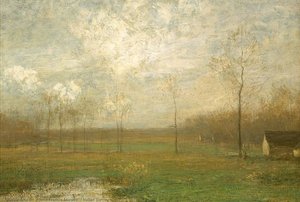
Woods Clearing

1914 · Oil On Canvas

Woods Clearing, painted by John Francis Murphy in 1914, presents a natural landscape centered on a field populated by trees. The work captures a specific moment in the seasonal cycle, focusing on the quietude of the terrain.

4
Eos (1848) tekijä John Francis Murphy

Eos

1848

This statue portrays Prince Albert’s pet greyhound, Eos. The Prince was given her as six-week-old puppy. Although he was only 14 at the time, he brought her up and trained her himself, and she remained his companion until she died on 31 July 1844, when she was ten and a half years old. John Francis, a favourite sculptor of Queen Victoria, exhibited this bronze at the Royal Academy in 1848.

5
October Mist (1902) tekijä John Francis Murphy

October Mist

1902

A Poetic Vision of Autumn: John Francis Murphy's "October Mist" John Francis Murphy’s “October Mist,” painted in 1902, is a captivating example of American Tonalism. This evocative landscape transports the viewer to a serene rural scene, dominated by a solitary tree standing sentinel within a lush field veiled in atmospheric mist. The painting isn't merely a depiction of nature; it's an exploration of mood and feeling, capturing the quiet melancholy…

6
Landscape (1880) tekijä John Francis Murphy

Landscape

1880 · Oil · Metropolitan Museum of Art, New York

is a painting by John Francis Murphy, created about 1880. The artist, who was born in Oswego, United States, in 1853, produced this work during a period of transition in American landscape painting. Murphy lived until 1921, leaving behind a body of work that reflects his specific approach to the natural environment.

John Francis Murphy -taideteokset, sijoitukset 11–39

Aiheet, jotka vangitsivat John Francis Murphyin katseen

Nämä neljä aihetta toistuvat näissä alkuperäisteoksissa useimmin, jokaisesta löytyy hienoin esimerkki.

Museot, joissa John Francis Murphy'n alkuperäisteokset sijaitsevat

Tämän sivun teoksista eniten sisältävät 8 museota.

Museo Kaupunki John Francis Murphy teokset Tämän listan maalaukset
Smithsonian American Art Museum, Washington, D.C.Smithsonian American Art Museum Washington, D.C. 5 Indian Summer, The Path to the Village, Small Landscape
Dallas Museum of Art, DallasDallas Museum of Art Dallas 5 Fence Corner, Landscape, Morning in October
Indianapolisin taidemuseo, IndianapolisIndianapolisin taidemuseo Indianapolis 3 Under Gray Skies, Early Autumn, Landscape
Metropolitan Museum of Art, New YorkMetropolitan Museum of Art New York 2 Landscape, The Old Barn
Museum of Fine Arts, BostonMuseum of Fine Arts Boston 2 Rocky Fields, Sunset
New Britain Museum of American Art, New BritainNew Britain Museum of American Art New Britain 2 New England Meadow in Spring, Afternoon in October
Toledo Museum of Art, ToledoToledo Museum of Art Toledo 1 Sunset
Buffalo AKG Art Museum, BuffaloBuffalo AKG Art Museum Buffalo 1 Neglected Lands

John Francis Murphy, yksi tunnusomainen maalaus vuosikymmeneltä

Teokset vuosikymmenittäin

Valitse vuosikymmen nähdäksesi sen määrittäneen alkuperäisteoksen.

John Francis Murphyn maalaukset: gallerian vastaukset

Mikä John Francis Murphy -taideteos on kaikkien kuuluisin?Paljasta vastaus

Indian Summer (1903), Smithsonian American Art Museum, Washington, D.C.. Seuraavina ovat Woods Clearing (1914) ja Sunset Landscape.

Kuinka vanha John Francis Murphy oli valmistuessaan teos Indian Summer?Paljasta vastaus

50 vuotta vanha: Indian Summer on peräisin vuodelta 1903, ja John Francis Murphy on syntynyt vuonna 1853.

Mitkä ovat John Francis Murphy'n 10 parasta maalausta?Paljasta vastaus

Indian Summer, Woods Clearing, Sunset Landscape, Eos, October Mist, Landscape, The Path to the Village, Rocky Fields, Wooded River Landscape ja Small Landscape. Yllä oleva sijoitus kertoo kunkin teoksen vuosiluvun ja museon.

Kuinka monta teosta John Francis Murphy loi?Paljasta vastaus

Katalogissamme on 41 teosta taiteilijalta John Francis Murphy, aikaväliltä 1880–1917.

Missä John Francis Murphy'n kuuluisimmat alkuperäisteokset sijaitsevat?Paljasta vastaus

Pääasiassa Smithsonian American Art Museum (Washington, D.C.), Dallas Museum of Art (Dallas) ja Indianapolisin taidemuseo (Indianapolis). Yllä oleva museotaulukko listaa ne kaikki.

Milloin John Francis Murphy maalasi kuuluisimmat teoksensa?Paljasta vastaus

Aikakaudella 1900s: 11 sivun 39 teoksista on tehty silloin, joista Indian Summer.

Mitkä ovat John Francis Murphy'n varhaisimmat ja viimeisimmät kuuluisat teokset?Paljasta vastaus

Tällä sivulla vanhin on Landscape (1880) ja uusin Early Autumn (1917).

Mihin aiheisiin John Francis Murphy palasi useimmin?Paljasta vastaus

Landscape (6), Grass (2) ja Trees (2), yhteensä 39 teosta tällä sivulla.

Mitä tekniikkaa John Francis Murphy käytti eniten?Paljasta vastaus

Oil On Canvas, 2 teoksesta sivun 39 teoksesta.

Mitä John Francis Murphy -taiteilijan alkuperäisteoksia Smithsonian American Art Museum -museossa on?Paljasta vastaus

Indian Summer, The Path to the Village ja Small Landscape: Smithsonian American Art Museum, Washington, D.C. -ssä on 5 tämän sivun teoksista.

John Francis Murphy: taiteilija

A Poet of the American Landscape: The Life and Art of John Francis Murphy

John Francis Murphy, born in Oswego, New York, in 1853, emerged as a pivotal figure in American landscape painting during a period of profound artistic transition. His name is inextricably linked with Tonalism, yet to define his work solely by this movement would be to diminish the subtle evolution and quiet innovation that characterized his career. Murphy’s journey began not amidst palettes and easels, but as a sign painter in Chicago – a practical trade that ultimately proved unsatisfying for a spirit yearning for more expressive pursuits. This early experience, however, instilled a foundational understanding of form and color which would later inform his delicate compositions. Dissatisfied with commercial art, he bravely relocated to New York City in 1875, embarking on a path of largely self-directed artistic education. He immersed himself in the study of the masters, frequenting museums and honing his skills through dedicated practice.

From Barbizon Influences to Tonalist Mastery

Murphy’s initial forays into landscape painting were deeply influenced by the Barbizon school – a group of French painters who championed realism and direct observation of nature. He quickly gained recognition, exhibiting at the National Academy of Design as early as 1876. However, it was through his engagement with artists like Alexander Wyant and George Inness that Murphy truly found his artistic voice. These figures emphasized tonal values – the subtle gradations of light and shadow – and atmospheric effects, principles which resonated profoundly with Murphy’s own sensibilities. He wasn't merely replicating what he saw; he sought to capture the *feeling* of a place, the mood evoked by the interplay of light, air, and form. Around 1900, his style began to shift, incorporating more modern approaches to depicting light and atmosphere while retaining the core tenets of Tonalism. This period witnessed a refinement of his technique, marked by increasingly sparse compositions and a masterful use of muted colors – browns, grays, and greens that lent his paintings an air of serene contemplation.

The Pakatakan Artist Colony and Artistic Recognition

In 1887, Murphy established the Pakatakan Artist Colony in Arkville, New York, nestled within the picturesque Catskill Mountains. This haven became a gathering place for artists seeking inspiration from the natural beauty of the region and fostering a collaborative artistic environment. The colony’s influence on Murphy's work is undeniable; the landscapes he produced during his time there are imbued with a sense of quiet intimacy and profound connection to the land. His dedication and talent did not go unnoticed. He was elected an associate of the National Academy of Design in 1885, becoming a full academician just two years later. Further accolades followed, including membership in the Society of American Artists and the American Watercolor Society, as well as prestigious awards like a gold medal at Charleston (1902) and the Inness Medal in 1910. These honors cemented his position as a leading figure in the American art world.

A Legacy of Atmospheric Depth and Poetic Sentiment

Murphy’s paintings are not grand statements or dramatic narratives; they are subtle meditations on the beauty and tranquility of the natural world. Works like October, held by the Corcoran Gallery of Art, and The Path to the Village and Indian Summer, both residing in the National Gallery of Art, exemplify his mastery of atmospheric perspective – creating a convincing illusion of depth and distance through subtle shifts in tone and color. His canvases often depict rural scenes – weathered barns, quiet fields, and winding paths – imbued with a sense of poetic sentiment. He wasn’t simply painting landscapes; he was evoking emotions, inviting viewers to share in his experience of the natural world. His ability to capture the essence of a place, rather than merely its appearance, is what sets him apart. His influence extended beyond his immediate circle, inspiring subsequent generations of artists to explore the expressive possibilities of Tonalism and atmospheric landscape painting. Though he passed away in New York City in 1921 from pneumonia, John Francis Murphy’s legacy endures through the enduring appeal of his paintings – a testament to the power of quiet observation, subtle technique, and profound artistic vision.