Jean-François Raffaëlli: Bridging Realism and Impressionism
Jean-François Raffaëlli (1850–1924) stands as a singular figure in the panorama of French art—a painter who stubbornly clung to the tenets of Realism while simultaneously absorbing the revolutionary spirit of Impressionism. Born in Paris on April 20, 1850, Raffaëlli’s artistic journey began not with grand ambitions but with an unexpected detour into theatrical performance, a formative experience that would profoundly shape his worldview and ultimately inform his distinctive visual language. Despite initial setbacks in this field, he swiftly recognized the allure of painting and enrolled at the École des Beaux-Arts in Paris in 1870, where he studied under Jean-Léon Gérôme—a sculptor and painter whose uncompromising adherence to Academic tradition served as a crucial counterpoint to Raffaëlli’s burgeoning artistic sensibilities.- Early Influences & Training: Raffaëlli's brief academic training instilled in him a meticulous attention to detail and a mastery of classical techniques—skills that would prove invaluable as he embarked on his independent exploration of artistic expression. However, Gérôme’s rigid formalism clashed with Raffaëlli’s innate inclination toward observation and empathy, propelling him towards a path divergent from the prevailing stylistic conventions of the time.
- The Birth of “Caractérisme”: Recognizing the limitations of Academic art, Raffaëlli championed what he termed “caractérisme”—a revolutionary theory that prioritized capturing the essence of human experience rather than merely replicating appearances. This approach demanded a radical departure from traditional artistic conventions and signaled Raffaëlli’s commitment to portraying individuals within their social contexts with unflinching honesty.
A Painter's Vision: Style and Technique
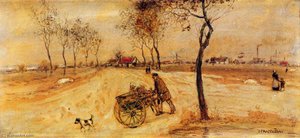
Raffaëlli’s artistic style is characterized by its remarkable blend of Realist precision and Impressionistic luminosity—a duality that distinguishes him from many of his contemporaries. He eschewed the polished surfaces and idealized forms favored by Academic painters, opting instead for earthy palettes and textured brushstrokes that conveyed a palpable sense of immediacy and atmosphere. Influenced by writers like Émile Zola and philosophers such as Hippolyte-Adolphe Taine—artists who championed social realism—Raffaëlli’s canvases pulsated with the energy of everyday life, capturing scenes of urban bustle and rural tranquility alike.- Detailed Observation: Raffaëlli's meticulous attention to detail—evident in his portraits and landscapes—reflects his unwavering belief that art should strive for accuracy and authenticity. He painstakingly rendered textures, colors, and forms, striving to convey not just what he saw but also how it felt.
- Palette & Brushwork: Raffaëlli’s distinctive palette—dominated by muted browns, ochres, and greens—served as a cornerstone of his artistic style. His expressive brushstrokes—loose, fluid, and imbued with palpable energy—contrasted sharply with the smooth, polished surfaces characteristic of Academic painting.
Major Works & Recognition
Raffaëlli’s oeuvre encompasses a diverse range of subjects—from portraits of prominent figures to depictions of marginalized communities—each imbued with profound empathy and social commentary. Among his most celebrated paintings are *Les Déclassés* (1881)—a haunting portrayal of Parisian absinthe drinkers that cemented Raffaëlli's reputation as a champion of Realism—and *At the Caster’s* (1886)—a masterful depiction of urban life that exemplifies Raffaëlli’s commitment to capturing the complexities of modern society. His inclusion in the Impressionist exhibitions of 1880 and 1881—despite initial skepticism from fellow Impressionists—marked a pivotal moment in his artistic career, propelling him into the vanguard of avant-garde art movements. He received the Légion d’honneur in 1889—a testament to his enduring contribution to French culture—solidifying his place as one of the era's most influential artists.- Les Déclassés: This painting remains a cornerstone of Raffaëlli’s artistic legacy, embodying his unwavering commitment to portraying the human condition with compassion and honesty.
- At the Caster’s: Considered by many critics as Raffaëlli's masterpiece, *At the Caster’s* exemplifies his ability to capture the spirit of Parisian life—a feat achieved through meticulous observation and masterful brushwork.
Legacy & Historical Significance
Jean-François Raffaëlli’s artistic legacy extends far beyond his individual paintings—he profoundly influenced subsequent generations of artists who sought to grapple with the challenges posed by modernity while retaining a grounding in humanist values. His “caractérisme”—a theory that championed empathy and social observation—served as an inspiration for artists striving to depict the complexities of human experience with nuance and sensitivity. Raffaëlli’s unwavering dedication to realism—combined with his embrace of Impressionistic techniques—established him as a pivotal figure bridging the gap between tradition and innovation—a testament to his enduring contribution to French art history.Kysymykset ja vastaukset
Voinko selata Jean-François Raffaëlli teoksia tyylisuuntien mukaan?
Kaikki suuntaukset-sivulla Jean-François Raffaëlli:n teokset on ryhmitelty taidesuuntauksen mukaan.
Mistä Jean-François Raffaëlli on kotoisin?
Jean-François Raffaëlli on syntynyt Ranska.
Missä kaupungissa ja maassa Jean-François Raffaëlli on syntynyt?
Jean-François Raffaëlli on syntynyt Pariisi, Ranska.