Jan Baptist Weenix muotokuva

78 tunnetuinta Jan Baptist Weenix -maalausta, gallerian valikoima

Päivitetty marraskuu 2026 · järjestetty suosituimmuuspisteiden mukaan (jokaisen teoksen haut, vierailut ja tilaukset) · 86 teosta taiteilijalta Jan Baptist Weenix luettelossamme

Lyhyesti

Kaikista Jan Baptist Weenix jättämistä alkuperäisteoksista kuuluisin on Tobit, asleep under a vine, is blinded (1642), joka kuuluu Museum Boijmans Van Beuningen -kokoelmaan, Rotterdam. Heti perässä tulevat Italian landscape with shelter and antiques ruins (1658) ja Still Life with a Dead Swan (1651). Katalogissamme on 86 teosta taiteilijalta Jan Baptist Weenix; galleria on säilyttänyt 78 maailman ihailluimmista teoksista, ja jokaisesta on esitetty sen päivämäärä, museo sekä tarina.

1621 – 1659, Amsterdam Dutch golden age Eniten teoksia: Bavarian State Painting Collections

Jan Baptist Weenix -taiteilijan 10 parasta maalausta: gallerian valinnat

1
Tobit, asleep under a vine, is blinded (1642) tekijä Jan Baptist Weenix

Tobit, asleep under a vine, is blinded

1642 · Oil On Canvas · Museum Boijmans Van Beuningen, Rotterdam

A single man reclines in the heavy shade of a vine. He is Tobit, lost to a deep, unsuspecting sleep. The air around him feels thick, weighted by the muted tones of ochre and forest green. Sunlight does not flood this scene; instead, it pierces through the foliage in sharp, controlled beams, illuminating the textures of his slumped posture and the coarse fabric of his clothing. He rests amidst a…

2
Italian landscape with shelter and antiques ruins (1658) tekijä Jan Baptist Weenix

Italian landscape with shelter and antiques ruins

1658 · Oil On Panel · Mauritshuis, Haag

The oil on panel painting titled Italian landscape with shelter and antiques ruins was executed by the artist Jan Baptist Weenix in 1658. This landscape painting depicts a specific pastoral setting within an Italianate environment. The scene is populated by a group of peasants and various livestock, including sheep and goats. These figures are situated near a rustic cottage and several ancient architectural ruins that occupy the landscape.

3
Still Life with a Dead Swan (1651) tekijä Jan Baptist Weenix

Still Life with a Dead Swan

1651 · Oil On Canvas · Detroit Institute of Arts, Detroit

The painting Still Life with a Dead Swan by Jan Baptist Weenix captures a heavy, silent moment of the hunt. Created about 1651, the work presents a collection of fallen game as a trophy of the chase. A white swan rests at the center, its pale plumage a stark contrast to the darker forms surrounding it. This central figure is accompanied by a turkey, two partridges, and a small finch,…

4
Tobit Sleeping Under the Vine (1641) tekijä Jan Baptist Weenix

Tobit Sleeping Under the Vine

1641 · Oil · Museum Catharijneconvent, Utrecht

In this work, titled Tobit Sleeping Under the Vine, we encounter a significant piece by the Dutch Golden Age painter Jan Baptist Weenix. Created around 1642, the painting belongs to the Baroque period, a time when the interplay of light and shadow began to define the dramatic tension of Northern European art. Weenix, born in Amsterdam, Netherlands, brought a disciplined approach to his subjects, often blending meticulous observation with a…

5
The Scissors Grinder (1641) tekijä Jan Baptist Weenix

The Scissors Grinder

1641 · Oil · Bavarian State Painting Collections, München

The air feels heavy with the scent of damp stone and the rhythmic, metallic scrape of steel against stone. Under a vast, expansive sky, a group of figures gathers within the skeletal remains of a classical ruin. A man leans into his work, operating a grinding wheel that cuts through the quietude of the scene. Beside him, a woman sits in repose, while a small child stands close by, watching…

7
Portrait of René Descartes (1647) tekijä Jan Baptist Weenix

Portrait of René Descartes

1647 · Oil · Centraal Museum, Utrecht

In this 1647 oil painting, Jan Baptist Weenix captures the French philosopher René Descartes. The subject appears in a medium close-up, his presence defined by a heavy, somber stillness. He is an elderly man, his face marked by the weight of thought and the passage of years. A bright white collar cuts through the darkness of his attire, framing a pale countenance that emerges from a deep, umber shadow.

8
Monument at a Harbour (1648) tekijä Jan Baptist Weenix

Monument at a Harbour

1648 · Oil · Statens Museum for Kunst, Kööpenhamina

The composition relies on strong vertical elements, primarily through imposing columns and a central, highly ornate pedestal topped with a large urn. These structures anchor the scene, providing a sense of scale against the scattered human figures in the foreground and middle ground. Through a use of deep recession, the perspective draws the eye past a colonnade toward a distant, hazy horizon where the masts of ships are visible.

9
Harbour with Antique Ruins (1648) tekijä Jan Baptist Weenix

Harbour with Antique Ruins

1648 · Oil On Canvas · Nationalmuseum, Tukholma

The scene unfolds in 1648, a moment captured in the oil on canvas known as Harbour with Antique Ruins. This work belongs to the hand of Jan Baptist Weenix, an artist who brings the weight of history into a living, breathing maritime setting. The painting presents a world where the weathered stone of classical antiquity meets the constant, rhythmic movement of a working harbor. It is a vision of a…

10
The Angel Raphael Leaving Tobias's Family (1648) tekijä Jan Baptist Weenix

The Angel Raphael Leaving Tobias's Family

1648 · Oil · Nationalmuseum, Tukholma

In "The Angel Raphael Leaving Tobias's Family" by Jan Baptist Weenix, a divine departure unfolds with sudden, celestial energy. The scene captures the exact moment the Angel Raphael ascends toward the heavens, leaving the family below in a state of profound awe and reverence. A powerful diagonal movement pulls the eye from the lower left foreground upward toward the upper left, where the angelic figure climbs into a swirling formation…

Jan Baptist Weenix-valikoima jatkuu, 11–78

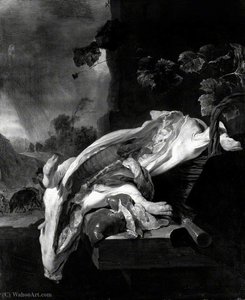
11vegetable-sellers at the house-door, 5 figures (1646) tekijä Jan Baptist Weenixvegetable-sellers at the house-door, 5 figures1646 12caravane near the shore (1646) tekijä Jan Baptist Weenixcaravane near the shore1646 13Mother and Child (1647) tekijä Jan Baptist WeenixMother and Child1647 14Circumcision of Moses' son (1640) tekijä Jan Baptist WeenixCircumcision of Moses' son1640 · National Museum in Warsaw 15Still Life with Game, Hunter and Two Dogs (1652) tekijä Jan Baptist WeenixStill Life with Game, Hunter and Two Dogs1652 · Bavarian State Painting Collections 16Butterfly Dog and Dead Bird (1649) tekijä Jan Baptist WeenixButterfly Dog and Dead Bird1649 · Museum Mayer van den Bergh 17Pleasure boating (1650) tekijä Jan Baptist WeenixPleasure boating1650 18The Sleeping Shepherdess (1658) tekijä Jan Baptist WeenixThe Sleeping Shepherdess1658 · National Gallery of Ireland 19Roman Tinker (1656) tekijä Jan Baptist WeenixRoman Tinker1656 · Städel Museum 20The love letter (1650) tekijä Jan Baptist WeenixThe love letter1650 · National Museum of Art, Architecture and Design 21Italian Harbour (1651) tekijä Jan Baptist WeenixItalian Harbour1651 · Hermitage-museo 22Italian Peasants among Ruins (1650) tekijä Jan Baptist WeenixItalian Peasants among Ruins1650 · Detroit Institute of Arts 23Sleeping girl (1656) tekijä Jan Baptist WeenixSleeping girl1656 · Bavarian State Painting Collections 24Rest on the Flight into Egypt (1657) tekijä Jan Baptist WeenixRest on the Flight into Egypt1657 · Museum Boijmans Van Beuningen 25Merry Company on a Ferry (1649) tekijä Jan Baptist WeenixMerry Company on a Ferry1649 · Museum Gouda 26Battle at the foot of the mountain. (1650) tekijä Jan Baptist WeenixBattle at the foot of the mountain.1650 · National Museum in Warsaw 27Christina Lepper de Kempenaer and Her Children (1653) tekijä Jan Baptist WeenixChristina Lepper de Kempenaer and Her Children1653 28Italian port scene, 1649 (1649) tekijä Jan Baptist WeenixItalian port scene, 16491649 · Centraal Museum 29Italian Landscape with Horsemen by a Spring (1657) tekijä Jan Baptist WeenixItalian Landscape with Horsemen by a Spring1657 · Centraal Museum 30Before the walls of Rome (1650) tekijä Jan Baptist WeenixBefore the walls of Rome1650 · National Museum in Wrocław 31Portrait of a man with a letter (1650) tekijä Jan Baptist WeenixPortrait of a man with a letter1650 · Agnes Etherington Art Center 32A Landscape with a Ford (1660) tekijä Jan Baptist WeenixA Landscape with a Ford1660 · Regional Gallery in Liberec 33In the Campagna (1669) tekijä Jan Baptist WeenixIn the Campagna1669 · National Gallery of Ireland 34Dead Fowl Being Eaten by a Cat (1653) tekijä Jan Baptist WeenixDead Fowl Being Eaten by a Cat1653 · Städel Museum 35Departure of an Oriental Entourage (1647) tekijä Jan Baptist WeenixDeparture of an Oriental Entourage1647 · Louvre 36Display of Dead Game (1641) tekijä Jan Baptist WeenixDisplay of Dead Game1641 · Petit Palais 37Dead Game (1641) tekijä Jan Baptist WeenixDead Game1641 38River Landscape with a Ferry (1650) tekijä Jan Baptist WeenixRiver Landscape with a Ferry1650 · Montrealin hienotaidemuseo 39Still Life with Dead Game and Poultry (1656) tekijä Jan Baptist WeenixStill Life with Dead Game and Poultry1656 · Centraal Museum 40Still Life with Fowl (1650) tekijä Jan Baptist WeenixStill Life with Fowl1650 · Museum of Fine Arts Ghent (MSK) 41Marine with a Venetian Bucintoro (1650) tekijä Jan Baptist WeenixMarine with a Venetian Bucintoro1650 · Staatliche Kunsthalle Karlsruhe 42The Dutch Ambassador on his Way to Isfahan, Jan Baptist Weenix, 1653 - 1659 (1659) tekijä Jan Baptist WeenixThe Dutch Ambassador on his Way to Isfahan, Jan Baptist Weenix, 1653 - 16591659 · Rijksmuseum 43After the Hunt, Jan Baptist Weenix, c. 1656 (1656) tekijä Jan Baptist WeenixAfter the Hunt, Jan Baptist Weenix, c. 16561656 · Rijksmuseum 44Still Life with White Mouse (1680) tekijä Jan Baptist WeenixStill Life with White Mouse1680 · Ernest Zmeták Art Gallery 45Still Life with Game tekijä Jan Baptist WeenixStill Life with GameHarvard Art Museums 46The Ford in the River (1647) tekijä Jan Baptist WeenixThe Ford in the River1647 · Hermitage-museo 47Harbor View with Rider in Oriental Dress, tekijä Jan Baptist WeenixHarbor View with Rider in Oriental Dress,Groninger Museum 48The Holy Women at the Tomb tekijä Jan Baptist WeenixThe Holy Women at the TombNational Gallery of Ireland 49An Italian Seaport tekijä Jan Baptist WeenixAn Italian SeaportRoyal Museum of Fine Arts Antwerp 50Architectural interior with foreign shippers, ruins and a shipyard beyond tekijä Jan Baptist WeenixArchitectural interior with foreign shippers, ruins and a shipyard beyond 51Study of a sheep tekijä Jan Baptist WeenixStudy of a sheep 52A pig's carcase tekijä Jan Baptist WeenixA pig's carcase 53The Tinker and His Dog tekijä Jan Baptist WeenixThe Tinker and His Dog 54Landscape with Peasants and Animals tekijä Jan Baptist WeenixLandscape with Peasants and Animals 55Dead Partridge (1650) tekijä Jan Baptist WeenixDead Partridge1650 · Mauritshuis 56Goat Lying Down, Jan Baptist Weenix, 1645 - 1660 (1660) tekijä Jan Baptist WeenixGoat Lying Down, Jan Baptist Weenix, 1645 - 16601660 · Rijksmuseum 57A Dog and a Cat near a partially disembowelled Deer, Jan Baptist Weenix, 1645 - 1660 (1660) tekijä Jan Baptist WeenixA Dog and a Cat near a partially disembowelled Deer, Jan Baptist Weenix, 1645 - 16601660 · Rijksmuseum 58Still Life with Dead Poultry, Lidded Pitcher and Passglas tekijä Jan Baptist WeenixStill Life with Dead Poultry, Lidded Pitcher and PassglasBavarian State Painting Collections 59Game-piece tekijä Jan Baptist WeenixGame-pieceNational Gallery of Ireland 60Dead game and hunting tackle in landscape tekijä Jan Baptist WeenixDead game and hunting tackle in landscape 61Hound with a Joint of Meat and a Cat Looking on tekijä Jan Baptist WeenixHound with a Joint of Meat and a Cat Looking on 62Bouquet of flowers tekijä Jan Baptist WeenixBouquet of flowersGemäldegalerie 63Shipping in Harbour tekijä Jan Baptist WeenixShipping in Harbour 64Herons and Lapwings tekijä Jan Baptist WeenixHerons and Lapwings 65Still Life of Dead Game in a Landscape with a Huntsman tekijä Jan Baptist WeenixStill Life of Dead Game in a Landscape with a Huntsman 66An italian port scene tekijä Jan Baptist WeenixAn italian port scene 67Shepherds and Flocks among Classical Ruins tekijä Jan Baptist WeenixShepherds and Flocks among Classical Ruins 68A Coast Scene with Classical Ruins tekijä Jan Baptist WeenixA Coast Scene with Classical RuinsWallace Collection 69Still Life with Dead Game tekijä Jan Baptist WeenixStill Life with Dead Game 70Hounds and an Owl with Dead Birds and Sculptures in a Landscape tekijä Jan Baptist WeenixHounds and an Owl with Dead Birds and Sculptures in a Landscape 71Still Life with Dead Birds tekijä Jan Baptist WeenixStill Life with Dead Birds 72Family in a Mediterranean Seaport tekijä Jan Baptist WeenixFamily in a Mediterranean Seaport 73Figures near a Seaport tekijä Jan Baptist WeenixFigures near a SeaportScottish National Gallery 74A Huntsman cutting up a Dead Deer, with Two Deerhounds tekijä Jan Baptist WeenixA Huntsman cutting up a Dead Deer, with Two DeerhoundsNational Gallery 75Ancient Ruins tekijä Jan Baptist WeenixAncient RuinsSzépművészeti Múzeum 76Figures among ruins tekijä Jan Baptist WeenixFigures among ruinsThe Kremer Collection 77Ancient Ruins (detail) tekijä Jan Baptist WeenixAncient Ruins (detail)Szépművészeti Múzeum 78Girl as Shepherdess (1650) tekijä Jan Baptist WeenixGirl as Shepherdess1650 · Musée de Picardie

Jan Baptist Weenixn kuuluisat maalaukset aikakausittain

Aiheet, jotka vangitsivat Jan Baptist Weenixin katseen

Nämä neljä aihetta toistuvat näissä alkuperäisteoksissa useimmin, jokaisesta löytyy hienoin esimerkki.

Museot, joissa Jan Baptist Weenix'n alkuperäisteokset sijaitsevat

Tämän sivun teoksista eniten sisältävät 8 museota.

Museo Kaupunki Jan Baptist Weenix teokset Tämän listan maalaukset
Bavarian State Painting Collections, MünchenBavarian State Painting Collections München 4 The Scissors Grinder, Still Life with Game, Hunter and Two Dogs, Sleeping girl
Centraal Museum, UtrechtCentraal Museum Utrecht 4 Portrait of René Descartes, Italian port scene, 1649, Italian Landscape with Horsemen by a Spring
National Gallery of Ireland, DublinNational Gallery of Ireland Dublin 4 The Sleeping Shepherdess, In the Campagna, The Holy Women at the Tomb
Rijksmuseum, AmsterdamRijksmuseum Amsterdam 4 The Dutch Ambassador on his Way to Isfahan, Jan Baptist Weenix, 1653 - 1659, After the Hunt, Jan Baptist Weenix, c. 1656, Goat Lying Down, Jan Baptist Weenix, 1645 - 1660
Museum Boijmans Van Beuningen, RotterdamMuseum Boijmans Van Beuningen Rotterdam 2 Tobit, asleep under a vine, is blinded, Rest on the Flight into Egypt
Mauritshuis, HaagMauritshuis Haag 2 Italian landscape with shelter and antiques ruins, Dead Partridge
Detroit Institute of Arts, DetroitDetroit Institute of Arts Detroit 2 Still Life with a Dead Swan, Italian Peasants among Ruins
Nationalmuseum, TukholmaNationalmuseum Tukholma 2 Harbour with Antique Ruins, The Angel Raphael Leaving Tobias's Family

Jan Baptist Weenix vuosi vuodelta: jokaisen vuoden määrittävät alkuperäisteokset

Vuosien 1640–1659 välillä Jan Baptist Weenix työskenteli 20 vuotta: valinta seuraa tätä pitkää uraa vuosi vuodelta, taiteilijan hienoimpien alkuperäisteosten kautta.

Teokset vuosittain

Valitse vuosi nähdäksesi alkuperäisteokset.

Keräilijöiden kysymyksiä Jan Baptist Weenix -taiteilijan maalauksista

Mistä teoksesta Jan Baptist Weenix on tunnetuin?Paljasta vastaus

Tobit, asleep under a vine, is blinded (1642), Museum Boijmans Van Beuningen, Rotterdam. Seuraavina ovat Italian landscape with shelter and antiques ruins (1658) ja Still Life with a Dead Swan (1651).

Kuinka vanha Jan Baptist Weenix oli, kun Tobit, asleep under a vine, is blinded tehtiin?Paljasta vastaus

21 vuotta vanha: Tobit, asleep under a vine, is blinded on peräisin vuodelta 1642, ja Jan Baptist Weenix on syntynyt vuonna 1621.

Mitkä ovat kymmenen kuuluisinta Jan Baptist Weenix -taideteosta?Paljasta vastaus

Tobit, asleep under a vine, is blinded, Italian landscape with shelter and antiques ruins, Still Life with a Dead Swan, Tobit Sleeping Under the Vine, The Scissors Grinder, Hunters Near Ruins, Portrait of René Descartes, Monument at a Harbour, Harbour with Antique Ruins ja The Angel Raphael Leaving Tobias's Family. Yllä oleva sijoitus kertoo kunkin teoksen vuosiluvun ja museon.

Kuinka monta maalausta Jan Baptist Weenix jätti jälkeensä?Paljasta vastaus

Katalogissamme on 86 teosta taiteilijalta Jan Baptist Weenix, aikaväliltä 1640–1659.

Missä museoissa Jan Baptist Weenix's mestariteokset sijaitsevat?Paljasta vastaus

Pääasiassa Bavarian State Painting Collections (München), Centraal Museum (Utrecht) ja National Gallery of Ireland (Dublin). Yllä oleva museotaulukko listaa ne kaikki.

Minä vuosina Jan Baptist Weenix maalasi kuuluisimmat teoksensa?Paljasta vastaus

Aikakaudella 1650: 11 sivun 78 teoksista on tehty silloin, joista Pleasure boating.

Mitkä ovat Jan Baptist Weenix ensimmäinen ja viimeinen tunnettua alkuperäisteosta?Paljasta vastaus

Tällä sivulla vanhin on Circumcision of Moses' son (1640) ja uusin The Dutch Ambassador on his Way to Isfahan, Jan Baptist Weenix, 1653 - 1659 (1659).

Mitä aiheita Jan Baptist Weenix käytti useimmiten?Paljasta vastaus

Landscape (18), Ruins (17) ja Sky (13), yhteensä 78 teosta tällä sivulla.

Mitä tekniikkaa Jan Baptist Weenix käytti eniten?Paljasta vastaus

Oil On Canvas, 30 teoksesta sivun 78 teoksesta.

Mihin taidesuuntaukseen Jan Baptist Weenix kuuluu?Paljasta vastaus

Dutch golden age ja Baroque, tämän sivun alkuperäisteosten perusteella.

Mitä Jan Baptist Weenix -teoksia Bavarian State Painting Collections -museossa on esillä?Paljasta vastaus

The Scissors Grinder, Still Life with Game, Hunter and Two Dogs ja Sleeping girl: Bavarian State Painting Collections, München -ssä on 4 tämän sivun teoksista.

Jan Baptist Weenix: elämä ja tuotanto

Hollannin kultakauden visionääri

Jan Baptist Weenix nousee esiin ainutlaatuisena hahmona Hollannin kultakaudella, ja häntä juhlitaan erityisesti hänen omaperäisestä kykynsä vuoksi yhdistää äärimmäinen tarkkaavaisuus ja mielikuvituksellinen visio. Vaikka hänen taiteellinen tuotantonsa oli määrällisesti vaatimattomampaa verrattuna aikalaisten, kuten Rembrandtin tai Vermeerin, kuin muiden, Weenixin panos hollantilaiselle taidehistorialle on kiistaton. Erityisen merkittävää oli hänen mullistava tapansa tutkia italialaisia maisemia ihmishahmojen kera, mikä loi tyylillisen esikuvan, joka resonoi useissa seuraavissa sukupolvissa. Amsterdamissa, vilkkaan sataman läheisyydessä vuonna 1621 syntynyt Weenix polveutui arkkitehtisukuun, ja tämä tausta vaikutti todennäköisesti hänen muotoutumiseensa aikakauden älyllisen ja rakenteellisen kukoistuksen keskellä.

Huolimatta henkilökohtaisista haasteista – kertomusten mukaan hän kärsi puhevaikeuksista sairauden vuoksi – Weenixilla oli intohimoinen rakkaus kirjallisuuteen ja taiteeseen. Hänen äitinsä tuki tätä intohimoa järjestämällä hänelle oppisopimuksen Jan Mickerin, Rembrandtin lanko, johdon alle. Tämä varhainen koulutus antoi hänelle kurinalaisen lähestymän piirtämiseen ja havainnointiin, josta tuli hänen koko tuotantonsa tavaramerkki. Hän hioi taitojaan edelleen Utrechtissa Abraham Bloemaertin ohjauksessa ja palasi myöhemmin Amsterdamiin opiskelemaan Claes Corneliszoon Moeyaertin kanssa, mikä vahvisti hänen juuriaan Alankomaiden vallitsevissa taidesuuntauksissa.

Matka valon ja maiseman äärellä

Weenixin uran suunta muuttui pysyvästi matkojen myötä, erityisesti hänen matkallaan Roomaan vuonna 1643 Nicolaes Pieterszoon Berchemin seurassa. Tämä retki mahdollisti hänet kohtaamaan Bentvueghels-killan eläväisen älyllisen ja taiteellisen piirin, mikä työnsi häntä kohti laajempaa tyylillistä kirjoa. Roomassa hän omaksui italialaisen tyylin, jota leimasivat lämmin, kultainen valo ja klassiset maisemat; ne loivat kauniin vastakohdan perinteisen hollantilaisen maalaustaiteen viileämmille ja melankolisemmille sävyille. Tämä roomalaisvaikutteinen ajanjakso antoi hänelle mahdollisuuden hallita "italialaista maisemaa", jossa Etelä-Euroopan karu kauneus uudelleentulkittiin pohjoiseurooppalaisen linssin läpi.

Tämän aikakauden teokset yhdistelivät usein klassisten ympäristöjen suuruuden intiimeihin, inhimillisiin elementteihin. Olipa kyseessä merenkulun kauppaa kuiskaavat satamanäkymät tai ajattomuuden tunnetta herättävät laajat näkymät, Weenixilla oli ainutlaatuinen kyky vangita paikan tunnelma. Hänen mestaruutensa ei rajoittunut vain kaukaisiin horisontteihin; hän oli yhtä taitava tavoittamaan elämän hiljaisen ja usein aistillisen todellisuuden asetelmissaan. Hänen kuvauksensa metsästyssaaliista ja eläimistä olivat hämmästyttävän realistisia, ja jokainen tekstuuri – metsästyskoiran karkeasta turkista höyhenten herkkään kiiltoon – oli toteutettu henkeäsalpaavalla tarkkuudella.

Realismin ja taiteellisuuden perintö

Jan Baptist Weenixin merkitys piilee hänen kykyssään rakentaa silta hollantilaisen perinteen karun realismin ja italialaisen liikkeen idealisoidun kauneuden välille. Hänen monipuolisuutensa antoi hänelle mahdollisuuden liikkua eri aiheiden välillä, dramaattisesta jännityksestä teoksissa kuten After the Hunt aina eläintutkielmiensa hiljaiseen, lähes vakavaan intensiteettiin. Hänen siveltimensä kautta katsoja kutsutaan maailmaan, jossa havaitun luonnon ja kuvitellun klassisen menneisyyden rajat hämärtyvät kauniisti.

Kun pohdimme hänen elämäänsä ja työtään, useat avainelementit määrittelevät hänen pysyvän merkityksensä:

  • Tyylillinen innovaatio: Hän oli uranuurtaja italialaisten maisemaelementtien integroimisessa hollantilaiseen perinteeseen, luoden uuden visuaalisen kielen aikansa taiteilijoille.
  • Tekninen mestaruus: Hänen kurinalainen koulutuksensa mahdollisti poikkeuksellisen tason yksityiskohdissa niin suurissa maisemissa kuin intiimeissä asetelmissakin.
  • Monipuolisuus: Kyky liikkua saumattomasti satamanäkymien, metsästysaiheiden ja eläinmuotokuvien välillä osoittaa harvinaista lahjakkuutta.
  • Historiallinen vaikutus: Bentvueghels-killan jäsenenä hän auttoi edistämään taiteellisten ideoiden kansainvälistä vaihtoa, joka määritteli 1600-luvun taidemaailmaa.

Vaikka hänen elämänsä oli suhteellisen lyhyt päättyen vuonna 1661, Jan Baptist Weenixin jättämä jälki näkyy edelleen maisemamaalauksen kehityksessä. Hän opetti tuleville sukupolville, kuinka horisonttia ei tule katsoa vain rajana, vaan kankaana valolle, historialle ja inhimillisille tunteille.