


1


Päivitetty marraskuu 2026 · järjestetty suosituimmuuspisteiden mukaan (jokaisen teoksen haut, vierailut ja tilaukset) · 28 teosta taiteilijalta Henri Evenepoel luettelossamme
Lyhyesti
Man in Red (1894) on se Henri Evenepoel -maalaus, joka herättää eniten huomiota; alkuperäisteos kuuluu museolle Musées Royaux Des Beaux, Bryssel. Sen jälkeen katse siirtyy kohteisiin My Ill Grandfather (1892) ja Charles Milcendeau (1899). Henri Evenepoelin 28 teoksemme joukosta nämä 26 ovat kuuluisimpia; jokainen on ainutlaatuinen alkuperäisteos, joka on esitelty vuosiluvun, museon ja sen syyn kera, miksi teos on säilyttänyt suosionsa.


This portrait, titled Charles Milcendeau, was painted by Henri Evenepoel in 1899. It captures a specific individual, Charles Edmond Théodore Soullans, who is known to us through this work as Charles Milcendeau. The painting offers a direct encounter with the subject, presented in a way that feels both personal and quiet.


 Count Aymer de la Chevalerie1896 · Royal Museum of Fine Arts Antwerp
12
 The running girl1895 · Royal Museum of Fine Arts Antwerp
13
 Wrestling Barrack at a Fair1898 · Royal Museum of Fine Arts Antwerp
14
 The Poulterer1897 · Royal Museum of Fine Arts Antwerp
15
 The Box1896 · Royal Museum of Fine Arts Antwerp
16
 Portrait of Edward Tuck, Vice-Consul of the United States in Paris1899 · Museum of Fine Arts Ghent (MSK)
17
 Sunday at the Bois de Boulogne1899 · Royal Museum of Fine Arts Antwerp
18
 Sunday in the Bois de Boulogne1891
19
 Orange Market at Blida1898 · Kuninkaalliset Taidemuseot Brysselissä
20
 Sunday Fair at Les Invalides1897 · Royal Museum of Fine Arts Antwerp
21
 Mendiant. Algerie1897
22
 Veterans' Festival1898 · Musées Royaux des Beaux-Arts
23
 Henriette in a Large Hat1899 · Musées Royaux Des Beaux
24
 La chambre de l'artiste
25
 Charles in a Striped Jersey1898
26
 The Spaniard in Paris1899 · Museum of Fine Arts Ghent (MSK)
Tämän sivun teoksista eniten sisältävät 8 museota.
| Museo | Kaupunki | Henri Evenepoel teokset | Tämän listan maalaukset |
|---|---|---|---|
 Royal Museum of Fine Arts Antwerp |
Antwerpen | 10 | My Ill Grandfather, Louise in Mourning, Returning from Work at Sunset |
 Museum of Fine Arts Ghent (MSK) |
Gent | 4 | Portrait of Hélène Roulet, the Wife of the Artist Adolphe Crespin, The Clown, Portrait of Edward Tuck, Vice-Consul of the United States in Paris |
 Musées Royaux Des Beaux |
Bryssel | 2 | Man in Red, Henriette in a Large Hat |
 Kuninkaalliset Taidemuseot Brysselissä |
Bryssel | 2 | Pictures - Portrait of Louis Charles Crespin, Orange Market at Blida |
 Musée d'Orsay |
Pariisi | 1 | Charles Milcendeau |
 Städel Museum |
Frankfurt | 1 | In the Café d'Harcourt in Paris |
 Museum of Fine Arts |
Houston | 1 | At the Moulin Rouge |
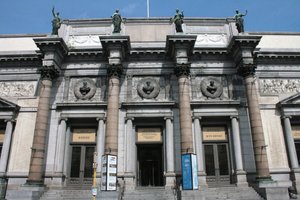 Musées Royaux des Beaux-Arts |
Bryssel | 1 | Veterans' Festival |
Henri Evenepoel’n täällä esitetyt alkuperäisteokset sijoittuvat noin kymmenen vuoden ajalle, 1891–1899: katse seuraa niitä vuosi vuodelta.
Valitse vuosi nähdäksesi alkuperäisteokset.

Lisää teoksia 1895
Lisää teoksia 1896
This portrait, titled Charles Milcendeau, was painted by Henri Evenepoel in 1899. It captures a specific individual, Charles Edmond Théodore Soullans, who is known to us through this work as Charles Milcendeau. The painting offers a direct encounter with the subject, presented in a way that feels both personal and quiet.
Lisää teoksia 1899
Man in Red (1894), Musées Royaux Des Beaux, Bryssel. Seuraavina ovat My Ill Grandfather (1892) ja Charles Milcendeau (1899).
22 vuotta vanha: Man in Red on peräisin vuodelta 1894, ja Henri Evenepoel on syntynyt vuonna 1872.
Man in Red, My Ill Grandfather, Charles Milcendeau, In the Café d'Harcourt in Paris, Pictures - Portrait of Louis Charles Crespin, At the Moulin Rouge, Portrait of Hélène Roulet, the Wife of the Artist Adolphe Crespin, The Clown, Louise in Mourning ja Returning from Work at Sunset. Yllä oleva sijoitus kertoo kunkin teoksen vuosiluvun ja museon.
Katalogissamme on 28 teosta taiteilijalta Henri Evenepoel, aikaväliltä 1891–1899.
Pääasiassa Royal Museum of Fine Arts Antwerp (Antwerpen), Museum of Fine Arts Ghent (MSK) (Gent) ja Musées Royaux Des Beaux (Bryssel). Yllä oleva museotaulukko listaa ne kaikki.
Aikakaudella 1897: 5 sivun 26 teoksista on tehty silloin, joista In the Café d'Harcourt in Paris.
Tällä sivulla vanhin on Sunday in the Bois de Boulogne (1891) ja uusin Charles Milcendeau (1899).
My Ill Grandfather, Louise in Mourning ja Returning from Work at Sunset: Royal Museum of Fine Arts Antwerp, Antwerpen -ssä on 10 tämän sivun teoksista.


