


1


Päivitetty lokakuu 2026 · järjestetty suosituimmuuspisteiden mukaan (jokaisen teoksen haut, vierailut ja tilaukset) · 23 teosta taiteilijalta Harry Morley luettelossamme
Lyhyesti
Gallerian silmissä Harry Morley's tunnetuin maalaus on Holiday (1935), jonka alkuperäinen teos on esillä The Geffrye -museossa, kaupungissa Lontoo. Charles George Ammon (1873–1960), 1st Baron Ammon of Camberwell, MP ja Doctor Alfred Wilson Emms (1850–1920) (1905) täydentävät kolmikon, jonka jokainen silmä tunnistaa. Galleria esittelee Harry Morley teoksista 23 tunnetuimmat 23 teosta alla; jokainen on alkuperäisteos, josta kerrotaan vuosi, museo sekä teoksen erityispiirteet.


 The Trial by Combat of Henry de Essex and Robert de Montfort at Reading, 8 April 11631918 · Reading Museum - Town Hall
12
 A Wayside Madonna1927 · New Walk Museum - Art Gallery
13
 The Judgement of Paris1929
14
 The Miles Arms Hotel, Avonmouth, Bristol1940 · Government Art Collection
15
 The Tank Park1940
16
 On the Driving Ground1940
17
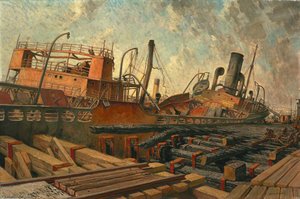 The Bombed SS 'Toscalusa' at a Western Port1940
18
 Francis Underhill (1878–1943), Bishop of Wells (1937–1943)1940 · The Bishop's Palace - Gardens
19
 Lieutenant Commander Wanklyn1943
20
 The Pedlar
21
 Arthur Richard Johnson (1854–1918), Co Founder of Hawley and JohnsonNew Walk Museum - Art Gallery
22
 Dorset Chalk QuarryVictoria Art Gallery
23
 The Dryads1923 · Temple Newsam House
Tämän sivun teoksista eniten sisältävät 8 museota.
| Museo | Kaupunki | Harry Morley teokset | Tämän listan maalaukset |
|---|---|---|---|
 New Walk Museum - Art Gallery |
Leicester | 6 | Doctor Alfred Wilson Emms (1850–1920), A Framework Knitter, Jessie Elizabeth Morley, the Artist's Sister |
 Reading Museum - Town Hall |
Reading | 3 | The Burial of Henry I at Reading Abbey, 4 January 1136, The Martyrdom of Hugh Faringdon, Last Abbot of Reading, 15 November 1539, The Trial by Combat of Henry de Essex and Robert de Montfort at Reading, 8 April 1163 |
 Victoria Art Gallery |
Bath | 2 | Madonna and Child, Dorset Chalk Quarry |
 The Geffrye |
Lontoo | 1 | Holiday |
 Guildhall Art Gallery |
Lontoo | 1 | Charles George Ammon (1873–1960), 1st Baron Ammon of Camberwell, MP |
 The Courts |
Carlisle | 1 | G. W. Allan Hodgson, Esq. (1869–1942), Clerk of the Peace for Cumberland (1927–1942) |
 Government Art Collection |
Lontoo | 1 | The Miles Arms Hotel, Avonmouth, Bristol |
 The Bishop's Palace - Gardens |
Wells | 1 | Francis Underhill (1878–1943), Bishop of Wells (1937–1943) |
Valitse vuosikymmen nähdäksesi sen määrittäneen alkuperäisteoksen.

Holiday (1935), The Geffrye, Lontoo. Seuraavina ovat Charles George Ammon (1873–1960), 1st Baron Ammon of Camberwell, MP ja Doctor Alfred Wilson Emms (1850–1920) (1905).
54 vuotta vanha: Holiday on peräisin vuodelta 1935, ja Harry Morley on syntynyt vuonna 1881.
Holiday, Charles George Ammon (1873–1960), 1st Baron Ammon of Camberwell, MP, Doctor Alfred Wilson Emms (1850–1920), Madonna and Child, G. W. Allan Hodgson, Esq. (1869–1942), Clerk of the Peace for Cumberland (1927–1942), A Framework Knitter, Jessie Elizabeth Morley, the Artist's Sister, The Burial of Henry I at Reading Abbey, 4 January 1136, The Martyrdom of Hugh Faringdon, Last Abbot of Reading, 15 November 1539 ja Lighting the Lamp of Peace. Yllä oleva sijoitus kertoo kunkin teoksen vuosiluvun ja museon.
Katalogissamme on 23 teosta taiteilijalta Harry Morley, aikaväliltä 1905–1943.
Pääasiassa New Walk Museum - Art Gallery (Leicester), Reading Museum - Town Hall (Reading) ja Victoria Art Gallery (Bath). Yllä oleva museotaulukko listaa ne kaikki.
Aikakaudella 1940s: 6 sivun 23 teoksista on tehty silloin, joista The Miles Arms Hotel, Avonmouth, Bristol.
Tällä sivulla vanhin on Doctor Alfred Wilson Emms (1850–1920) (1905) ja uusin Lieutenant Commander Wanklyn (1943).
Doctor Alfred Wilson Emms (1850–1920), A Framework Knitter ja Jessie Elizabeth Morley, the Artist's Sister: New Walk Museum - Art Gallery, Leicester -ssä on 6 tämän sivun teoksista.
Harry Morley (1881-1943) wasn’t merely a painter; he was a translator of worlds, seamlessly blending the grandeur of classical mythology with the quiet beauty of the English countryside. Born in Leicester, his early life hinted at an architectural inclination – a fascination with structure and form – before he decisively chose to dedicate himself to the evocative power of art. This dual influence, between the rigid lines of design and the fluid forms of nature, became the defining characteristic of his oeuvre, creating images that are both formally sophisticated and deeply rooted in observation.
Morley’s artistic journey began with a series of traveling scholarships, a fortunate circumstance that propelled him to Italy and France. These formative years were crucial; he immersed himself in the works of the Old Masters – Raphael, Titian, and above all, the Venetian Renaissance – absorbing their techniques and philosophies. The Italian light, the meticulous detail, and the emphasis on narrative became integral components of his artistic vocabulary. However, Morley didn’t simply replicate these styles; he adapted them to his own sensibility, injecting a distinctly English perspective into his compositions.
His marriage to Lilias Swain in 1911 marked a significant turning point. Swain, herself a skilled calligrapher and embroiderer, brought a complementary aesthetic to their partnership – an appreciation for intricate detail and a refined sense of design. Together, they embarked on numerous artistic expeditions, documenting their travels through watercolor sketches and paintings that captured the essence of the places they visited. This shared passion fueled a collaborative spirit, enriching Morley’s work with a heightened awareness of visual harmony and a subtle elegance.
Morley's most celebrated works depict scenes from classical mythology – figures like Apollo, Diana, and Venus emerging from the dappled shade of ancient groves or reclining amidst serene landscapes. Yet, these aren’t cold, idealized representations; Morley imbues his mythological subjects with a palpable humanity. He avoids the stiff formality often associated with this genre, instead portraying them with a quiet dignity and an underlying sense of vulnerability. His figures are rendered with meticulous detail, capturing every nuance of expression and gesture – from the flowing drapery to the subtle play of light on skin.
Simultaneously, Morley developed a profound connection to the English landscape. He found inspiration in the rolling hills, verdant meadows, and dramatic coastlines of his homeland. These landscapes weren’t simply backdrops for his mythological narratives; they were integral participants in the stories he told. The interplay between light and shadow, the textures of foliage, and the subtle shifts in color created a sense of atmosphere and mood – reflecting the changing seasons and the rhythms of rural life. His paintings of English scenes are characterized by a remarkable sensitivity to detail, capturing the essence of place with an almost photographic precision.
Morley’s technical skill was considerable, honed through years of dedicated practice and informed by his study of the Old Masters. He primarily worked in oil and tempera, mastering both mediums to achieve different effects. Tempera, with its luminous colors and slow drying time, allowed him to build up layers of paint gradually, creating a rich, textured surface – particularly evident in works like “On the Driving Ground,” where the gritty texture of the war-torn landscape is powerfully conveyed.
Beyond the Italian Renaissance, Morley was also influenced by the English Pre-Raphaelites, particularly their interest in narrative and symbolism. He shared their commitment to meticulous detail and their ability to evoke emotion through carefully chosen imagery. However, unlike the Pre-Raphaelites, who often focused on medieval or literary subjects, Morley drew his inspiration from classical mythology and the natural world.
Despite facing economic hardships during the Great Depression, Morley remained a prolific artist throughout his career. He was elected an Associate Member of the Royal Academy in 1921, a testament to his standing within the British art community. His work was regularly exhibited at the Royal Academy Summer Exhibition, and he enjoyed considerable critical acclaim for his elegant compositions and masterful technique.
Harry Morley’s legacy lies not only in his individual paintings but also in his ability to bridge the gap between classical tradition and English landscape. He demonstrated that it was possible to honor the past while simultaneously forging a unique artistic identity. His work continues to be admired for its beauty, grace, and profound sense of place – a testament to the enduring power of art to transport us to other worlds.