A Swedish Master Across Borders: The Life and Art of Carl Frederik von Breda
Carl Frederik von Breda, a name often whispered in the halls of Swedish art history, occupies a truly unique position – a bridge between the established traditions of his homeland and the burgeoning innovations of 18th-century Britain. Born in Stockholm in 1759, his artistic journey wasn’t simply one of progression; it was a deliberate, almost audacious, embrace of transatlantic influence, resulting in portraits that captured both the formality of Swedish court life and the vibrant spirit of London's intellectual circles. His story is not merely that of an artist, but of a cosmopolitan soul navigating the shifting currents of European art and society. From his early years, Breda demonstrated a remarkable talent for observation and representation. He enrolled at the Royal Swedish Academy of Arts at nineteen, studying under Lorens Pasch the Younger, absorbing the classical techniques and historical subjects that were hallmarks of Swedish painting at the time. However, it was his father, Lucas von Breda – an art collector and arbitrator with connections to European artistic circles – who truly shaped his early exposure to a wider world. Lucas’s collection introduced young Carl to the works of masters like Rembrandt and Van Dyck, sparking within him a desire for something beyond the purely academic confines of the Academy. This early exposure laid the foundation for his later fascination with British portraiture, particularly the work of Sir Joshua Reynolds.London Calling: The Influence of Reynolds and British Portraiture
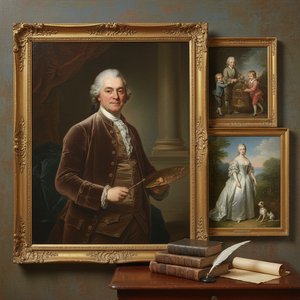
A pivotal moment arrived in 1786 when Breda, facing a setback in an Academy competition, made a bold decision: he relocated to London with his family. This move proved transformative, fundamentally altering the trajectory of his artistic development. In London, Breda sought out tutelage under Sir Joshua Reynolds, arguably the most influential portraitist of his time. While Reynolds wasn’t known for intensive instruction in the traditional sense, his presence profoundly impacted Breda's style. Reynolds championed a more dynamic and expressive approach to portraiture, moving away from the stiff formality of earlier conventions and embracing a looser brushwork and a greater attention to capturing the sitter’s personality. Breda quickly absorbed these principles, adapting them to his own artistic sensibilities and developing a distinctive style that blended Swedish precision with British dynamism. He established a successful studio on St James's Street, attracting a clientele drawn from London’s intellectual and social elite – the “learned men and literati,” as they were known. These weren’t merely commissions; they were engagements with some of the most forward-thinking minds of the era, including abolitionists Thomas Clarkson and James Ramsay, engineers James Watt and Matthew Boulton of the famed Lunar Society, botanist William Withering, and the celebrated Italian opera singer Teresa Vandoni. These portraits are not simply likenesses; they’re imbued with a sense of character and intellect, reflecting Breda's ability to capture not just physical appearance but also the essence of his subjects. The portrait of James Watt, for example, is particularly striking – a dark and moody depiction that captures the engineer’s intensity and intellectual curiosity. Similarly, his portrayal of Teresa Vandoni reveals her dramatic presence and vocal artistry with remarkable sensitivity. It's important to note that Breda’s exposure to Reynolds also influenced his technique, leading him to experiment with new methods of painting and creating a more vibrant palette.Return to Sweden and Artistic Maturity
In 1796, after nearly a decade in London, Breda returned to Stockholm, accepting a professorship at the Royal Swedish Academy of Arts. This marked a new phase in his career – one characterized by artistic maturity and a distinctive style honed during his years abroad. He was immediately inundated with portrait commissions, quickly becoming a leading figure in the Swedish art scene. His brushwork became bolder and more spirited, reflecting the energy and dynamism he had absorbed in London. The late 1790s are often considered to be among his finest years, producing works exhibiting an early embrace of Romantic sensibilities – a shift away from the rigid formality of Neoclassicism towards a greater emphasis on emotion, drama, and individual expression. Notable portraits from this period include those of his father Lucas, two of his nephews, the scholar Nils von Rosenstein, and, perhaps most celebrated of all, Teresa Vandoni. The portrait of Vandoni is particularly striking, capturing her dramatic presence and vocal artistry with remarkable sensitivity – a testament to Breda’s ability to synthesize classical training with a modern sensibility.Legacy and Historical Significance
Carl Frederik von Breda's impact on Swedish art extended far beyond his own prolific output. His exposure to British artistic trends—particularly the influence of Reynolds—helped modernize portraiture in Sweden, inspiring subsequent generations of artists to embrace new techniques and stylistic approaches. He wasn’t simply a painter of faces; he was a chronicler of his time, creating a visual record of some of the leading scientific, intellectual, and cultural figures of the late 18th and early 19th centuries. His portraits of members of the Lunar Society, for example, offer invaluable insights into this influential group of innovators – a group that profoundly shaped the industrial landscape of Britain. The artistic legacy continued within his family; his son, Johan Fredrik von Breda, followed in his father’s footsteps, receiving tutelage from him and continuing the family tradition. While some critics noted a perceived decline in consistency in his later works—a tendency towards monotony—Breda remained an important figure in Swedish art history until his death in Stockholm in 1818. He is remembered today as “the Van Dyck of Sweden,” a testament to his skill, elegance, and enduring contribution to the world of portraiture – a master who successfully bridged the gap between two distinct artistic worlds.Key Works & Collections
- James Watt: A compelling portrait of the renowned engineer, held in the National Portrait Gallery, London.
- Matthew Boulton: Another significant work depicting a member of the Lunar Society, residing in Birmingham Museum and Art Gallery.
- Teresa Vandoni: Often considered his most celebrated piece, capturing the essence of the Italian opera singer.
- Portrait of Joshua Reynolds: A testament to Breda’s admiration for his mentor and a key work in establishing his own artistic credentials.
- Mrs. William Hartigan: An example of his skill in capturing the elegance and refinement of society figures.
Kysymykset ja vastaukset
Mitä tunnelmia Carl Fredrik von Breda's teokset välittävät?
Carl Fredrik von Breda-taiteilijan Tunnelmallinen huone kokoaa taideteokset tunnelman mukaan.
Onko Carl Fredrik von Breda teoksista saatavilla täydellinen lista?
Voit selata kaikkia tämä sivusto-sivuston Carl Fredrik von Breda teoksia artistin Kaikki teokset -sivulta.
Voinko tutkia Carl Fredrik von Breda teoksia avainsanojen avulla?
Löytääksesi tiettyyn teemaan liittyviä Carl Fredrik von Breda teoksia, käytä taiteilijan Avainsanojen mukaan -sivua, joka ryhmittelee teokset avainsanojen mukaan.