A Visionary of the Edwardian Dream: The Life and Art of Anne Anderson
Anne Anderson stands as a luminous figure in the annals of Scottish illustration, a master of the Art Nouveau aesthetic who breathed life into the most beloved tales of folklore and fantasy. Born in 1874 to James and Grace Anderson, her early years were shaped by the vibrant, sweeping landscapes of Argentina, where her family resided during her formative childhood. This international upbringing provided a unique, expansive perspective that she would later weave into her delicate, dreamlike compositions. Upon returning to England at the dawn of the twentieth century, Anderson began to carve out a professional identity that was as much about technical precision as it was about emotional resonance. Her work did not merely illustrate stories; it conjured entire worlds, characterized by a soft, ethereal beauty and a subtle use of symbolism that captured the very essence of the Edwardian era.
The trajectory of Anderson’s career was deeply intertwined with her personal life and her creative partnership with her husband, Alan Wright. Married in June 1912, the duo shared a profound artistic bond. While Wright was a respected illustrator in his own right, his professional reputation faced a significant decline following a controversial commission for Baron Corvo. In the wake of this scandal, Anderson emerged as the primary creative force, with Wright providing steadfast support and contributing to her magnificent visions. Her style, heavily influenced by the rhythmic lines and organic forms of contemporaries such as Charles Robinson and Jessie Marion King, allowed her to navigate the transition from the late Victorian period into the more fluid, decorative movements of the early twentieth century with unparalleled grace.
The Enchanted Page: Mastery of Illustration and Design
Anderson’s artistry was remarkably multifaceted, extending far beyond the boundaries of the printed page. While she is most celebrated for her exquisite children's book illustrations, she was also a skilled painter, etcher, and designer of greeting cards. Her ability to manipulate medium and texture allowed her to infuse narratives with a sense of wonder that appealed to both the young and the sophisticated collector. Her work found a home in prestigious publications such as Blackie’s and Cassell’s, and her delicate motifs were even immortalized on Royal Doulton China and various postcards, making her aesthetic a part of the daily visual fabric of her time.
The breadth of her subject matter is a testament to her versatility. She possessed a unique talent for capturing the tension between the whimsical and the slightly unsettling, a hallmark of many great fairy tales. Her portfolio includes iconic interpretations of legendary stories, such as:
- The Little Mermaid: A study in fluid motion and oceanic mystery.
- The Snow Queen: Capturing the crystalline, chilling beauty of winter landscapes.
- Beauty and the Beast: Blending romanticism with intricate, decorative detail.
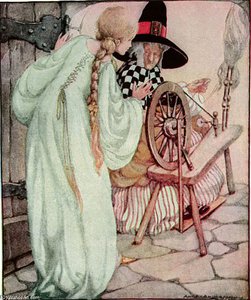
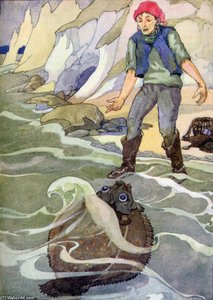
- Grimms Fairy Tales: Where her use of watercolor brings mischievous gnomes and vulnerable protagonists to life through a lens of classic charm.
- The Marsh King’s Daughter: A dreamy exploration of transformation and the natural world.
Legacy and Artistic Significance
Beyond the mere depiction of characters, Anderson’s work serves as a historical window into the Art Nouveau movement's influence on popular culture. Her use of flowing lines, botanical motifs, and a soft, muted palette helped define the visual language of an era obsessed with the beauty of the natural world. Even in her more robust works, such as the oil painting Strong Hans, one can detect the same rhythmic elegance that defines her watercolor illustrations. She had a rare gift for making the fantastical feel tangible, grounding her mythical creatures in environments that felt lush, textured, and deeply atmospheric.
Though she passed away in 1930, the legacy of Anne Anderson continues to resonate through the enduring popularity of her imagery. Her ability to marry the delicate sensibilities of Scottish design with the universal magic of folklore ensures her place as a cornerstone of early twentieth-century illustration. Today, her work remains a cherished touchstone for those seeking to rediscover the enchantment of a bygone age, standing as a testament to a life dedicated to the pursuit of beauty and the art of storytelling.